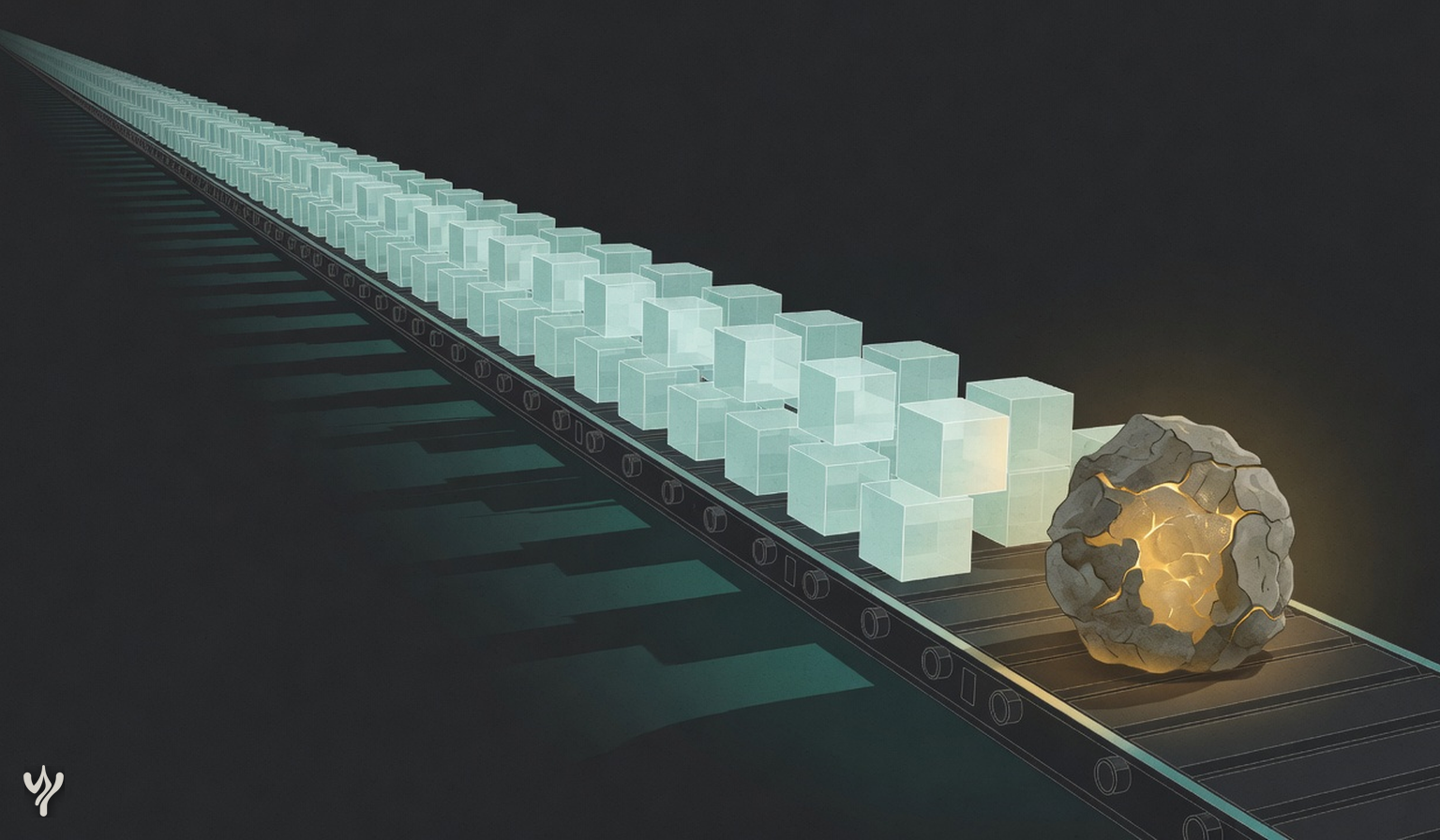
Two advisers give you the same advice, word for word. Only one of them can be held to it. The difference between them is not in the advice, and that difference is the subject of this essay: when machine cognition becomes cheap, what commoditizes is the deliverable, never the mind that must stand behind it, and never the person for whom any of it is done.
Picture the two advisers more carefully. Both tell you to sell the business this year rather than next, for the same reasons, in the same order, with the same caveats. One of them is a text that appeared on a screen. The other is a person who will sit across from you in eighteen months if the advice was wrong, who can be asked why, who can be sued, whose reputation moves with your outcome, and who might, on reflection, change her mind about what she should have told you.
You would pay the second adviser more. Not for the words: the words are identical, and identical words are fungible by definition. You are paying for something the words do not contain. You are paying for a subject who has taken a position and can be held to it.
Now a second case. Someone wrongs you and a machine drafts their apology: well judged, specific, free of self-pity. Suppose it is better than anything they could have written. It is still not what you wanted. An apology is a deliverable; remorse is a change in the person who wronged you, and no quality of prose substitutes for that change, because the change is the thing being asked for.
These two cases carry the whole argument. What commoditizes is the deliverable, not the mind. The first version of this essay walked the technology stack from software to models to silicon and ended with a list of what remains scarce: atoms, electrons, context, trust, attention. The list was not wrong. It was a list of inputs, and it left out the one thing the entire apparatus is for. This version puts the person back at the center: the intellect that frames the question, the judgment that decides and answers for the decision, and the conscious life for which any outcome matters at all.
A commodity is not a cheap thing. Oil is a commodity and a barrel is not free; wheat is a commodity and its marginal cost is a season of land, fuel, and weather. What makes them commodities is fungibility. One barrel of a given grade substitutes for another, nobody asks who pumped it, and the buyer switches supplier on price alone. The unit is defined by a specification, not by an author.
Fungibility rests on two conditions. First, verification must be cheap: the buyer can confirm the grade without trusting the seller, which is why commodities come with assays, benchmarks, and delivery standards. Second, differentiation must be worthless: whatever residual differences exist between units do not move the buyer. Where either condition fails, the thing being sold is not the unit; it is the seller.
This corrects a mistake that runs through most writing about technology, including the earlier version of this essay, which said that "gravity is about replicability." Digitization drives marginal cost toward zero everywhere it touches, but near-zero marginal cost is not commoditization. Software had near-zero marginal cost for half a century and much of it never commoditized, because its outputs were not fungible: switching was costly, quality was hard to verify, and context accumulated around the product. Cheap replication accelerates commoditization where the fungibility conditions already hold. It does not create them.
So the test is not "has this become cheap to produce?" It is a pair of questions. Could a buyer swap this output for another of the same grade without caring where it came from? And could they verify the grade without having to trust its origin? Two yeses and the thing is on the commodity path, whatever its price. A no to either and something other than the unit is being bought.
Run a few things through it. A block of routine code passes: the test suite verifies it, and nobody cares which process wrote it. A first draft of a memo passes. A signed audit opinion fails, twice over: you cannot verify it cheaply, which is why you bought it, and its origin is the product. A parent's attention fails in the most extreme way, since a substitute providing the identical acts is not a substitute at all. The test does not sort things into smart and stupid. It sorts them into units and subjects.
Now the cascade, compressed, because the details matter less than the direction. Nearly three quarters of all new code at the largest search company is now generated by AI and approved by engineers, up from about half a year earlier, according to its chief executive's letter in the company's 2025 annual report. Read that honestly: it is a share of code, not a measure of labor productivity, and every line still passed through a human who agreed to it. But it says plainly that generating code has stopped being the constraint at a firm that spent two decades treating engineering talent as the binding one. Review, acceptance, and the decision about what should exist are what remain.
The price of the underlying cognition tells the same story more violently. Stanford's AI Index reports that the cost of running a model at a fixed level of performance, the level of the best general chatbot of late 2022, fell from twenty dollars per million tokens in November 2022 to seven cents in October 2024: more than a 280-fold decline in roughly two years. No manufactured input in living memory has deflated at that pace.
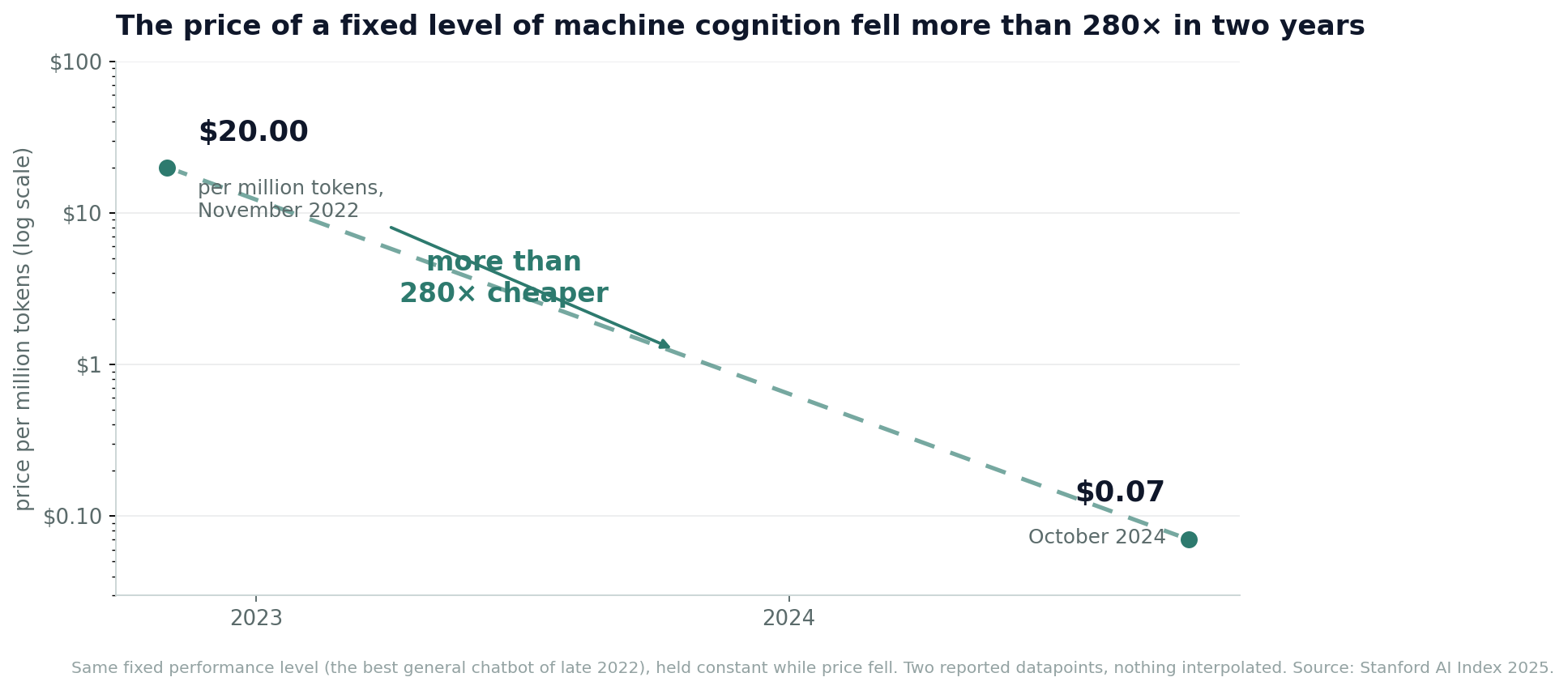
One distinction keeps this honest. That is a price per token, not a price per task. As models are set to work in long, multi-step runs, a single task may consume thousands of times the tokens a single question once did, so the cost of getting something done can fall far more slowly than the cost of a token, and in some workflows it can rise. The direction is not in doubt, though. The marginal answer is cheap and getting cheaper, and organizations are re-shaping themselves around that fact.
Underneath sits the furnace, and the furnace is still physical. Fabrication capacity, advanced packaging, and grid power obey lead times measured in years and are governed by atoms and electrons, not by a learning curve alone. That constrains how fast the abundance arrives. It does not change where the abundance goes: into the production of answers, drafts, code, images, and analyses, which is to say into the deliverable layer.
The word "thinking" is doing too much work in this debate. At least three different things travel under it, and they commoditize very differently.
The first is cognitive output: the answer, the draft, the diagnosis rendered as text, the code. Outputs are units. They can be specified, verified against tests or ground truth, and swapped for another of the same grade. Where those conditions hold, outputs pass the fungibility test, and this is exactly what is commoditizing now. Anyone whose value to the world is a stream of such units should take the cascade above personally.
The second is intellect, and intellect is not an output. It is the act of framing a question, of integrating across contexts that no single stream of outputs contains, of noticing that the question being answered is the wrong one. Intellect operates on the stream of outputs; it is not an item in it. When a machine does some of this, and machines increasingly can propose reframings, the result is another output that enters the stream, and someone must still decide whether to accept it. That regress terminates in a mind that is not producing a unit but taking a position.
The third is judgment, and here I want a definition that can be wrong. Judgment is deciding under uncertainty among incommensurable values, where no calculation settles the trade-off because the terms do not share a scale, and then owning the consequences: being the one who can be asked why, who bears the loss, who can be sanctioned. Two halves, the choosing and the owning. A decision without the owning is an output. An owning without a decision is insurance.
That definition has a falsifier, and I will name it. If the world builds AI agents with legal standing, entities that can sign contracts in their own right, post bonds, carry liability, be sued and be sanctioned, and if courts and counterparties accept such an entity as the terminus of responsibility with no human behind it, then the second half of judgment no longer belongs to humans and this claim collapses. Notice what kind of claim it is. It is not a claim about metaphysics. It is a claim about our institutions of responsibility, which can change, and I would rather state that plainly than smuggle a contingent fact in as an eternal one.
The fourth thing, which is not a kind of thinking so much as the condition of it, is consciousness: lived, first-person experience. It is the locus of welfare and of meaning, the place where an outcome is good or bad for someone rather than merely measured. It is not a tradable output at all. It does not appear on any list of scarce inputs because it is not an input. It is the reason anything is on the list.
Philosophical care is needed here, and I want to get it exactly right. The "hard problem" of consciousness, the question of why physical processes are accompanied by experience at all, is an unsolved explanatory gap. It is not a proof that machines can never be conscious. The philosophical zombie, a being behaviorally identical to us with no inner life, is a contested thought experiment whose premises serious philosophers dispute, particularly the step from conceivability to possibility. So the honest claim is epistemic: perfect behavioral mimicry would not by itself settle whether experience is present, in either direction. Science has not settled the question of machine consciousness, and this essay does not pretend to.
It follows that consciousness is not a business moat, and anyone who tries to make it one has misread the argument. It is not scarce in the economic sense; nearly everyone has it, and it cannot be accumulated. It is not for sale in any sense relevant to a market. To see why it still belongs at the center of a strategy essay, four ideas that usually travel under the single word "scarce" need to be pulled apart.
Economic scarcity is what earns rents: an input in short supply that others need. Institutional authority is what a license or a signature confers: the standing to make a decision count. Relational non-fungibility is what a particular friend, doctor, or parent has: not that others could not perform the same acts, but that the substitution itself is what would be unacceptable. Intrinsic value is what a person has regardless of all three. The earlier essay's list of scarcities lived entirely in the first category. A person is not exhausted by the services they can sell.
Let the objections speak at full strength before answering them, because they are good.
First: most human judgment is mediocre. It is biased, inconsistent, tired, and already automated by habit and checklist. Decades of work comparing expert prediction to simple rules have embarrassed experts across many fields. Any essay that leans on "human judgment" as if the phrase named something reliably excellent is leaning on air.
Second: professional judgment is partly automatable. Much of what professionals call judgment is pattern recognition on a stable distribution, and pattern recognition is an output. Radiologists, underwriters, and lawyers have all discovered that the residue of their work that resists specification is smaller than they believed.
Third: if judgment is defined as whatever machines cannot yet do, the definition is circular and unfalsifiable. It retreats as capability advances and can never be caught out.
Fourth: trust, context, and responsibility are already partly commoditized. Credit ratings, audits, escrow, insurance, warranties, bonded couriers: first-order trust has been a purchasable product for centuries. The earlier version of this essay claimed that "trust is the one thing that has never been disrupted by a cost curve." That was an overclaim. Trust products are among the oldest commodities we have.
Here are the answers, with the concessions kept whole. To the first: the argument does not claim that human judgment is good. It claims that judgment as defined, choosing among incommensurables and owning the choice, is a role, not a performance level. Bad judgment is still judgment, and it is still owned; the owner still answers for it. A mediocre judge who can be sanctioned is doing something a flawless oracle that cannot be sanctioned is not doing.
To the second: conceded, and the residue is smaller than professionals think. But the residue is the whole of the matter for pricing, because the part of a professional's work that is pattern recognition was always on the commodity path, and the abundance of answers only makes that visible.
To the third: this is why judgment was defined positively above and given a falsifier. The definition does not move as capabilities move. It moves only if the institutions of responsibility move, and I have said what that would look like.
To the fourth: conceded fully, and it sharpens rather than weakens the point. First-order trust is purchasable; recursive trust is not, or not yet. Who chooses the raters, and who rates them? Who insures the insurer, and who absorbs the residual risk when the warranty issuer fails? Every chain of "who pays if this goes wrong" must terminate somewhere, and at present it terminates in a person or a body of persons. What survives commoditization is not trust in general but ultimate liability, and with it the human choice of ends.
Two economic concessions belong here as well, because the earlier essay lacked both. Rents do not automatically migrate to complements when an input becomes cheap. They migrate only when the complement is scarce and ownable, protected by some barrier to entry. If judgment is widely distributed and not excludable, then cheap answers make judgment more valuable to the world while earning it wages, not rents. Owning the commitment layer requires capital, license, and reputation; those barriers are why it can hold pricing power, and their absence is why "be the human in the loop" is not by itself a business.
And the phrase "scarcity is never destroyed, only displaced" should be used, if at all, as a named heuristic with known failure modes. It fails under satiation, when the new abundance is simply enough and no fresh bottleneck is valued. It fails under inelastic demand, when a cheaper input does not lead to more of it being consumed. And it fails for non-excludable goods, where the value created is real but cannot be captured by anyone. Displacement is the usual case. It is not a law.
Put the pieces together and the shape of work changes in a specific sequence: production, then selection, then commitment, then ends.
When production is scarce, the bottleneck is making the thing, and the maker is paid. When answers become abundant, the bottleneck moves to selection: which of these thousand drafts, which of these hundred candidate diagnoses, and is this one actually correct? Selection is partly automatable in turn, through tests, evaluations, and cross-checking, so it too begins the walk toward commodity. The bottleneck then moves to commitment: who signs, who stands behind this, who bears the consequences if it is wrong. Commitment cannot be produced in bulk, because its value is exactly the cost to the one committing. And behind commitment sits the question of ends: what any of it is for, a question only an experiencer can ask, because only for an experiencer is anything for anything.
The thought experiments now resolve. The two advisers differ at the commitment stage: same production, same selection, and only one of them can own the outcome. The generated apology fails at the stage of ends: it is a perfect output in the service of a change that has not occurred in the only place it could occur, inside the person who wronged you. The optimized hospital schedule is a triumph of production and selection, but the objective function it optimizes, whose waiting time counts, whose pain is weighted how, whose interests are in the model at all, is a decision about ends, and someone owns it whether or not they admit to it. And the parent and the child: no one prices a market for what a parent means, not because the acts of care could not be performed by others, but because the substitution is the thing that would destroy it. That is relational non-fungibility in its purest form, and it is the model for everything the fungibility test refuses.
The practical implications follow from the sequence. For business: own the commitment layer, not the generation layer. Pricing power sits where the signature sits. Firms that sold access to production are being repriced against firms that sell accountability for outcomes, and that repricing is not a mood but the fungibility test working itself out. The generation layer will be a supplier to you or a cost inside you; it will rarely be the thing you charge for.
For education: judgment is built by practice and dissolved by outsourcing, and the design of the tool decides which happens. In a randomized trial with roughly a thousand students, unrestricted access to a frontier model as a tutor raised performance on practice problems, and those students then scored 17 percent worse on the exam than peers who had no access at all; a version of the tutor with guardrails, built to guide rather than hand over answers, removed the harm. The lesson is not that machines make students worse. It is that the struggle the machine can remove is the very thing the student was there to do, and a well-designed tool preserves it.
For work: the irony of automation, described in 1983 and never refuted, is that automating the easy parts leaves humans the hard parts, for which they are now less practiced; the operator who takes over when the automation fails needs to be more skilled than before, not less, and the automation has been quietly eroding that skill. That is a classic argument rather than a measurement, but a recent signal points the same way. In an observational study, clinicians who had routinely used AI polyp detection saw their unaided adenoma detection rate fall from 28.4 percent to 22.4 percent when the assistance was absent.
Observational data cannot settle cause, and the effect is a property of how the tool was deployed rather than a law of nature. But it is a warning: the residual human role becomes more skilled, not less, and that skill now has to be built deliberately, because the daily work no longer builds it for free.
There is a version of this argument that ends in anxiety: humans must find the last redoubt where they still outperform machines, and defend it. That version has already lost, because it accepts the wrong terms. Dignity is not contingent on outperforming a machine at anything. The comparison is a category error. A person is not a production unit that must justify its cost against a cheaper one, and an essay about commodities should be the first to say so, because it knows what a commodity is and knows that a person is not that kind of thing.
An economy of infinite answers exists for experiencers. Not as a slogan; as an accounting fact. Every cost that matters is a cost to someone, every benefit a benefit for someone, and the someone is a conscious life. Remove the experiencers and the answers are not cheap or expensive. They are nothing at all, patterns in silicon that are for no one.
Kant put the boundary in one sentence: "So act that you treat humanity, whether in your own person or in the person of any other, always at the same time as an end, never merely as a means." The word that carries the weight is "merely." We use one another as means constantly, and rightly: the adviser is a means to a decision, the surgeon a means to health, the engineer a means to working code. Ordinary cooperation is not the violation. The violation is to treat a person as nothing but a means, to reduce them to the deliverable. That is the one thing a fungibility test, applied to persons, would do. It is the reason the test must stop at the subject.
The earlier version of this essay ended by asking what is worth building and who will stand behind it. Those remain the right questions, and this version has tried to say why: standing behind something is commitment, and deciding what is worth building is a question about ends. But both questions have a subject. Someone asks them. Someone is answered by them, or fails to be. Someone, at the end of every chain of abundant answers, is the one for whom the answers were worth having.
Everything is commodity. Everything except the one asking what it is all for.


Thoughts and essays, published with Yokush. See more posts
 Siddharth5 min
 Siddharth13 min
 Siddharth
Comments 0