 Siddharth
The Collapse of the Core: When Intelligence Becomes the Integration Layer

Siddharth
September 6, 202617 min read

The thirty-year moat of core banking platforms, payment processors, and ERP suites was never the software. It was the cost of understanding the software. That cost just collapsed by a factor of ten per year — and I can price the collapse to the fourth decimal place.
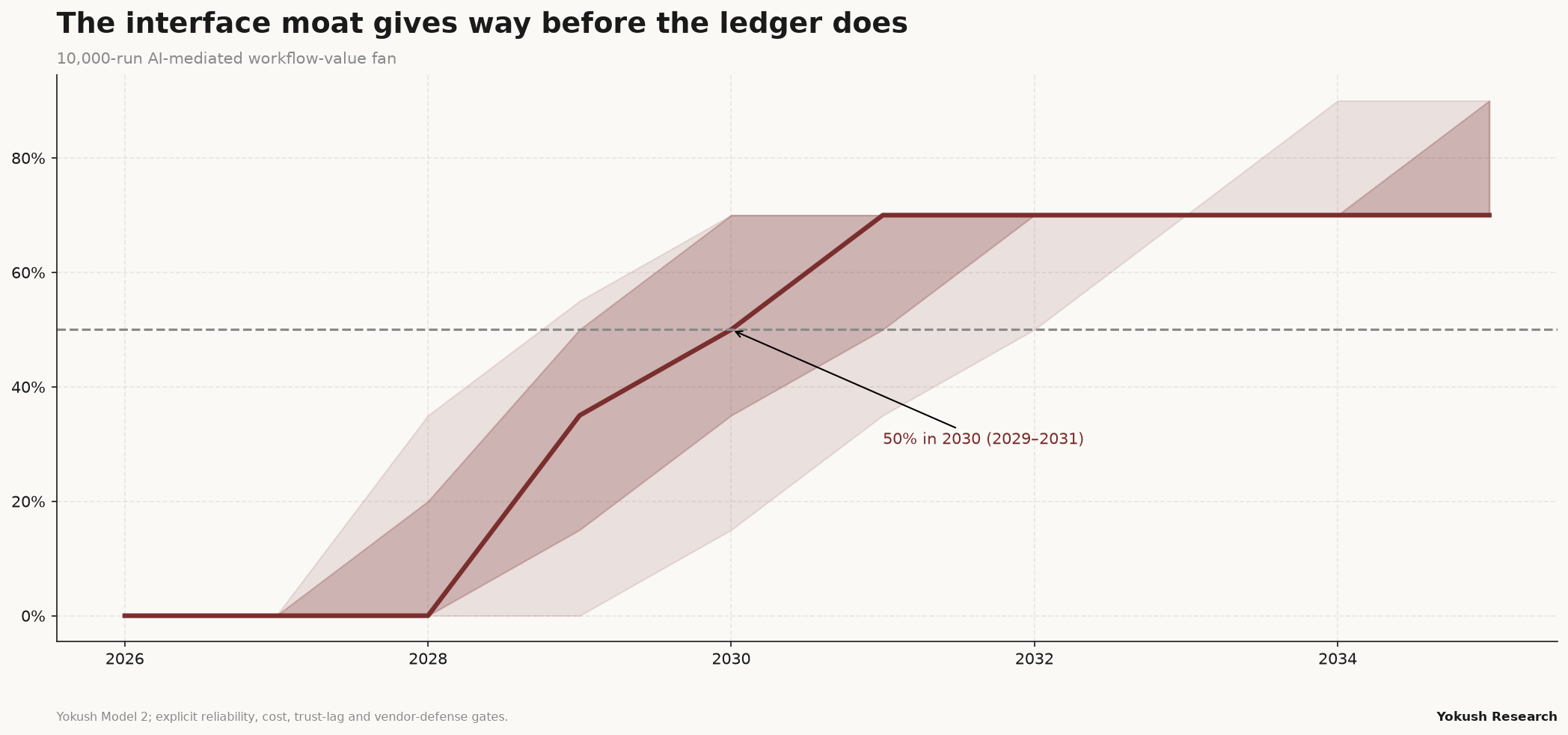
For three decades, the "core" — the system of record at the center of a bank, a payment processor, an enterprise — has been the load-bearing wall of the business. Everything was built on top of it. Nobody left. Not because the software was good; because leaving was impossible. I published the first piece of this argument last year, when I showed that an AI agent layer could virtualize a legacy core's interfaces for $15–20 million against the $100 million-plus a replacement costs. That paper was about the integration tax. This one is about something bigger: the core's value itself. My claim, which I will support with four models and a 10,000-run Monte Carlo simulation: AI-mediated orchestration crosses 50% of core-attributable workflow value at a typical institution around 2030 (interquartile range 2029–2031), and the core — all of them, banking and ERP alike — gets demoted from system of record and control to system of storage.
The moat was never the software. It was the cost of understanding the software — the schemas, the state machines, the interfaces, the ten thousand integrations. Intelligence just became too cheap to meter for exactly that kind of understanding.
The business fact first: the core-processing industry is one of the most concentrated, most profitable, and least loved markets in enterprise software — and its economics depend entirely on switching costs, not on product velocity.
A Federal Reserve bank's annual survey of the US banking industry puts the structure plainly: the largest core processor serves 42% of US banks and 31% of credit unions; the next serves 21% and 12%; the third 9% and 3%. The big three together process for more than 70% of American banks. Now the part that should keep their strategy teams up at night: 46% of the big three's own customers are dissatisfied, 61% have been with their provider for more than a decade, and 21% say they plan to switch. [1] That is not a market choosing its vendors. That is a market held hostage by the cost of moving.
The cost of moving is not hypothetical. A mid-cap core replacement runs above $100 million and 12 to 36 months, and published industry studies routinely find most such programs materially overrun — timelines overrun in the overwhelming majority of cases, and failure claims run as high as 80% depending on definition. The industry's rule of thumb is a neat summary of the trap: for every $1 of core software, expect $2–3 of implementation and $1 per year to run. The North American core platform market — $5.6 billion in 2025, growing a comfortable 11.8% a year — is, in effect, a growth market because nobody can leave.
The escape hatch that venture capital built also stalled. The cloud-native "neocore" challengers raised at euphoric valuations in 2021 — one peaked near $2.7 billion before an investor marked it down 40%; another, once valued near €5 billion, has raised no new equity since 2022. Their engineering is real; their economics are not the problem. The problem is that replacement itself is the wrong shape of intervention. You cannot out-engineer a moat that is made of understanding costs by rebuilding the same monolith in a newer language.
The ERP complex tells the same story at larger scale: a $66 billion market (2024) growing 11% a year, an installed base staring down a 2027 support deadline that forces a migration decision, average large installs carrying on the order of 20,000 custom code objects, and annual support running ~22% of license value. Meanwhile the experience-layer platforms around the ERP — workflow and HCM systems users actually touch — are growing 17–21% a year against the core's 11%. The budget is already voting.
The business fact first: the price of the intelligence needed to understand a core system is falling roughly ten-fold per year at constant capability. Nothing in the core's own cost structure is falling at all. When a complement collapses in price by an order of magnitude annually, the product whose value depends on that complement's scarcity does not decline gracefully. It gets repriced.
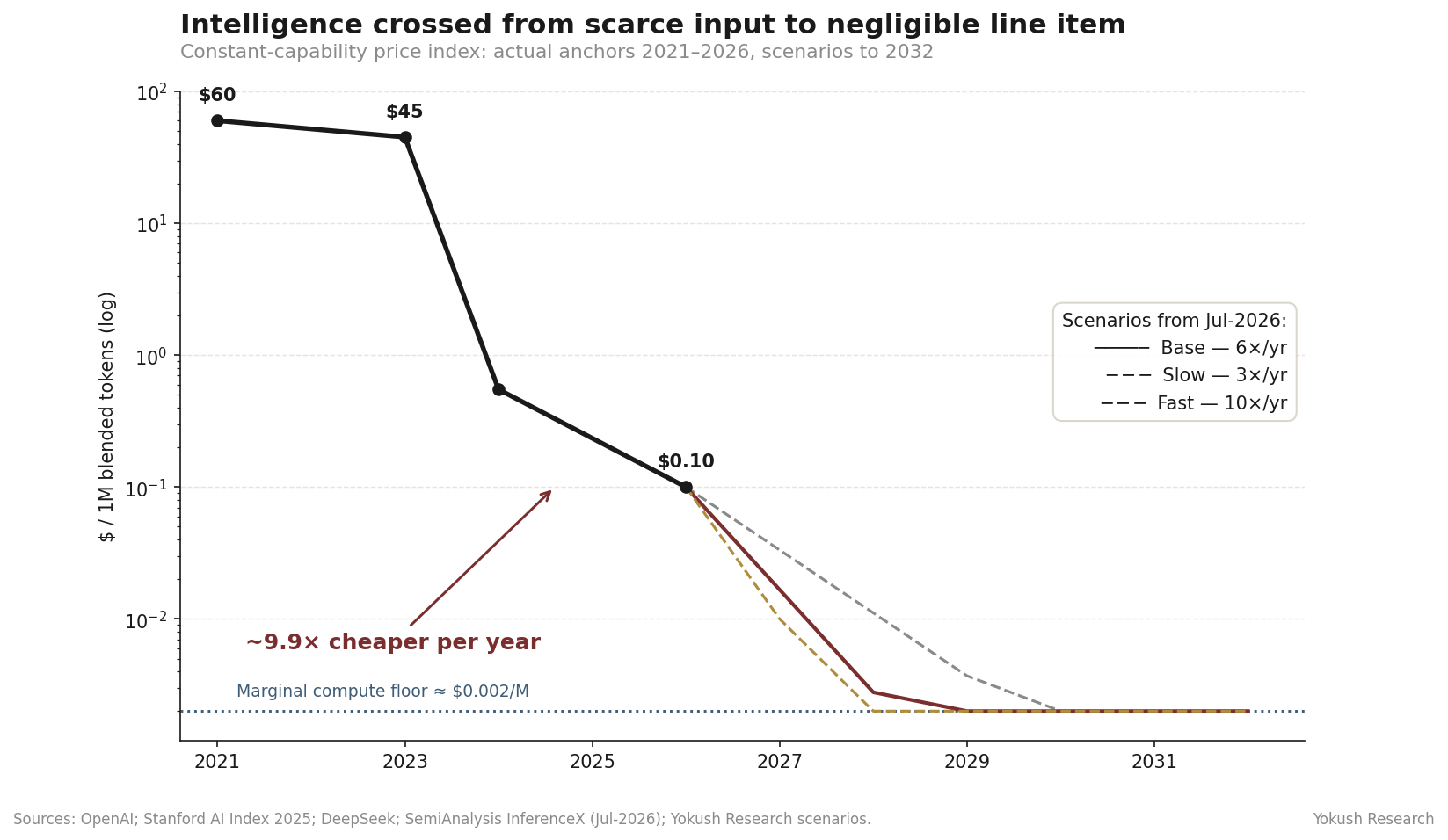
The anchor points: GPT-4-class capability cost about $45 per million blended tokens in November 2023. It costs about $0.10 today — an implied 9.9× per year, right on the trajectory the LLMflation series has documented since 2021, when GPT-3-class capability at $60 per million fell a thousand-fold in three years. [2] Stanford's AI Index measured a 280× fall in GPT-3.5-class pricing in just 23 months. [3] The serving-cost floor on modern Blackwell-class infrastructure is already at $0.012–0.04 per million tokens for 100B-class open-weight models, and H100 rental has fallen from $7–10 an hour at the 2023 scarcity peak to $2–3.50 today. [4]
Now an engineering correction, because this blog is read by people who build: the widely-quoted claim that "a 27B model does 2,000–3,000 tokens per second on a single GPU" is true only as aggregate throughput at batch, not single-stream. The measured numbers: a 20B-class sparse model (about 3.6B active parameters) on one H100 sustains roughly 310 tokens/sec single-stream, about 2,660 tokens/sec aggregate at 16 concurrent requests, and about 14,400 at 256. [5] A dense 27B runs 100–160 single-stream. The distinction matters enormously for latency budgets (Section IV) and not at all for economics, because enterprise workloads are batch workloads — and the aggregate numbers are the ones that price out.
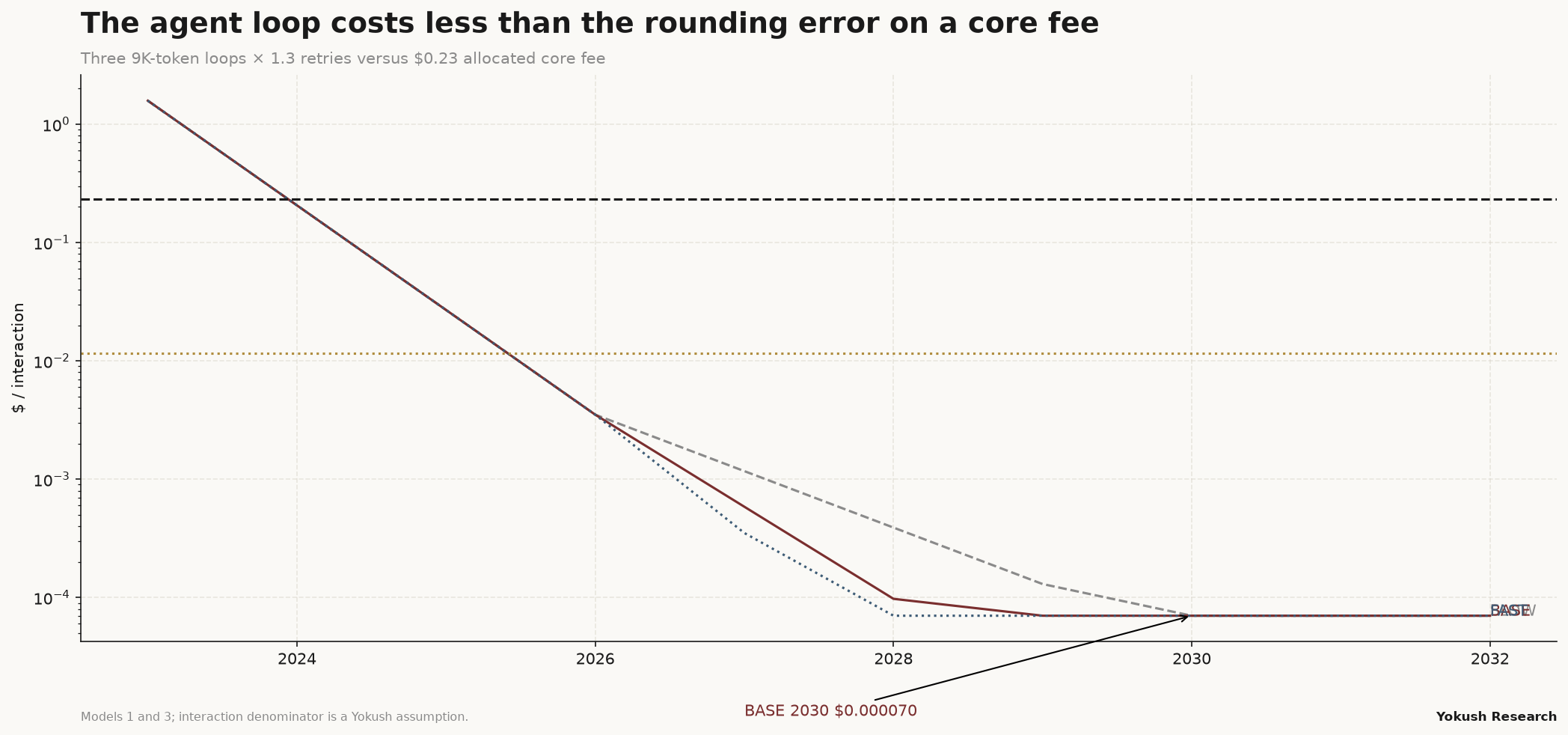
So price it out. A fully agent-mediated banking interaction — three inference loops, roughly 27,000 blended tokens including retries — costs about $0.0035 today, falling to roughly $0.00007 by 2030 on my base-case price path. The allocated core fee for the same interaction at a representative mid-size bank — $28 million a year of core and channel spend over roughly 120 million interactions — is about $0.23. The economics gate is not merely passed. It is passed by 65× today and by roughly 3,000× by 2030.
The business fact first: this thesis was false in 2023 and became true in 2025–2026, because three independent capability curves crossed production thresholds inside the same 24-month window. Simultaneity is the signal. The "SOA will unlock the core" wave of 2005 and the "APIs will unlock the core" wave of 2015 each had one curve. This one has three.
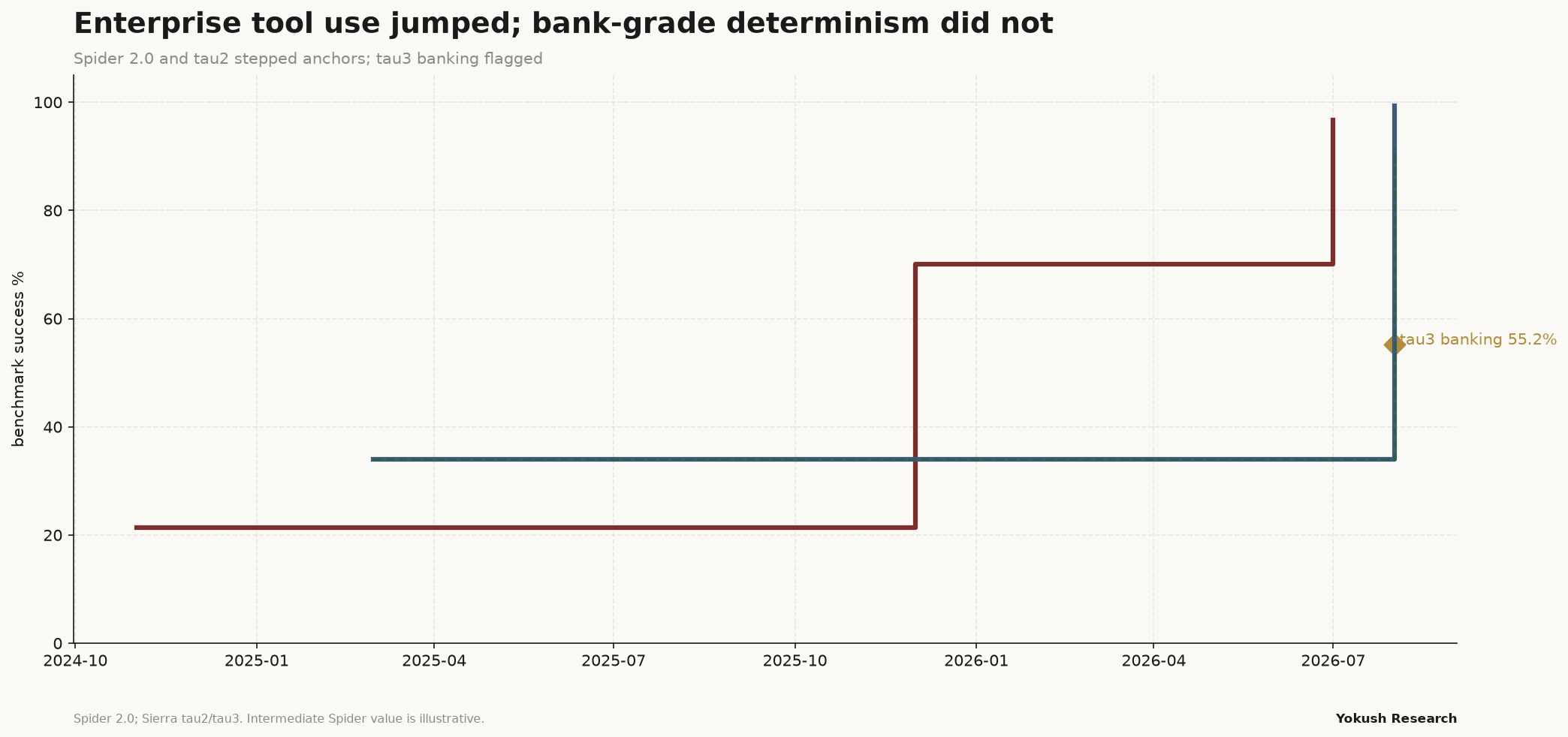
Curve one — enterprise data access. Spider 2.0 is the benchmark that matters: multi-database, real cloud warehouses, hundred-line SQL workflows — the actual shape of enterprise data work. The best system scored 21.3% at release in November 2024 (against 91.2% on the legacy academic version — the gap measuring how fake the old benchmark was). By July 2026 the leaderboard's best agentic systems score 96.7%. [6], [7] In twenty months, "the machine cannot read our schemas" went from true to false.
Curve two — tool-use reliability. On the τ²-bench family, which scores agents on multi-turn, policy-constrained customer-service workflows, 2025-era frontier models scored 34–49%. The August 2026 leaders score 91–99%. [8] And here is the honest gap, because I do not write godlike-agent stories: the banking-knowledge domain of the newest τ³ generation has a best score of 55.2%. Banking-grade reliability is not solved. My model gates every workflow's migration on reliability thresholds precisely because of numbers like that.
Curve three — protocol standardization. MCP — the open protocol for connecting models to tools and data — launched November 2024, was adopted by every major model vendor by April 2025, was donated to a neutral foundation in December 2025, and counts roughly 9,400 public servers and ~97 million monthly SDK downloads as of mid-2026. [9] MCP collapses the N×M integration matrix (every application × every model) to N+M. That is the same standardization the core itself once monopolized — except this one is open.
One more datum for the ledger: roughly 220 billion lines of COBOL still run production banking. Modern code models read and translate COBOL at pilot scale today. Comprehension is no longer the bottleneck. Certification is. That single sentence is the difference between 2023 and 2026.
The business fact first: the collapse is not a wave, it is a queue — ordered by latency class. Knowing the order is worth money. It tells you which products get disintermediated first (advisory, servicing), which hold until decade's end (payment initiation), and which never flip (settlement finality).
The engineering is unglamorous and decisive. A card issuer has roughly 120 milliseconds to decide; no inference stack touches that, and none needs to — the authorization path stays deterministic forever, which is a feature, not a failure, of this thesis. Real-time rails run sub-second to seconds; agent-initiated payments already work there because the industry wrapped them in signed mandates rather than trusting the model. And everything a human currently mediates — servicing, onboarding, dispute handling, advisory — has a budget of seconds to minutes. The AI path, at 1–8 seconds end-to-end with 0.2-second time-to-first-token on a single GPU, is already inside every one of those budgets. AI does not need to be fast enough for everything. It needs to be fast enough for everything a human currently mediates. It already is.
The proof that this is not theory: agent payments. Between April 2025 and April 2026, the two dominant card networks launched agent-credential frameworks within 24 hours of each other, a major internet platform open-sourced an agent-payments protocol now backed by 60+ partners under neutral foundation governance, and an agentic checkout protocol shipped from a leading AI lab and a leading payments platform together. AI-sourced referral traffic to US retail grew 393% year over year in Q1 2026. The checkout interface — the most defended interface in commerce — is being demoted right now. Banking servicing is the same pattern, two years behind.
The business fact first: I built a Monte Carlo simulation — 10,000 runs, 2026–2035 — that models five workflow segments weighted by their share of a bank's core-attributable value, each flipping from native-core control to AI-mediated orchestration only when four gates all pass: agent reliability above the segment's threshold, cost below 5% of the allocated core fee, regulatory trust-lag elapsed, and vendor defense exhausted. The median crossing — AI-mediated orchestration handling 50% of core-attributable workflow value — lands in 2030, with an interquartile band of 2029–2031.
| Workflow segment | Share of value | Median flip | P25–P75 | Flipped by 2035? |
|---|---|---|---|---|
| Advisory · analytics | 15% | 2029 | 2028–2030 | Yes |
| Servicing · ops | 35% | 2030 | 2029–2030 | Yes |
| Onboarding · origination | 20% | 2031 | 2030–2032 | Yes |
| Payment initiation (soft real-time) | 20% | 2035 | 2034–2035 | 47.5% probability |
| Authorization · settlement (hard real-time) | 10% | — | — | ~0% — finality stays deterministic |
The sensitivity analysis produced the result I did not expect when I specified the model, and it is the most actionable sentence in this post: across every tested range, regulatory and trust lag is the only driver that moves the median crossing across the full 2029–2031 band. Reliability growth governs whether the tail segments flip at all. Cost no longer binds — the cost gate was passed before the simulation began. The binding constraint on the collapse of the core is no longer economics or model quality. It is institutional trust mechanics: supervisory posture, auditability standards, procurement cycles. If you work on any of those three, you are the critical path of this entire thesis.
The business fact first: for a representative $20 billion-asset bank — 500,000 accounts, $28 million a year of core and channel spend — I priced three seven-year paths with full uncertainty on the cost drivers. Status quo: $173.6 million (median, discounted at 8%). Rip-and-replace: $286.5 million, with overruns drawn from the industry's actual distribution. AI-mediated wrap: $168.3 million. The wrap beats replacement in 10,000 out of 10,000 runs. Not 95 out of 100. Every single one.
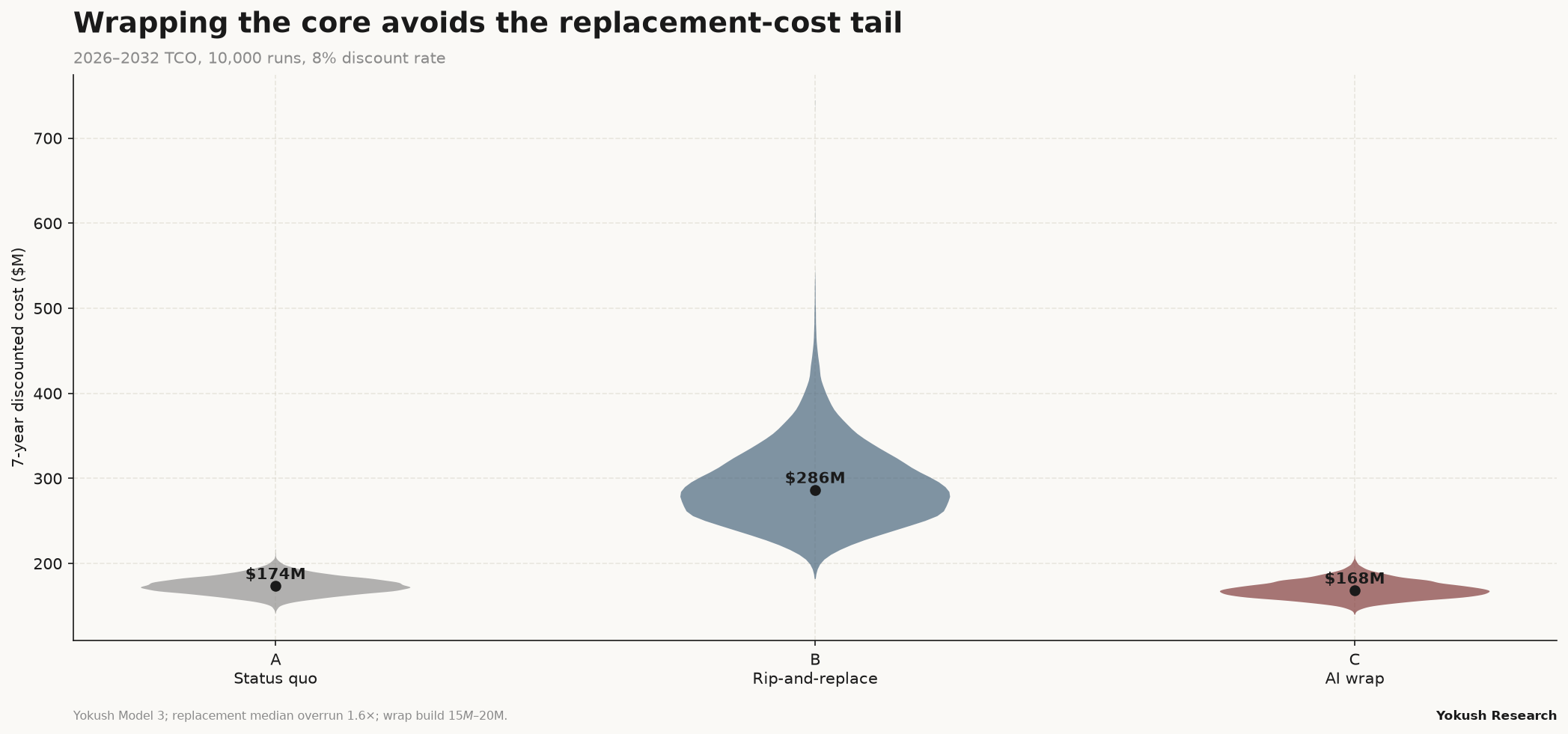
Read the nuance honestly: the wrap's median edge over the status quo is modest — about $5 million this decade, and it wins that comparison only 73.5% of the time. The wrap is not primarily a cost-slasher in year one. Its value is that it (1) removes a $118 million replacement trap, (2) compounds as inference prices fall, and (3) creates renegotiation leverage: once an institution can demonstrate dual-path operation — native core and mediated layer, reconciled — the 25% fee reduction my model assumes with 70% probability becomes a conversation, not a prayer. Per account per month, the wrap path runs $6.41 in 2026 (build included) falling to $4.42 by 2032, while the status quo drifts up as change-request complexity compounds.
For the ERP-locked enterprise, the same decision arrives wearing a deadline: the 2027 support cliff. Wrap-don't-replace is the option that keeps your options.
The business fact first: when the core stops being the contract, its fee pool splits. The parts that impose structure, workflow, and interface — I estimate 60% ± 10 of core fee value — become compressible, because they are exactly what a mediation layer provides. The parts that store durable records, post with certified finality, and satisfy regulators — the other 40% — retain. The core does not die. It becomes infrastructure in the unflattering sense: billed like storage, defended like a utility.
The architecture that captures the migrated value is three layers deep, and none of them is a product category today: a semantic layer (canonical data contracts, schema-on-read projection, entity resolution, lineage), a policy engine (rules-as-code, dual control, thresholds, mandates), and a verification layer (deterministic guardrails, audit write-ahead logs, event-sourced reconciliation). The pattern that makes it safe is neuro-symbolic: the probabilistic path understands and composes; the deterministic path moves money and finalizes; a reconciliation loop sits between them. In my earlier paper this stack virtualized the core's interfaces for multi-tenant fintech access. The generalization is the point of this one: the same stack demotes the core's schema, workflow, and interface from contract to implementation detail.
The business fact first: applying the erosion model to the big three processors' ~$4 billion North American revenue pool, I estimate $1.19 billion of revenue at risk by 2032 (range $1.17–2.44 billion) — roughly 30% of the pool — as the erodable 60% of fee value compresses under renegotiation pressure from wrap-equipped institutions. Vendor defense — opening APIs, cutting price proactively — slows the erosion about 1.5×, but converts a moat into managed decline. There is no scenario in my model where the interface tier keeps its pricing power. The choice is between managed and unmanaged.
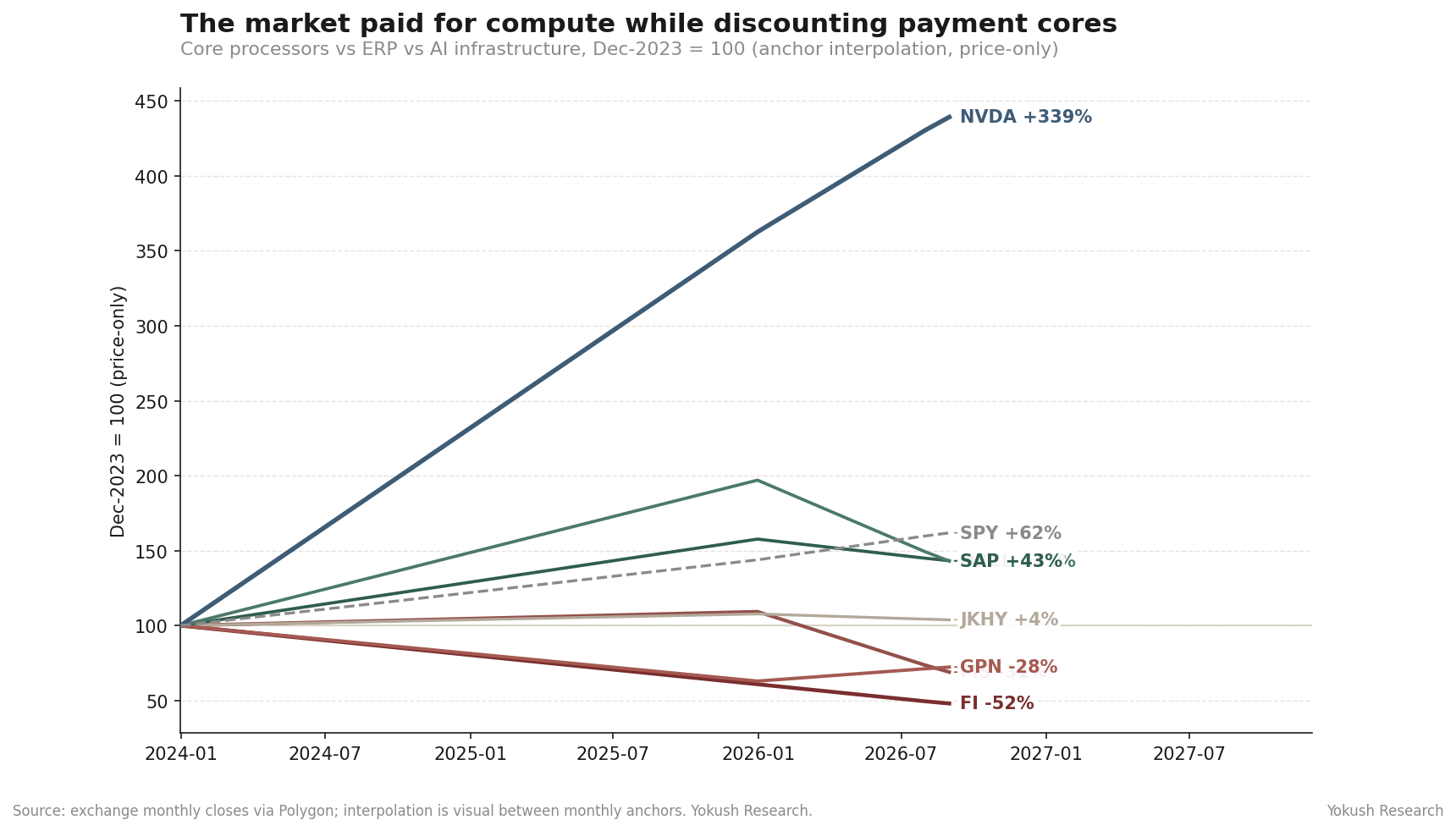
The market has started to sketch its own version of this trade. Since December 2023: the largest core processor is down 52%, the second-largest bank processor down 31%, the largest merchant processor down 28% — while the AI infrastructure complex rose 339% and the index 62%. The ERP giants rode their own cloud and AI re-ratings to +43% before giving much of it back in 2026. I want to be careful here: these are confounded numbers — post-pandemic processing normalization, fintech exposure, rate cycles all mix in. But the sign is consistent, and the loudest data point is behavioral: the card networks — who monetize volume — standardized agent access to payments within a year, while the core processors — who monetize captivity — have shipped almost nothing comparable. When the volume-monetizers move faster than the captivity-monetizers, the market has told you which moat they believe in.
History's pattern agrees on cadence. Every enterprise layer that lost its abstraction battle got consolidated at scale: an integration-platform leader absorbed for $6.5 billion (2018), a mainframe-era systems house for $18.9 billion (2018), an app-server vendor for $8.5 billion (2008), an integration vendor taken private at $4.3 billion (2014). The median run from abstraction-technology appearance to incumbent revenue decline is five to eight years. The cores entered their abstraction window in 2025.
If you buy cores (banks, fintechs, ISVs): stop treating core replacement as modernization — my model prices that mistake at $118 million per institution, with 100% dominance in 10,000 runs. Build the three layers that hold value — semantic, policy, verification — and own them. Rent intelligence; models rotate every 3–6 months and MCP-style access keeps you uncoupled. Sequence by latency class: read-only semantic layer over servicing data in 2026, guarded write path on low-risk products in 2027, onboarding and origination 2028, payment initiation behind signed mandates 2029–30. And use dual-path operation explicitly as the renegotiation lever; it is worth more than any procurement tactic ever invented in this market.
If you sell cores: the interface is not the asset; the certified ledger is. Open the schema, price the API surface honestly, and cannibalize the interface tier before outsiders do it for free. A processor that opens becomes the deterministic settlement layer of an agent-mediated world — a smaller, defensible, utility-grade business. A processor that defends the interface competes with every model vendor on earth, simultaneously, on their home turf.
If you are ERP-locked: the 2027 deadline is a forced decision, not a mandate to re-buy a system of storage. Wrap first. Keep the option.
If you invest: long the picks-and-shovels of mediation — semantic/observability/verification infrastructure, agent-access rails — and be skeptical of captive-intermediation multiples. Watch five signposts: the first billion-dollar bank running majority-servicing through an agent layer; a Tier-1 processor disclosing fee concessions; a Tier-1 processor shipping MCP-native core APIs; agentic-commerce volume guidance from the networks; banking-domain reliability benchmarks crossing 90%.
A thesis that cannot name its kill criteria is a mood, not a thesis. Mine:
| Claim | Observable signal | Deadline, else |
|---|---|---|
| Servicing flips this decade | AI-mediated servicing share measurable at 10+ US banks | End-2029 → thesis too fast |
| Reliability keeps climbing | Banking-domain agent benchmarks >90% | 2028 → median slips past 2033 |
| Vendors can't defend the interface | A Tier-1 processor ships MCP-native core APIs | 2027 → defense stronger than modeled |
| Interface demotion spreads from commerce | Agentic protocols clear 1% of US e-commerce GMV | 2028 → consumer interface holds longer |
| Cost stays out of the way | Constant-capability price <$0.01/M sustained | Through 2027 → floor binds early |
And the honest ledger of what I could not verify: my segment weights are assumptions, not measurements. My fee-renegotiation probability has no history to calibrate against — no institution has yet renegotiated a core contract because of a demonstrated wrap layer, because almost nobody has demonstrated one yet. Benchmark pass rates do not certify auditability, security, or regulatory acceptability. One headline agent-caused loss event could add three to five years of trust lag across the industry. And if two or three model providers become the de facto semantic layer, enterprises will have traded one moat for a worse one — which is exactly why the open-protocol path matters more than any single vendor's roadmap.
This is a timing thesis, not a direction thesis. The direction was sealed the moment enterprise-schema comprehension became an inference call — somewhere between November 2024, when the best system read a real enterprise schema at 21%, and July 2026, when it read one at 97%. The moat was the cost of understanding. Understanding is now a line item, and the line item is collapsing at ten-fold a year.
The core does not get replaced. It gets demoted — from the system that decides, to the system that remembers. The only live question is whether the median year is 2029 or 2033, and the answer to that question is being written right now not in model labs, but in supervisory posture, audit standards, and procurement cycles. The technology is ready. The queue is forming. The trust is the clock.
Methods: full model specification, assumptions registry, reproducible code, and the 59-page underlying report ("The Collapse of the Core," personal research, August 2026) are available on request. Inference economics: a16z LLMflation, Stanford AI Index 2025, SemiAnalysis InferenceX, published serving benchmarks. Capability: Spider 2.0, τ-bench, MCP. Industry structure: Federal Reserve Kansas City banking survey; cost and overrun figures from published industry studies. Market data: exchange closes via Polygon, Dec-2023 through Aug-28-2026, price-only. All model outputs are directional timing bands under stated assumptions — this is research, not investment advice.

Thoughts and essays, published with Yokush. See more posts
 Siddharth5 min
 Siddharth13 min
Comments 0