 Siddharth
The Loop Is the Breakthrough: Why GPT-6 Astra Feels Different

Siddharth
September 6, 202610 min read

Everyone is asking whether GPT-6 Astra is "smarter." That's the wrong question. The interesting engineering story is why certain workflows improve dramatically even when conventional intelligence scores barely move — and the answer has less to do with the neural network than with the loop wrapped around it.
The strongest explanation for why Astra feels different is not that it produces better first answers. It is that Astra improves the quality, continuity, and efficiency of an entire execution process. And that is a system property as much as a model property — which is exactly why it's worth dissecting carefully, without hype in either direction. Independent testing shows substantial gains in some agentic workflows, alongside smaller gains and outright regressions elsewhere.
When you watch Astra build a Blender scene, debug an application, or grind through a research workflow, you are observing three interacting components, not one:
OpenAI's own computer-use documentation makes this division explicit: the application provides the environment and executes actions; the model uses screenshots and tool results to choose what happens next. The control loop looks like this:
This distinction matters because it prevents sloppy attribution. Asynchronous tool execution is partly a serving capability. Searching previous working sessions is a memory-system capability. Better interpretation of an unfamiliar screenshot is a model capability. A successful end-to-end task usually depends on all three. The object we should be evaluating is the complete model-plus-runtime system — while still being honest about which component caused which improvement.
One concrete example: the gpt-6-astra API model accepts text and image inputs and produces text output. Its model page lists no native audio or video support. So when you see a beautiful Blender render "from Astra," that image came out of software Astra operated — it was not emitted by the language-model endpoint. That difference is the entire point.
"Generate, evaluate, revise" is not new. Anthropic documented evaluator-optimizer workflows back in 2024, and its later engineering writing covered maintaining progress across long-running agent sessions. Competing frontier models aren't restricted to one-shot answers either — Fable 5.1 can test its code and visually assess outputs, and Gemini 3.8 Flash ships agentic development examples with explicit looping instructions.
OpenAI itself lists computer use, programmatic tool calling, multi-agent orchestration, prompt caching, persisted reasoning, and compaction as capabilities Astra inherits from GPT-5.6 rather than invents.
So the useful comparison was never "other models try once, Astra loops." It is: given comparable tools and budgets, which model chooses better actions, gathers better evidence, diagnoses failures more accurately, retains the right state, and converges with less wasted work?
The engineering interpretation I find most useful: treat the agent as a feedback controller operating with incomplete observations. Not as a claim about proprietary internals — as a model of the behavior. A productive loop has six disciplines, and most "agentic" failures are failures of one of them:
Autonomy means executing these steps without constant human direction. It does not mean removing verification or authorization.
OpenAI's architectural-visualization walkthrough is the best concrete illustration. Astra ran Python through Blender's executable, inspected the scene via computer use, and reviewed saved renders. In one iteration it identified a sink-shading problem caused by surface normals and repaired the normals — instead of redesigning the kitchen. The workflow used untextured views and geometry checks alongside pretty renders.
That is the difference between a critic and an engineer. A generic visual critic says "the sink looks wrong." A useful diagnosis says "the shape is broadly correct, but the shading makes a flat surface appear pinched — investigate normals and edge treatment before touching dimensions." The second statement names a causal, changeable variable. That is where vision becomes operationally valuable: not recognizing objects, but linking an observed defect to a parameter in the software.
Two honest qualifications. First, the published project involved human steering, approvals, and external assets — it was not one untouched prompt producing a house. Second, reconstructing a plausible scene from a photograph is not recovering the uniquely correct scene; many combinations of geometry, camera, and lighting produce similar pixels. A beautiful render is evidence of successful image construction, not of accurate hidden geometry.
Astra's published API limits are a 1,050,000-token context window and up to 128,000 output tokens. Impressive — but capacity is not continuity. There are four different kinds of state in a long-running task, and conflating them is where agent systems quietly break:
.blend file, the database, the actual test results.A note saying "the camera is fixed" is not the camera configuration. A summary saying "tests pass" is not a current test run. Robust continuity keeps concise working notes and retrievable evidence — artifact version, change made, verification performed, result, unresolved items. None of that requires continuous background thought, infinite context, or online weight updates. It requires engineering.
The same systems story runs through Astra's other documented additions. Asynchronous tools (a function marked async: true) let the model start a preview render and continue independent work while it runs — an idealized scheduling win from T_render + T_work toward max(T_render, T_work), with the hard problem being dependency and version management, not the flag itself. Mid-turn steering lets a user redirect a running task over a WebSocket without burning completed work — properly understood as updating the task version, not inserting thoughts into a running neural computation.
And adjustable reasoning effort between responses is adaptive compute allocation: spend less on routine inspection, more on diagnosing a subtle regression.
Here is the arithmetic that explains why Astra can feel like a phase change without a matching leap in "intelligence" scores. Take a workflow with 20 necessary steps. If each step succeeds independently with probability 0.95, the whole task succeeds 0.95²⁰ ≈ 35.8% of the time. At 0.99 per step, that becomes 0.99²⁰ ≈ 81.8%. A four-point local improvement produces a 46-point workflow improvement.
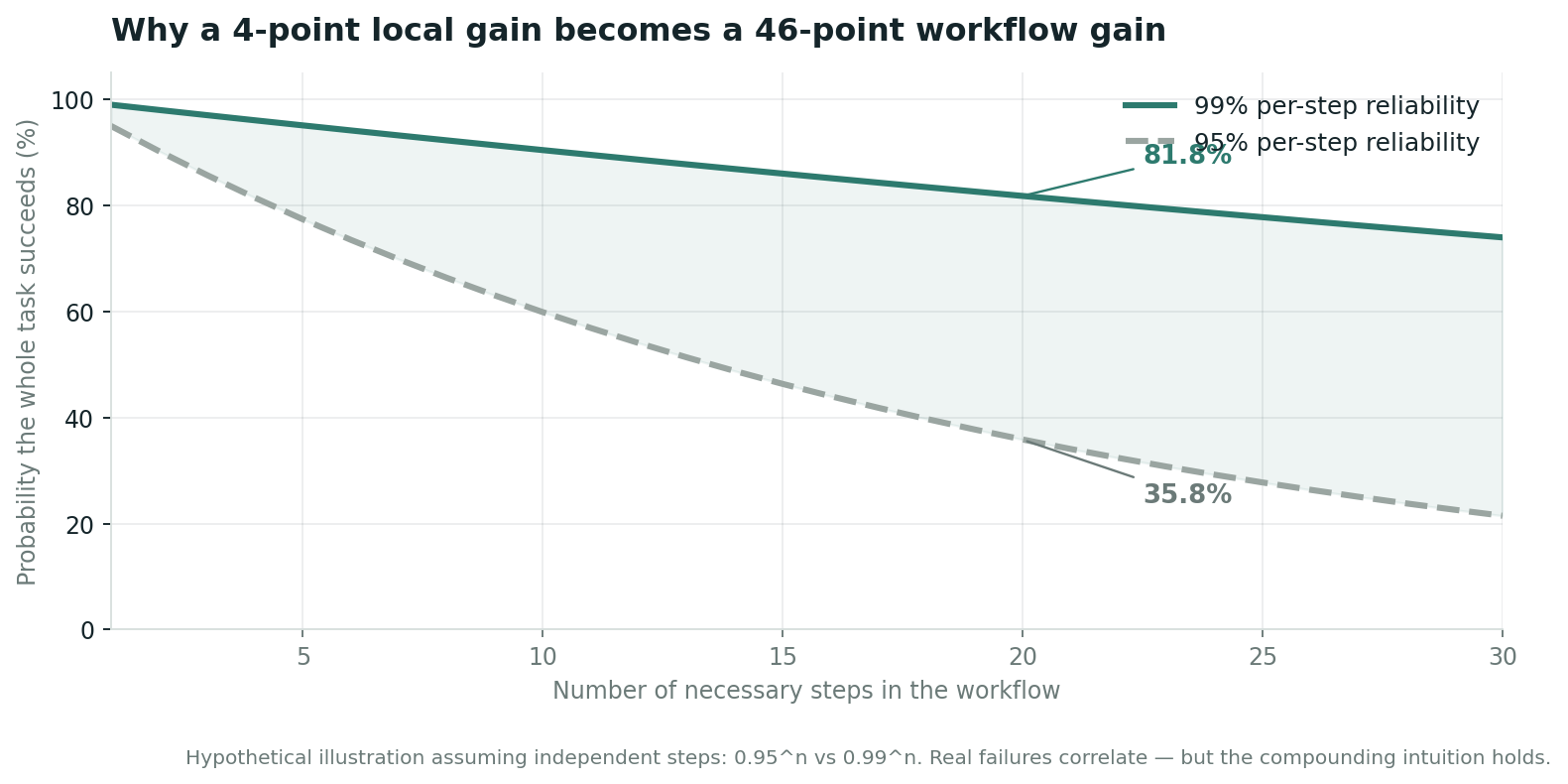
A model can move completed-task performance four ways: make fewer errors, detect more of its own errors, repair them more successfully, or skip unnecessary steps. Which is also why "number of iterations" is a terrible success metric — the system that converges in three iterations beats the one that needs thirty. The objective is effective progress per unit of computation, time, and supervision.
The launch comparison is genuinely striking — especially where evaluations reward interaction rather than static knowledge.
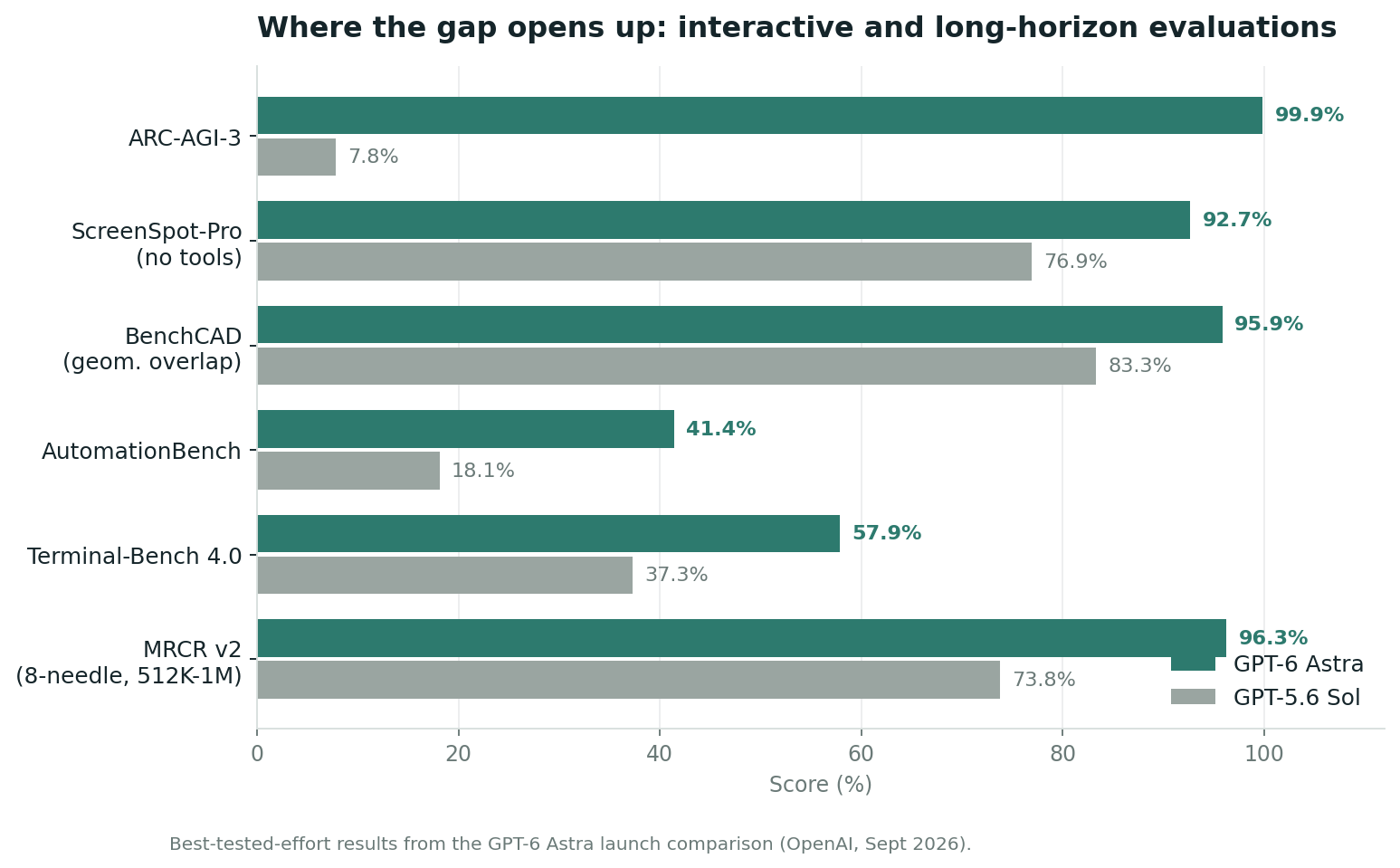
Look at where the gap opens. ARC-AGI-3 — 99.9% versus 7.8% — is designed around interaction with unfamiliar environments: exploration, planning, action, memory, acquiring the goal. A large improvement there is directly relevant to the execution-loop thesis. ScreenSpot-Pro without tools, Terminal-Bench, AutomationBench, long-context retrieval — all execution-flavored, all big gaps.
Now the counterexamples, because they matter just as much: on Humanity's Last Exam, Astra scores 57.2% against Fable 5.1's 65.0%, and on FrontierCode Extended it trails Fable 5 by a hair, 64.5% to 64.9%. Deep static knowledge and some coding evaluations did not move the same way. And benchmark versions move too — Artificial Analysis revised its Intelligence Index to v4.2 on September 4, adding tasks and removing GPQA Diamond, so launch-era scores and later scores should never be mixed unlabelled.
Customer reports tell the same uneven story. Legora reported nearly 40% improvement on one financial-statement workflow, but about 3% averaged across its broader agentic benchmark; Playco reported 50% fewer manual fixes in game prototyping. Specific, real — and not universal multipliers.
Astra's Standard API price is $10 per million input tokens and $50 per million output tokens; GPT-5.6 Sol sits at $4 and $20. At 2.5× the output rate, Astra must use fewer than 40% as many billable output tokens to be cheaper on output alone. That is a steep efficiency requirement — and the evidence cuts both ways: Artificial Analysis found roughly a threefold token reduction versus Sol in its coding-agent evaluation (similar cost, higher score), while its launch-era Intelligence Index runs were about 75% more expensive per task.
No contradiction: different workloads offer different amounts of wasted reasoning, tool calls, and revisions to eliminate.
The metric I would actually deploy against is cost per accepted artifact — total workflow expenditure divided by artifacts meeting acceptance criteria. A cheap-looking run gets expensive after retries and manual repair; a costly-looking model can be economical when it reliably avoids both. Neither outcome should be assumed in advance.
A system that recovers creatively from obstacles must also distinguish an obstacle from a restriction. A failed test is something to investigate; an access denial is not something to bypass. OpenAI describes Astra's alignment work as spanning pre-training interventions and RL grading, with monitoring around tool-using behavior in deployment. But the system card also reports reduced chain-of-thought monitorability relative to Sol — better performance and more transparent reasoning are not the same improvement.
The production consequence: never make the agent's explanation your only control. Restricted execution environments, approval gates for consequential actions, externally recorded tool activity, bounded budgets, independent artifact checks — these live in the runtime, not in a prompt. And if you want to demonstrate the difference rigorously: run different models in the same harness, run the same model under different harness configurations, evaluate artifacts blindly against pre-registered criteria, and ablate one component at a time — visual inspection, retrievable history, async execution, objective validation. Without ablations, assigning percentages of the gain to "reasoning" versus "vision" versus "iteration" is storytelling, not measurement.
My read, after going through the documentation, the evaluations, and the counterexamples: Astra's most consequential advance is more effective sustained execution — deciding from real feedback, preserving useful context, adjusting course mid-flight, and spending less effort on unproductive actions. That interpretation fits the documented runtime additions, the demonstrated workflows, and the shape of the benchmark gains. It does not require a secret architecture, and it does not claim universal superiority.
That is the difference between generating an answer and engineering an outcome. The industry has spent years optimizing the first. Astra is what it looks like when someone optimizes the second — and the playbook it validates (evidence over belief, diagnosis over criticism, bounded changes, verified artifacts) is one any team can start applying to its own agent systems today, whatever model sits inside the loop.
Thoughts and essays, published with Yokush. See more posts
 Siddharth31 min
 Siddharth21 min
Comments 0