 Siddharth
The Third Asset: Compounding Knowledge and the End of Disposable AI

Siddharth
July 22, 202617 min read

Every AI conversation you've ever had is gone. The insights evaporated. The corrections were lost. The preferences you patiently explained — forgotten. You paid full price for every interaction, and the next one starts from zero. There is a better way to account for this, and it changes everything about how AI agents should be built.
You sit down with your AI assistant. You explain your project — the context, the constraints, the stakeholders, the tone. You correct its first attempt. You refine the output. After twenty minutes, you have something good. You close the tab.
Tomorrow, you open a new chat. You explain everything again. The assistant has never met you. It doesn't remember that you prefer tables over prose, that your client is risk-averse, that you always want sources cited inline, that last week's framing was too aggressive. You pay for the privilege of teaching it from scratch.
Now imagine doing this with a human colleague. Every Monday morning, they arrive at the office having forgotten everything. You re-onboard them. By Friday, they're productive. Monday, they're blank again. You'd fire them. Or you'd build a system so they never forget.
This is not a metaphor. There is a formal economic argument — published in April 2026 — that the tokens you spend building persistent knowledge artifacts should be reclassified on the balance sheet from consumables to capital goods, the same way accounting standards reclassified software development costs in 1985 . The implication is staggering: the knowledge layer of your AI stack is not an operating expense. It is a compounding asset — and almost nobody is treating it that way.
To understand where compounding fits, you need to see the full architecture. Every AI system — whether it's ChatGPT, a custom enterprise agent, or the assistant on your phone — is built from three distinct layers. The critical question for each layer is simple: do you rent it, own it, or compound it?
Here's what matters: Layer 1 is a commodity you rent by the token. Every frontier model — GPT-5, Claude, Gemini — is available to anyone willing to pay. There is no durable advantage in which model you use. Your competitors use the same one.
Layer 2 is the harness — the orchestration code, the tool integrations, the memory pipeline, the prompts. This is where most enterprise effort goes today, and it does create advantage. A well-engineered agent harness is meaningfully better than a raw API call. But harnesses converge. Frameworks like LangChain, CrewAI, and AutoGen are commoditizing the orchestration layer rapidly.
Layer 3 is the knowledge and context layer — everything the system has learned about you, your work, and your domain. This is where the magic happens. And here is the key insight: Layer 3 has a time dimension that the other two don't. A model doesn't get better the more you use it. A harness doesn't learn. But knowledge — if you build it right — compounds.
The paper that crystallized this for me comes from researchers who applied corporate accounting standards to AI token economics . Their argument is elegant in its simplicity.
When you pay for an AI interaction today, it hits your budget as an expense. Consumed. Gone. The interaction produced an answer, the answer was used, the tokens are spent. Next interaction, full price again.
But what if that same interaction left behind something durable? A synthesized wiki page. A corrected heuristic. A new skill. A refined understanding of your preferences. Then the tokens weren't consumed — they were invested. The artifact has value that persists beyond the interaction. And unlike most capital assets, knowledge has a peculiar property: it accretes rather than depreciates. Cross-references compound. Contradictions get flagged and resolved. The knowledge graph gets denser and more useful over time.
Four properties distinguish a capitalized token from a consumed one:
The chart below makes this concrete. The dashed line is where most AI systems operate today — flat. Every interaction starts from scratch. The solid line is what happens when you treat each interaction as a capital investment in a persistent knowledge base:
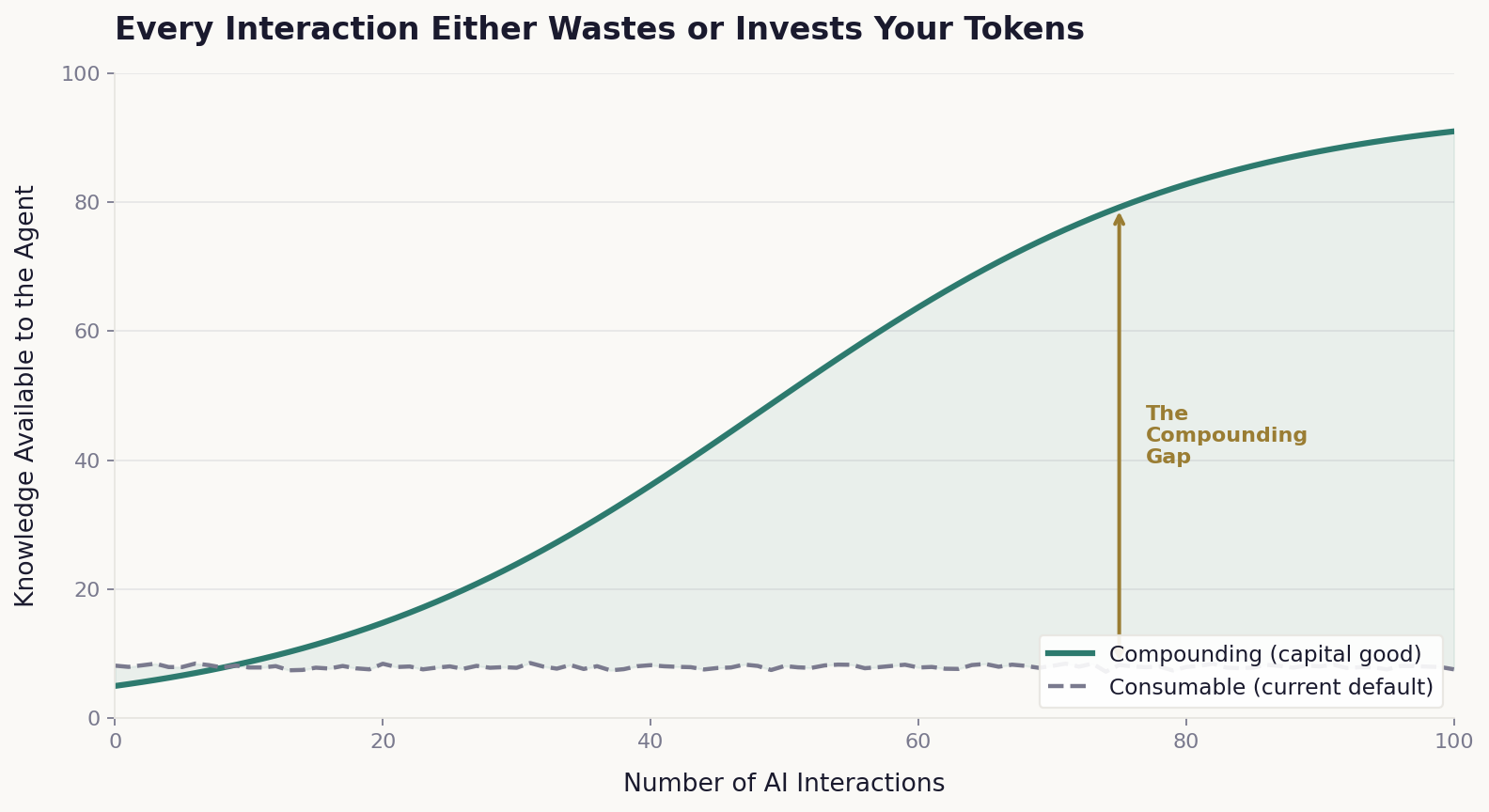
The gap between those two lines — call it the Compounding Gap — is the value you are destroying every time your AI system fails to persist what it learned. Over hundreds or thousands of interactions, it is the difference between an assistant that gets smarter about you and one that remains a stranger.
If compounding knowledge is the goal, memory is the mechanism. And here, the AI field has converged on something genuinely useful: a three-tier architecture borrowed directly from cognitive psychology.
You already know how this works because you use it every day. Consider three things you know:
Your brain consolidates episodes into facts, and facts into skills. You don't remember every coffee meeting. You remember the preferences and the habits. The same consolidation operation is how an AI agent learns across sessions.
Here is the engineering reality: production-grade memory systems are no longer research projects. Several open-source frameworks are running in production at scale. One of them — Mem0 — demonstrated a 26% improvement over OpenAI's built-in memory on standard benchmarks while cutting token costs by over 90% . Another — Zep, built on a bi-temporal knowledge graph — tracks when every fact was created, when it expires, and when it was invalidated, enabling something most systems can't do: retroactive correction. When the world changes and a fact becomes wrong, the system doesn't overwrite — it marks the old fact as expired and records the new one with a validity timestamp. This is how you get an auditable knowledge base instead of a pile of potentially stale assertions
.
The retrieval problem — finding the right memory at the right time — has converged on a hybrid approach. Pure vector search (the dominant method in most RAG systems) is structurally blind to relational queries. Ask "who manages the person who approved the deployment?" and vector similarity gives you nothing useful. The solution is parallel search across three methods — dense vector similarity, sparse keyword matching, and graph traversal — fused together. No single method is sufficient.
Memory is the substrate. But memory alone doesn't compound — it accumulates. The difference between accumulation and compounding is the codification loop.
Think about it like compound interest. Money in a savings account accumulates linearly. Money that gets reinvested compounds exponentially. The reinvestment step — taking the returns and putting them back to work — is what creates the exponential curve. In AI systems, that reinvestment step is called codification.
The loop has four stages:
Most AI systems today do steps 1 through 3. They plan, they execute, they sometimes evaluate. But step 4 — Codify — is almost always missing. And that is precisely the step that converts an expense into an investment.
Codification means encoding what was learned back into the system. When the agent discovers that a particular approach works better for your use case, it doesn't just produce a better answer — it writes a skill file. When it makes a mistake and you correct it, it doesn't just fix this output — it adds a rule. When it notices you always reformat tables a certain way, it doesn't wait for you to ask again — it updates its standing instructions.
The most influential practitioner of this pattern is Andrej Karpathy, who described a three-layer knowledge architecture — raw sources feeding an LLM-generated wiki feeding a schema file — with three core operations: Ingest (read a new source, write summaries, update cross-references across a dozen existing pages), Query (search the index, read relevant pages, synthesize with citations), and Lint (weekly health checks that find contradictions and orphaned pages). His key observation: "the wiki is a persistent, compounding artifact. Cross-references are already there. Contradictions have already been flagged."
This is the fundamental flaw in how most organizations deploy retrieval-augmented generation (RAG). They index raw documents but never synthesize them. Every query starts from scratch, reading the same source material and reasoning about it fresh. The knowledge never compounds. It's like a library where nobody is allowed to take notes — you can read the books, but you can't build on what you learned.
Now we arrive at the aspiration that drives most of this work: the digital twin. The idea is seductive. Capture enough of a person's interactions, preferences, decisions, and communications, and you can build a software model that replicates their judgment. A digital you. An immortal you. A you that can be cloned and distributed to colleagues.
Here is the honest reality, backed by the first rigorous benchmarks in the field.
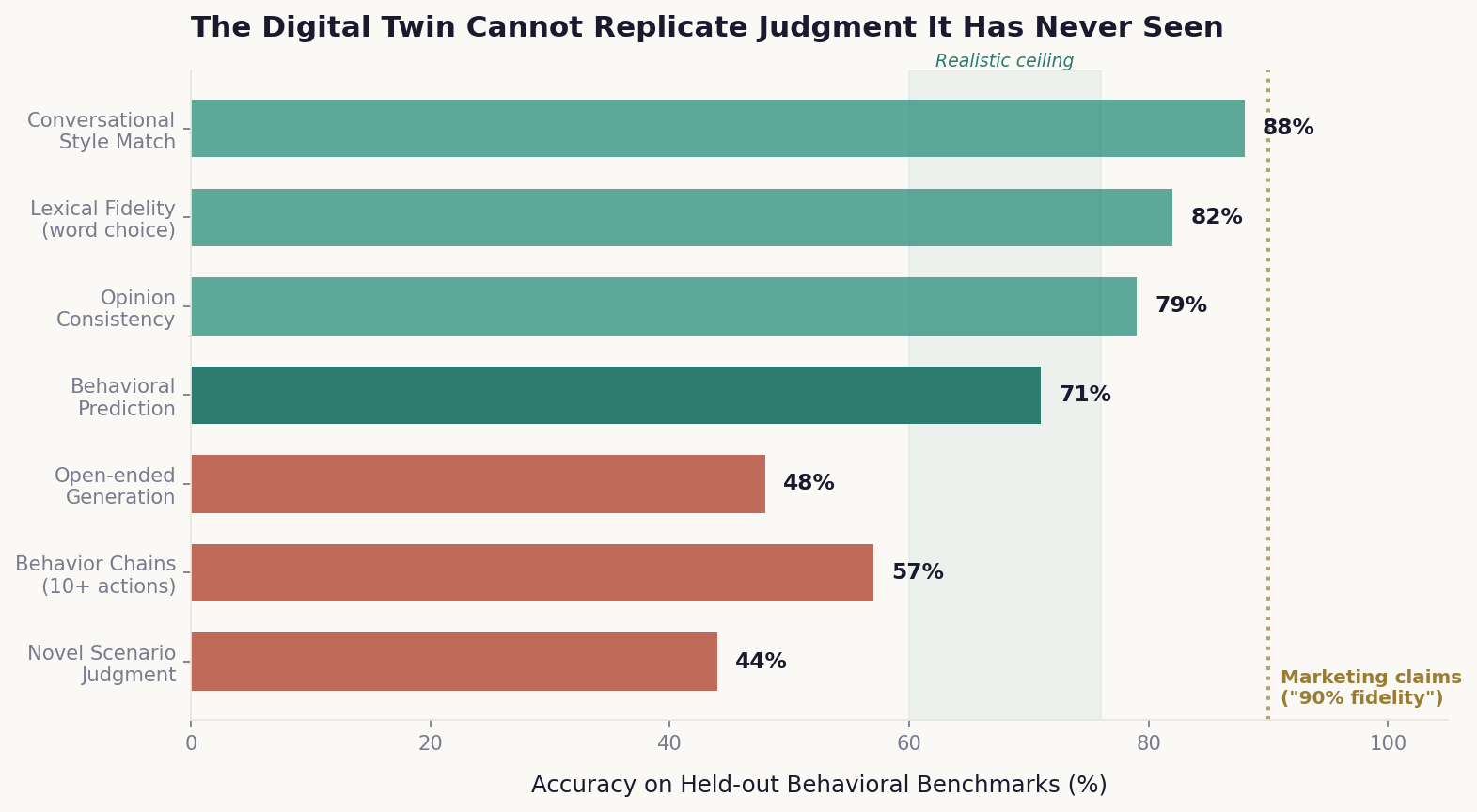
The pattern is clear and important. Twins are good at surfaces and bad at depths. They can replicate how you talk (88% style match) and what words you tend to use (82% lexical fidelity). They can stay consistent with your stated opinions (79%). But the moment you ask them to predict what you would decide in a new situation, accuracy drops to 71% on simple behavioral tasks and collapses to 44% on novel scenario judgment .
One study found something particularly troubling: when you give a digital twin a richer, more detailed description of the person it's supposed to model, it doesn't get more accurate — it gets biased. Richer personas skewed simulations toward more progressive outcomes, systematically moving the twin away from the actual person's judgment. The researchers called this a "blue-shift" bias.
Another study tested behavior chains — sequences of 10 to 20 linked decisions, the kind of multi-step reasoning that real work actually requires. Even the best models achieved less than 60% accuracy, and they found a snowball effect: initial errors compounded through the chain, degrading the simulation of each subsequent decision.
So should we abandon the digital twin concept? No. But we should reframe it. Stop trying to build a replica. Build a compounder.
A replica tries to be you. It fails because judgment under uncertainty is not fully recoverable from digital footprints — it's tacit, contextual, and developed through years of organizational experience that no log file captures. A compounder, by contrast, is a system that captures your explicit heuristics, decision patterns, and preferences, gets measurably better at serving you over time, and — critically — honestly flags when it's outside its competence. It doesn't pretend to be you. It's a second brain that compounds, bounded by an honest assessment of what it actually knows.
This isn't a compromise. It's the right design. A system that says "I don't know how you'd decide this — here's what I'd need to learn" is far more useful than one that confidently fabricates a judgment you'd never make.
So far we've covered memory (the substrate) and the codification loop (the mechanic). The third piece is the self-improvement engine — the system that evaluates its own performance and updates its strategies. This is what makes compounding genuine rather than just accumulation.
Every self-improving agent implements the same closed loop: Execute, Evaluate, Extract insights, Update. What's changed in the last 18 months is that this loop has moved from research papers into production, with measurable results:
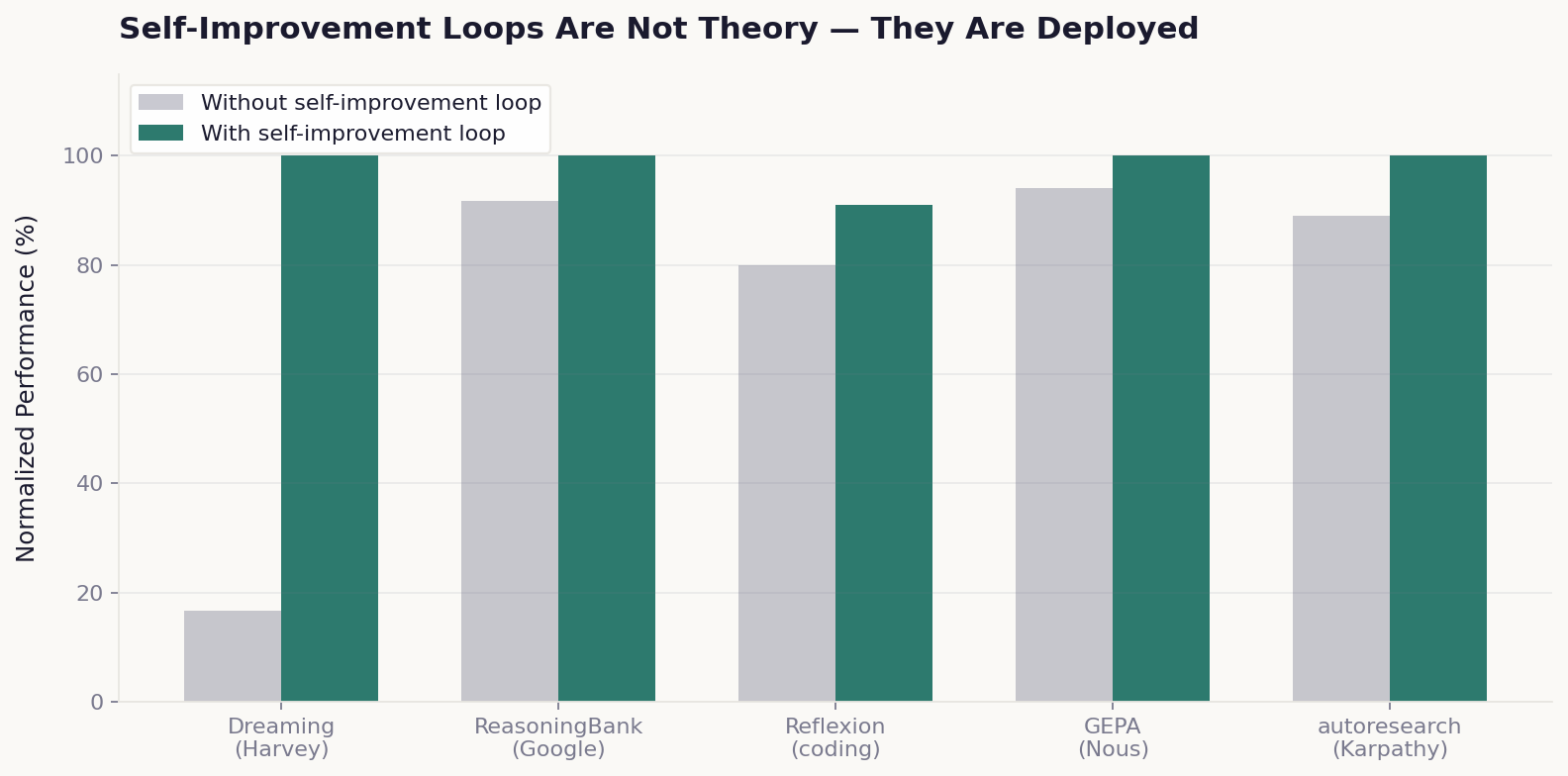
Let me highlight the most striking deployment. Anthropic built a feature called "Dreaming" — a scheduled process that runs between sessions, reviews past work, identifies recurring patterns and mistakes, consolidates memory, and discards stale information. At Harvey, a legal AI company, agents with Dreaming showed a six-fold improvement in task completion rate compared to runs without it. One consolidation pass covering 913 sessions completed in about eight minutes. The system literally learns while you sleep.
Google's ReasoningBank, presented at ICLR 2026, takes a different approach. Instead of storing raw interaction traces, it distills transferable reasoning strategies from both successful and failed attempts. It captured the high-level pattern of what worked, not just the specific answer. The result: an 8.3 percentage point improvement in success rates, 2.8 fewer interaction steps per task, and a 34% relative effectiveness gain over prior memory designs .
And the foundational paper in this space — Reflexion, from NeurIPS 2023 — showed that agents which verbally reflect on their mistakes and carry those reflections forward improve dramatically. On a coding benchmark, accuracy jumped from 80% to 91% simply by adding a reflection step. The agent doesn't get a bigger model. It doesn't get more training data. It just thinks about what went wrong and remembers.
This is where the personal becomes the professional — and where the real economic value lives for organizations.
Imagine you've been using a compounding knowledge system for a year. It knows your research methods, your analytical frameworks, your decision heuristics, your communication style. It has hundreds of skills, thousands of facts, and a refined understanding of how you weigh evidence and detect risk. Now imagine you could package that knowledge and hand it to a junior colleague.
This is not science fiction. The leading system in this space — an open-source project called COLLEAGUE.SKILL — does exactly this. Its design principle is the key insight that most digital twin products get wrong: expertise transfer should produce bounded artifacts encoding how a person weighs evidence, not unrestricted person simulations .
The system separates expertise into two tracks:
| TRACK | WHAT IT CAPTURES | EXAMPLE CONTENT |
|---|---|---|
| Capability | How you think, decide, and evaluate | Mental models, decision heuristics, review criteria, risk detection patterns, analytical frameworks |
| Behavior | How you communicate and interact | Communication style, interaction rules, formatting preferences, escalation triggers |
The output is a versioned, inspectable, correctable skill package. A colleague — or another AI agent — can load it and immediately benefit from your compounded expertise. When it gets something wrong, the feedback loop is natural: you correct it in plain language, and the package updates. When the expertise evolves, you create a new version.
How well does this actually work? A methodology developed by Forum AI assembled panels of senior practitioners, conducted structured interviews adapted from cognitive task analysis, and synthesized expert reasoning into calibrated evaluation criteria. The result: AI judges grounded in expert-elicited reasoning achieved an F1 score between 0.81 and 0.97 against expert consensus. Uncalibrated frontier models — the same models everyone uses out of the box — substantially underperformed. On one specific task (detecting unreliable sources), an expert-guided judge achieved a kappa of 0.79, while a frontier model running on its own managed just 0.03.
That gap — between 0.03 and 0.79 — is the value of encoding expertise. It is the difference between a tool that guesses and one that judges.
Compounding is powerful. It is also dangerous. The same mechanism that makes knowledge richer over time can make it wronger over time if poorly governed. Here's what can go wrong:
And then there is the brutal production reality: 88% of enterprise AI agent pilots fail to graduate to production. Gartner predicts that over 40% of agentic AI projects will be canceled by the end of 2027. The architectures work. The memory systems work. The self-improvement loops work. What fails is the organizational capacity to evaluate, govern, and maintain these systems over time.
This is not a technology problem. It is an institutional problem. And it is the gap where real competitive advantage lives.
Whether you're a builder, a leader, or simply someone who uses AI tools every day, the implications are concrete:
If you build AI systems: Stop treating memory as an afterthought. The three-tier architecture (episodic, semantic, procedural) with hybrid retrieval (vector + keyword + graph) is the production standard. Build a codification loop — every interaction should leave behind a durable artifact. Run sleep-time consolidation. And invest as much in governance (source citations, TTL policies, review mechanisms) as in the architecture itself.
If you lead an organization: The knowledge layer is where your durable AI advantage lives — not in which model you license. Your firm's compounded expertise — the judgment of your senior people, encoded in a form that compounds and transfers — is an asset that appreciates while your competitors' model subscriptions depreciate. Start accounting for it that way. The question isn't "how do we deploy AI?" It's "how do we build a knowledge base that makes every AI interaction cheaper and better than the last?"
If you use AI tools personally: You are already generating the raw material — every conversation, every correction, every preference you express. The question is whether that material is being captured and compounded or thrown away. If your tool doesn't remember, you're paying tuition every semester for the same course.
The paradigm shift is not "build a digital twin." The paradigm shift is treat every AI interaction as a capital investment in a compounding knowledge asset, governed well enough that the compounding is genuine and not drift.
The memory architectures are production-ready. The self-improvement loops are deployed and measurable — six-fold task completion improvements are not hypothetical. The distillation pattern — separating capability from behavior, encoding expertise as inspectable artifacts, calibrating against expert consensus — is reliable enough for real professional use.
The digital twin, as a faithful replica of a human mind, is not real and may never be. But that's the wrong target. The right target is a compounder: a system that captures what it can, honestly flags what it can't, and gets measurably better at serving you every single day.
The gap between the technology and widespread deployment is organizational, not technical. The architectures exist. The benchmarks exist. The deployment results exist. What doesn't exist yet — at most organizations, in most industries — is the institutional capacity to treat knowledge as a capital asset, govern its compounding, and harvest its returns.
That gap is the opportunity. And it won't stay open for long.
This analysis draws on verified deep research across 239 papers in the self-improving agent literature, production benchmarks from Mem0, Zep/Graphiti, and Anthropic, and deployed system results from Harvey, Google, and independent researchers. Key sources: Wen & Ku (2026) on knowledge compounding economics; COLLEAGUE.SKILL (2026) on expertise distillation; TwinVoice (2025) and Columbia DAPLab on digital twin fidelity; Reflexion (NeurIPS 2023) on verbal reinforcement learning; and ReasoningBank (ICLR 2026) on reasoning strategy distillation.
Thoughts and essays, published with Yokush. See more posts
 Siddharth31 min
 Siddharth24 min11
 Siddharth11 min
Comments 0