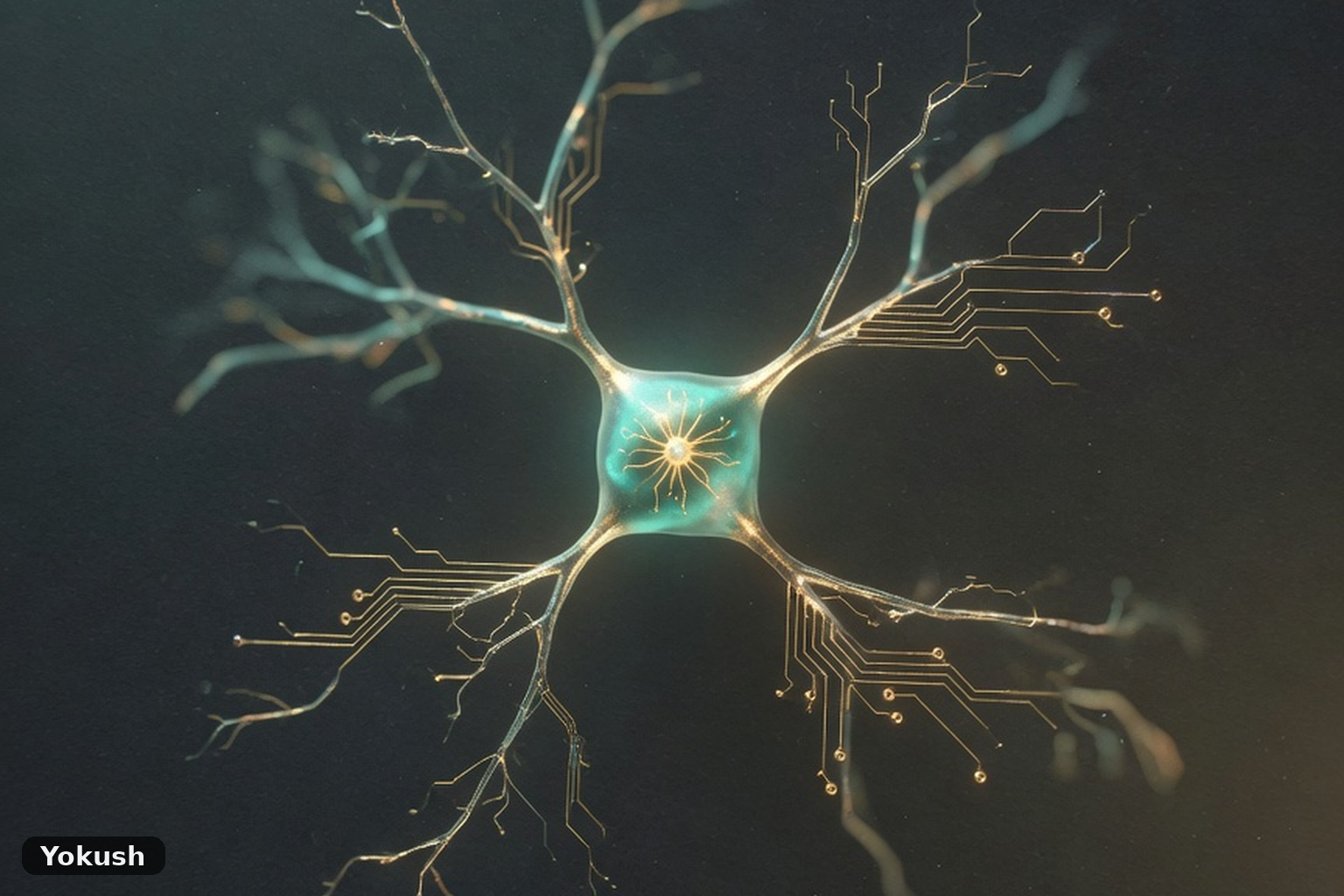
We are building bigger brains and wondering why our enterprises can't feel their own limbs. The answer, it turns out, has been inside us all along.
You are cooking. Your hand brushes a hot pan. Before you feel the heat — before any thought flickers through your cortex — your hand is already pulling back. The signal traveled from your fingertip to your spinal cord and straight back to your muscles. It never asked your brain for permission. It didn't need to.
This is not a design flaw. It is the single most important architecture lesson in biology, and almost nobody building enterprise AI has learned it.
We are in the middle of the largest deployment of artificial intelligence in history. Trillions of dollars are being committed. And our collective strategy can be summarized in one sentence: build a bigger cortex and hope for the best.
The brain is not the organism. It is one organ. And most of what keeps you alive — your digestion, your reflexes, your fight-or-flight response, your hormone regulation — runs on entirely different hardware, on entirely different timescales, with entirely different decision protocols.
In 1983, a neuroscientist named Benjamin Libet attached volunteers to EEG machines and asked them to press a button whenever they felt like it, noting the exact moment they became aware of their decision. What he found rattled centuries of philosophical assumption: the brain's motor cortex began preparing the movement roughly 350 milliseconds before the person consciously "decided" to press.
The brain had already chosen. Consciousness was just the press release.
Now, Libet's experiment has been debated, reinterpreted, and partially walked back. A 2021 review concluded that the canonical interpretation — readiness potentials as measurable neural decisions preceding awareness — is no longer field consensus. But here is the part that survived: the architecture of the finding is correct. Most of what the brain does is unconscious, automatic, and predictive. The slow, deliberate "you" — the narrator in your head — is a thin layer wrapped around a vast, silent machine.
Kahneman gave this structure names everyone could use: System 1 is fast, automatic, and intuitive. System 2 is slow, deliberate, and analytical. What matters for our purposes is that most of your decisions are System 1. You do not deliberate which leg to put forward when you walk. You do not reason through whether to flinch at a loud noise. And you do not consciously regulate your blood sugar — an entire distributed network of organs, hormones, and neurons does that without you.
This is not a philosophical quirk. This is an architectural principle. And we are violating it at scale.
Every major enterprise AI investment today converges on a single pattern: get a larger model, give it a larger context window, prompt it to reason harder, and hope it handles everything. The frontier models are remarkable — genuinely. But the deployment pattern is the equivalent of wiring every business decision through the prefrontal cortex and being confused when it's slow, expensive, and occasionally hallucinates nonsense.
In biological terms, here is what most "AI-powered" enterprise architectures look like:
Now compare this to how a biological organism actually solves problems. When your hand touches a hot surface, the spinal cord runs a three-neuron loop in roughly 50 milliseconds and initiates withdrawal — before your cortex even registers the heat. The brain is informed afterward. It gets the credit, but it did none of the work.
This is not a metaphor. It is a deployment pattern that has been field-tested for 500 million years. And we are ignoring it.
If biological intelligence is distributed across layers of autonomy — each solving problems at the right level of sophistication and speed — then enterprise AI deployment needs the same discipline. Not every decision deserves the prefrontal cortex. Most don't.
Here is a framework for thinking about where cognitive load belongs:
This is not an argument against frontier models. It is an argument against using them for everything. If your payment routing goes through an LLM, you have built a brain that needs to think about every heartbeat. Biological organisms died out of that design half a billion years ago.
Here is what a properly architected enterprise AI system looks like — mapped directly to the biological layers it mirrors:
This is not a theory. It is how the most advanced deployments already work. The agent orchestrator — the component most people think of as "the AI" — is actually the thinnest layer. It handles only the genuinely novel inputs. Everything else has been pushed down the stack: into retrieval systems that serve previously solved patterns, into deterministic rules that execute without consultation, into feedback loops that regulate the system on longer timescales.
The model is not the organism. It is one organ. And in a well-architected system, it is not even the busiest one.
There is a second, harder reason this matters. The human brain runs on roughly 20 watts — about a third of an old incandescent lightbulb — while supporting approximately 86 billion neurons. A single modern GPU draws up to 700 watts under full load.
A modern data center campus is approaching the electrical consumption of a small city.
If intelligence were purely a function of parameter count, biology would be losing. It is not.
The brain's efficiency is not a miracle. It is an architecture. Most of what the brain does is handled by subsystems that are specialized, local, and low-power. The cortex — the expensive, energy-hungry deliberative layer — is invoked sparingly. The basal ganglia runs motor programs on repeat without cortical involvement. The spinal cord handles reflexes in circuits so short they barely consume energy. The enteric system manages digestion with half a billion neurons that never once "think" in the way we mean it.
This is not an analogy. It is the same engineering constraint playing out across two substrates. If every business decision routes through a frontier model, you are not building an intelligent system. You are building a brain in a vat — one that hallucinates, burns money, and has no limbs.
Which brings us back to the question that opened this essay. What do we even mean by intelligence?
If intelligence is the ability to reason from first principles, then yes — the cortex is the star of the show, and LLMs are the closest thing we have built to it. But if intelligence is the ability to survive and act in a complex environment — to respond to threats in 50 milliseconds, to regulate internal state across hours and days, to route problems to the right layer at the right time — then intelligence is not a property of any single organ. It is a property of the entire architecture.
The gut does not "think." But it solves problems your brain cannot. It operates at a scale, speed, and autonomy that cortical deliberation could never match. If a problem can be solved without consciousness, biology solves it without consciousness. That is not a compromise. That is the entire design.
Enterprise AI is not about building better brains. It is about building organisms. Stop asking how smart your model is. Start asking whether you have wired the body.
The reflex arc does not deliberate. The gut does not reason. And your payment routing should never touch an LLM. The architecture that has kept every animal alive for half a billion years has a lesson for us — if we are willing to stop worshipping the cortex long enough to hear it.

Thoughts and essays, published with Yokush. See more posts
 Siddharth21 min
 Siddharth31 min
 Siddharth
Comments 0