
For forty years, strategy meant digging a trench around the castle and waiting. This essay takes the trench seriously as an economic object: it gives the moat a decay constant, measures that constant across four eras, and shows what happens to fortification when the diffusivity of knowledge rises a thousandfold. The water leaves. The walls remain standing. And everyone is fighting on dry land.
In November 1999, the most successful investor of the twentieth century wrote down the strategy of the twentieth century. The key to investing, he argued, was not predicting which industries would transform society; it was "determining the competitive advantage of any given company and, above all, the durability of that advantage." The businesses that reward investors are the ones with "wide, sustainable moats" around them. Four years earlier he had put the image in stone: "In business, I look for economic castles protected by unbreachable 'moats.'"
That single metaphor — castle, moat, unbreachable — quietly became the operating system of modern strategy. Every pitch deck ends with it. Every diligence memo asks about it. Entire careers are spent digging, widening, defending it. And for a long time the metaphor earned its keep, because it smuggled in three assumptions that were, in its era, roughly true: that attack arrives from one direction, at a gate you can watch; that what you know stays inside your walls; and that time is on the defender's side.
This essay is an obituary written with instruments. All three assumptions have now failed — not rhetorically, but measurably, in units you can put on a chart. What remains of the moat is smaller, more expensive, and differently located than the strategy canon taught you. And in the process, the moat has done something worse than die: it has inverted. Today, digging one often destroys the capital that pays for the digging.
The argument has seven movements. First, why the metaphor was always wrong. Then the physics of advantage, the evidence, an autopsy of every classical moat, a steelman that refuses to die on command, what actually compounds instead, and finally the arithmetic — the part where we do the numbers and find the razor you should carry into every investment meeting.
Start with the word. A moat is not a defensive strategy; it is a landscape feature — a ditch around a mound, originally the mound itself. Its defensive value depends entirely on the attacker's technology. Against a siege tower it is excellent. Against a projectile, it is a pond. Against an aircraft, it is a decoration.
The strategy literature never updated the metaphor; it only formalized it. The five-forces framework identified entry barriers as the force that "puts a cap on the profit potential of an industry," and catalogued them: scale, brand, capital requirements, distribution access, proprietary technology. The most rigorous simplification of that tradition reduced all five forces to one — barriers to entry — and then reduced barriers to exactly three sources: a supply advantage, customer captivity, or economies of scale coupled with captivity. "Competitive advantages are actually barriers to entry and vice versa."
Notice what every item in both lists assumes: that the thing being protected is a stock. Knowledge. Data. Habit. Position. A pile of something you can own, and others cannot. The moat works by making the stock excludable.
The problem is that knowledge has never behaved like a stock. Kenneth Arrow stated the underlying mechanism in 1962: information is non-rival and only partially excludable, and this breaks the market for it. "Its value for the purchaser is not known until he has the information, but then he has in effect acquired it without cost." In plain terms: to sell information you must disclose it, and disclosing it destroys your exclusive claim to it. Every product you ship is a disclosure. Every demonstration, every documentation page, every customer integration, every benchmark score — a leak with a marketing budget.
The leakage was always there; it was just slow. Across two centuries and fifteen technologies in 166 countries, the average country adopted a technology forty-five years after it was invented — and newer technologies diffused faster than old ones. The moat never repealed diffusion. It was a local tax on its speed.
Edwin Mansfield quantified the tax in a pair of studies that strategy people quote too rarely. Imitation, across 48 products in chemicals, drugs, electronics and machinery, cost about 65 percent of the original innovation cost and took about 70 percent of the original innovation time. Development decisions reached rivals within 12 to 18 months; detailed knowledge of a new product's nature and operation leaked within about a year.
Roughly 60 percent of patented innovations were imitated within four years of introduction — and patents raised imitation cost only modestly, except in pharmaceuticals.
Even in the industrial golden age of the moat, the wall was a two-to-three-year delay, not a decade of safety.
Here is the whole argument in one picture: the classical wall, and the force now dissolving each layer of it. Hold this diagram in your head; the rest of the essay fills in its numbers.
To kill a metaphor rigorously, you have to replace it with a better model. Two pieces of physics are useful here, and they are not the same piece, which is why most commentary on this subject gets muddled.
Diffusion governs how capability spreads. Fick's first law, J = −D∇φ, says the flux of a substance is proportional to the concentration gradient that drives it, times a diffusivity D. The steeper the gradient, the faster the equalizing flow. Substitute "knowledge of how to do something" for concentration and you have the economy's basic behavior: any steep advantage in know-how creates a flow of imitation down the gradient, and the speed of that flow is set by D — the economy's technology for moving knowledge. Apprenticeships, trade journals, reverse engineering, hiring away your rival's engineers: all low-D channels. Open-weight models, distillation, synthetic data, and agents that can perform any demonstrated skill after watching a transcript: these are not a new channel. They are a different value of D.
Decay governs how a given firm's advantage erodes. Treat a moat as a radioactive stock, M(t) = M₀e^(−λt), where λ is a constant hazard rate — the probability per unit time that your edge gets matched. A constant hazard has a clean property: a half-life, H = ln 2 / λ, the time in which half your advantage is gone regardless of how much you started with. It is also memoryless: an old moat is no safer than a new one. That sounds abstract until you discover that the corporate world actually obeys it. Public companies dissolve — through bankruptcy, merger, acquisition — at an approximately constant hazard, with a measured half-life of about 10.5 years.
The same exponential decay shows up one level down, in profits. Above-average profitability mean-reverts at roughly 38 percent per year in large samples of American firms — an advantage half-life on the order of a year and a half to two years, measured before AI was a factor. And the direction of travel is not new. A review of 27 persistence-of-profit studies found that all but one detected declining persistence over time: advantage has been getting harder to sustain for decades.
The visible summary of all of this is corporate tenure. The average company stayed on the S&P 500 for about 32 years in the 1960s. By 2026 the average tenure is about 15 years and still falling, with a forecast of 12 years by 2027.
The evolutionary biologist Leigh Van Valen gave the mechanism its name in 1973: the Red Queen effect. Extinction probability within a group is constant over time, because every gain by one player degrades the effective environment of everyone else — momentary fitness is control over resources whose total is fixed, a zero-sum game played at increasing speed. You must run to stay in place. Van Valen even proposed a unit for this — the macarthur, one unit per five-hundred-year half-life. Corporations, as we just saw, run about forty macarthurs. Knowledge-based advantages, as we are about to see, now run in the thousands.
One more calibration, because it is the quiet revolution nobody reports. Textbook capital depreciation is usually modeled around five percent a year — a capital half-life near fourteen years. Your building, your machines, your fleet: slow-decaying assets. Now compare that with the half-life of the knowledge that told you what to do with them. When the half-life of your advantage falls below the depreciation schedule of your equipment, the accounting world inverts. Knowledge becomes the fast-depreciating asset. Machines become the safe one. The moat was always supposed to protect the most durable thing you owned. It now protects the least durable.
Enough theory. Here is what happened when D and λ were measured rather than argued.
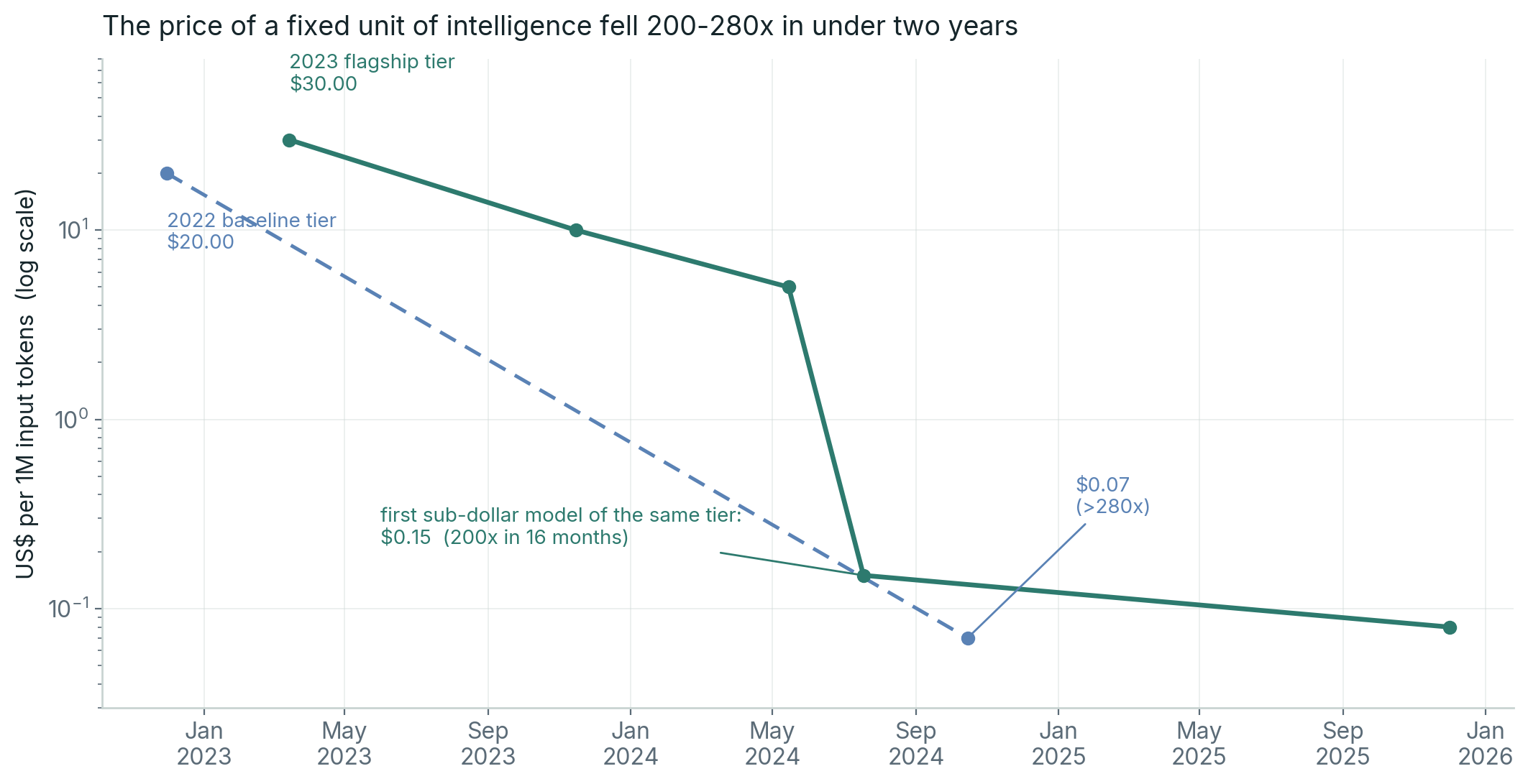
Start with the cleanest possible measurement: hold quality constant and track price. The capability level of the best widely available model in late 2022 cost $20.00 per million input tokens. By October 2024, the same capability level cost $0.07 — more than a 280-fold decline in under two years. The frontier tier of March 2023 launched at $30.00 per million tokens; sixteen months later, a model of that class cost $0.15. Two hundredfold.
The per-task numbers are more violent than the per-token numbers. The quality-adjusted cost of AI inference has fallen roughly thirteenfold per year since 2023 — faster than any previous transformative technology measured in the same way. On one hard scientific-reasoning benchmark, the price of a correct answer at a fixed accuracy fell from about thirty cents per question to about four hundredths of a cent in roughly eighteen months.
Algorithmic progress alone — with hardware effects stripped out — contributes about threefold per year.
Every one of those numbers is a measurement of D, the diffusivity of capability. When a fixed unit of intelligence becomes two orders of magnitude cheaper in two years, "we have the intelligence and you don't" is not a moat. It is a two-year head start on a conveyor belt.
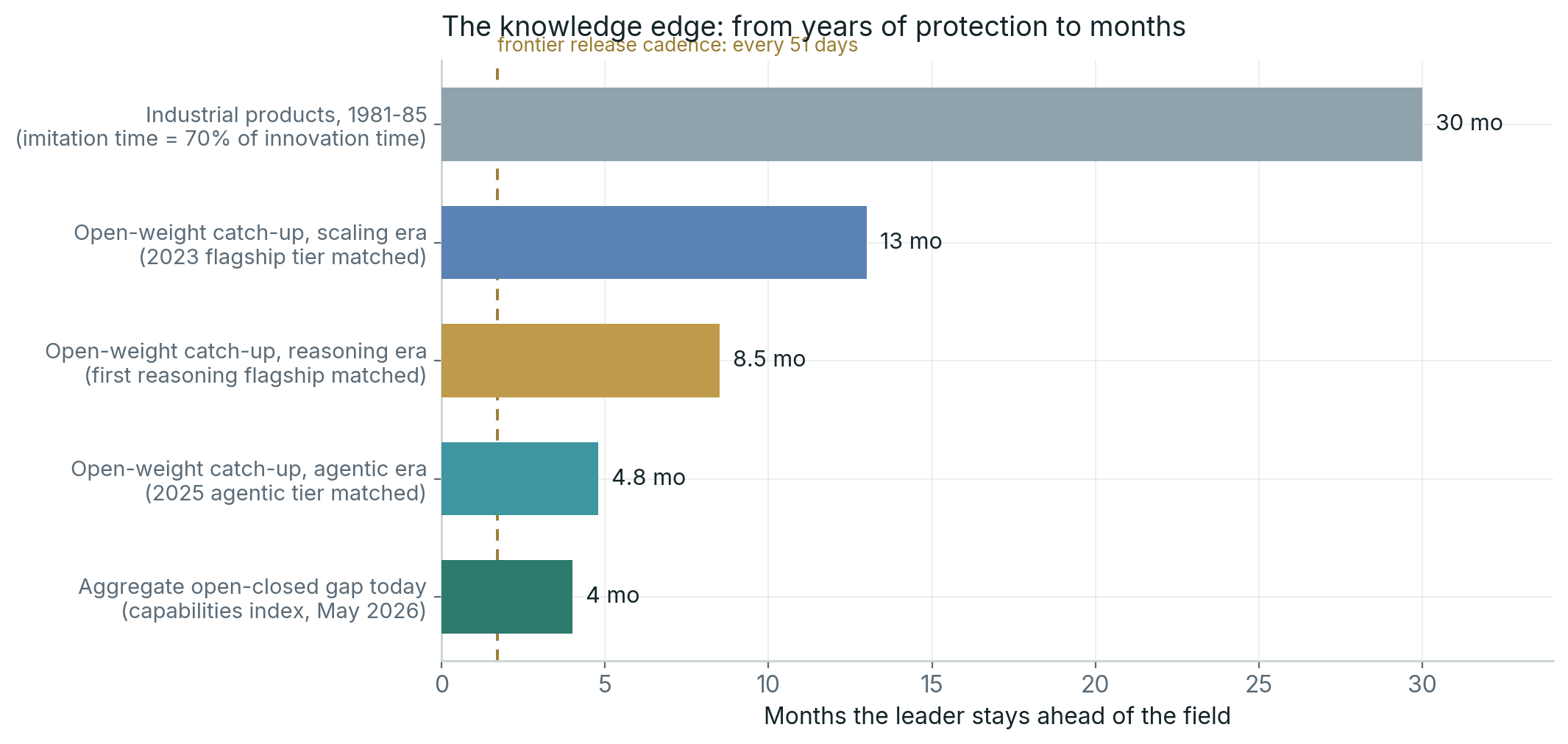
The second measurement is more directly a moat statistic: how long does the leader stay ahead? In late 2024, the best open-weight models trailed the closed frontier by roughly a year. By May 2026, the measured gap on a broad capabilities index was about four months.
An independent fit using task-horizon methodology landed on 4.4 months.
Decomposed by capability era, the compression is even sharper: matching the flagship tier of the scaling era took about thirteen months; closing the gap on the first reasoning flagship took eight and a half; matching the agentic tier took about five. The research house that tracks this most closely summarizes it in one sentence: with each generation, the catch-up takes half as long.
Product features, which used to be the last defensible layer, now copy in weeks. A deep-research agent was reproduced in six to eight weeks; an agentic terminal-coding tool in seven; a 21.8-point advantage in a terminal-agent harness compressed to about 3 points in eight weeks once the harness was pulled in-house.
And the frontier itself now resets every 51 days on average — meaning the leader must re-establish its lead roughly seven times a year just to hold a gap measured in months.
Here is the fact pattern that confuses everyone, and it is worth being precise about, because both halves are true. The amortized cost of the final training run at the absolute frontier has been rising about 3.5-fold per year — from tens of millions of dollars to, by some reconstructions, hundreds of millions.
The summit has never been more expensive.
But almost nobody competes at the summit. They compete at ninety percent of the summit — and the price of that has collapsed so far it belongs to a different physical regime:
| The cost of copying, four benchmarks | Reported cost | What it bought |
|---|---|---|
| 1981–85: imitating an industrial innovation | ~65% of innovation cost | Mansfield, 48 products — imitation was already cheaper than invention |
| 2023: cloning a frontier model's instruction-following behavior | <$600 total | 52,000 demonstrations, a 7B student, matching the teacher in blind evaluation |
| 2023: reaching near-frontier code ability with synthetic data | 4 days on 8 GPUs | A 1.3B-parameter model trained on model-written textbooks; the data advantage was synthetic, not owned |
| 2024–25: a near-frontier open-weight model, plus its reasoning stage | $5.6M, then $294K | Final-run compute at rental prices; the reasoning stage published in full |
Table 1 — Imitation cost as a share of innovation cost: from about two-thirds in the industrial era to rounding error in the AI era. The 2024–25 figures are final-run compute, excluding research overhead; that is precisely the point — the final run is what a follower must buy.
The same logic reaches inside companies. The stock of quality-adjusted public text available for training is estimated in the hundreds of trillions of tokens, and its exhaustion would constrain everyone equally — which means pre-training data is a commons, not an asset anyone can wall off. Returns to more unique data are logarithmic, and up to about four epochs of repetition cost essentially nothing.
Distillation moves behavior from a frontier model to a student for the price of API calls. In 2026, a government advisory and a frontier lab's report alleged industrial-scale distillation campaigns — hundreds of millions of exchanges. No evidence has been published, and the allegations remain unproven. But notice what no one contested: the price. Everyone accepted that this was cheap enough to be worth doing at nation-state scale.
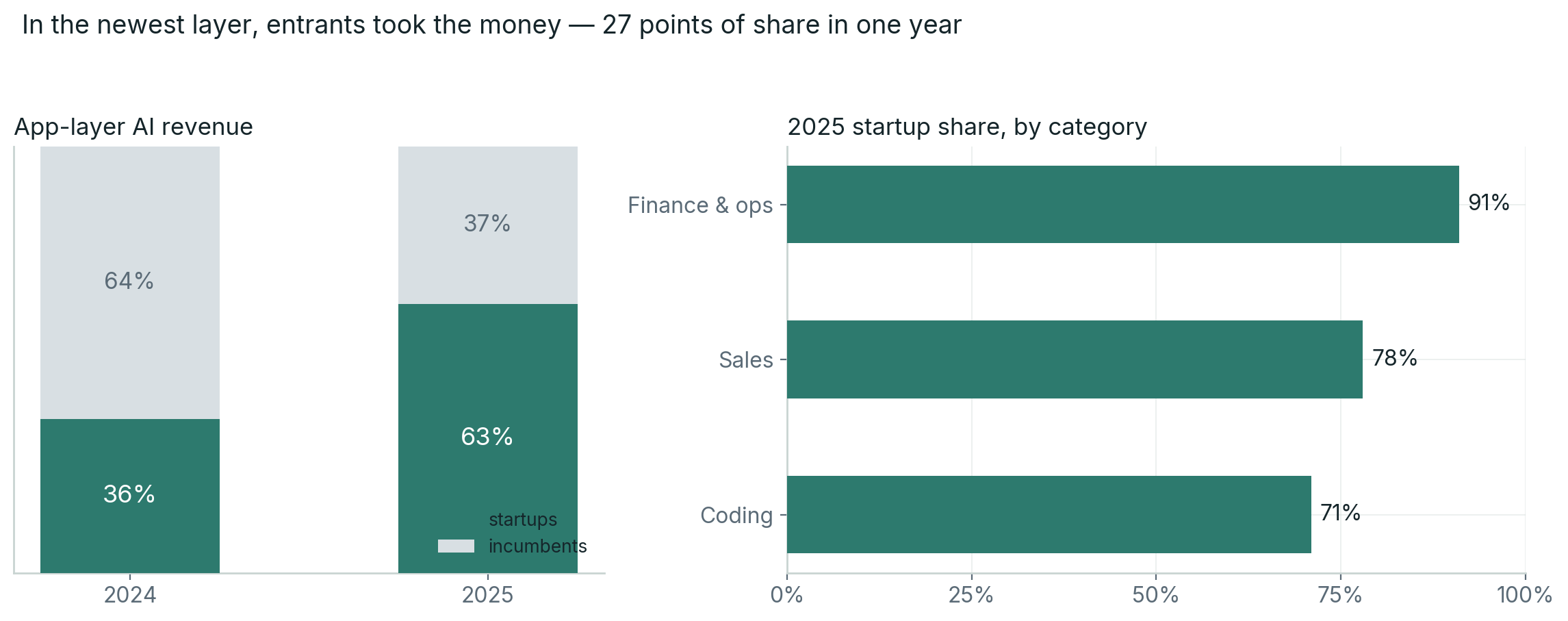
If knowledge moats were holding, the incumbent application vendors would be collecting the rents. They are not. Enterprise spending on generative AI tripled to about $37 billion in 2025. In the application layer, startups captured 63 percent of revenue — up from 36 percent a single year earlier, a 27-point swing. In coding, 71 percent. In sales, 78. In finance and operations, 91.
The obverse is a graveyard, and it has a specific cause of death. A writing-assistant startup that had reached $75 million in annual recurring revenue and a $1.5 billion valuation by reselling a frontier model's outputs saw the base-model vendor ship the same experience as a $20 subscription; its revenue flattened and then fell. In August 2026, a five-year-old automation startup shut down entirely because the large platforms shipped its capability natively.
Startup shutdowns hit a record 966 in the United States in 2024, up 25.6 percent year over year.
And the executive who runs a major platform's startup organization now says it out loud: wrappers have their "check engine light" on, because thin intellectual property wrapped around someone else's model is not differentiation.
Notice what died in each case. Not a bad product. A position — a trench around someone else's capability. The trench was the business model, and the trench is exactly what no longer holds water.
Now let us be systematic, because "there is no moat" is only useful if you can say which moats, by how much, and with what evidence. Eleven classical defenses, examined one by one:
| Moat | The claim | What the evidence says now | Verdict |
|---|---|---|---|
| Proprietary data | "We have the corpus" | Public text is a commons; returns are logarithmic; synthetic data substitutes wherever answers are verifiable | Dead, as usually claimed |
| Process know-how | "They can't do what we do" | Behavior distills for hundreds of dollars; agentic harnesses replicate in weeks | Dead |
| Product features | "We shipped it first" | Copy lag: 2–8 weeks across labs; harness advantages evaporate in a quarter | Dead — a head start, not a wall |
| IP & patents | "Legally excludable" | Even pre-AI: ~60% imitated within 4 years, modest cost effect except pharma; behavior is not patentable | Wounded, domain-dependent |
| Switching costs | "Leaving hurts too much" | The pain of leaving was always human work — retraining, renegotiation, migration — and it is precisely the work agents now do for cents | Dying — the chooser became a machine |
| Brand & preference | "They buy the name" | Agent-mediated procurement selects on measured performance and price; brand survives where trust is the product (money, health, safety) | Bifurcating |
| Network effects | "Everyone is already here" | Real liquidity still defends: even a giant with unlimited AI failed to build a rival social graph. Parallel graphs can still be built — by distribution, not by models | Holding — liquidity is people |
| Scale & cost | "Our fixed cost is a wall" | Intelligence is rented by the token; sunk cost converted to variable cost; scale remains only where atoms are involved | Weakened structurally |
| Regulation & licenses | "Permission to operate" | The parchment is durable; the moat was the cost of getting one — and compliance is information work, exactly what agents absorb. Attackers automate their way to permission instead of out-modeling their way past it | Shallowing |
| Physical assets | "Atoms don't copy" | An algorithmic home-flipping business wrote down ~$881M: the model could not hedge physical inventory. Physical stacks fall only to better physical stacks | Holding — matter does not diffuse |
| Distribution & defaults | "We own the shelf" | No longer ownable, only rentable: one platform pays another >$20B a year for default placement — on court-ordered one-year terms | Rented, not owned |
Table 2 — The moat autopsy. Read down the last column: nothing made of information survives — not knowledge, not paperwork, not process. Only matter and other people even slow the leak, and Section V prices even those.
Two of these verdicts deserve a second look, because they are the newest and least appreciated.
Switching costs were a human artifact. The pain of leaving was never really about data formats; it was about human re-learning, human negotiation fatigue, human fear of regret. As procurement, integration, and operation get delegated to agents, switching becomes a computation rather than an emotional event. An agent does not have a favorite vendor. It has an objective function and a budget. The wall does not get breached; it gets routed around, continuously, by software that checks the alternatives every night.
Brand preference was always two different assets, and the AI era separates them. Affective preference — "I like this name" — dies at the agent margin, because the chooser has no affect. Trust-as-liability — "who is accountable when this goes wrong, and can they pay" — does not die at all, because hallucination and liability make accountability more valuable, not less. A brand that was really a liability wrapper is a moat. A brand that was really a habit is a countdown.
Any essay worth your time must survive its own counter-evidence. There is real counter-evidence here, and it is not minor.
First, the very top has gotten stickier, not looser. Since around 2000, the probability that a top-four firm gets displaced from its rank has roughly halved — from over 20 percent to about 10 percent over four years — a decline attributed largely to incumbents' proprietary software investment. Read beside the falling S&P tenure, this is not a contradiction; it is a bifurcation. The median listed company churns faster than ever. The largest companies entrench.
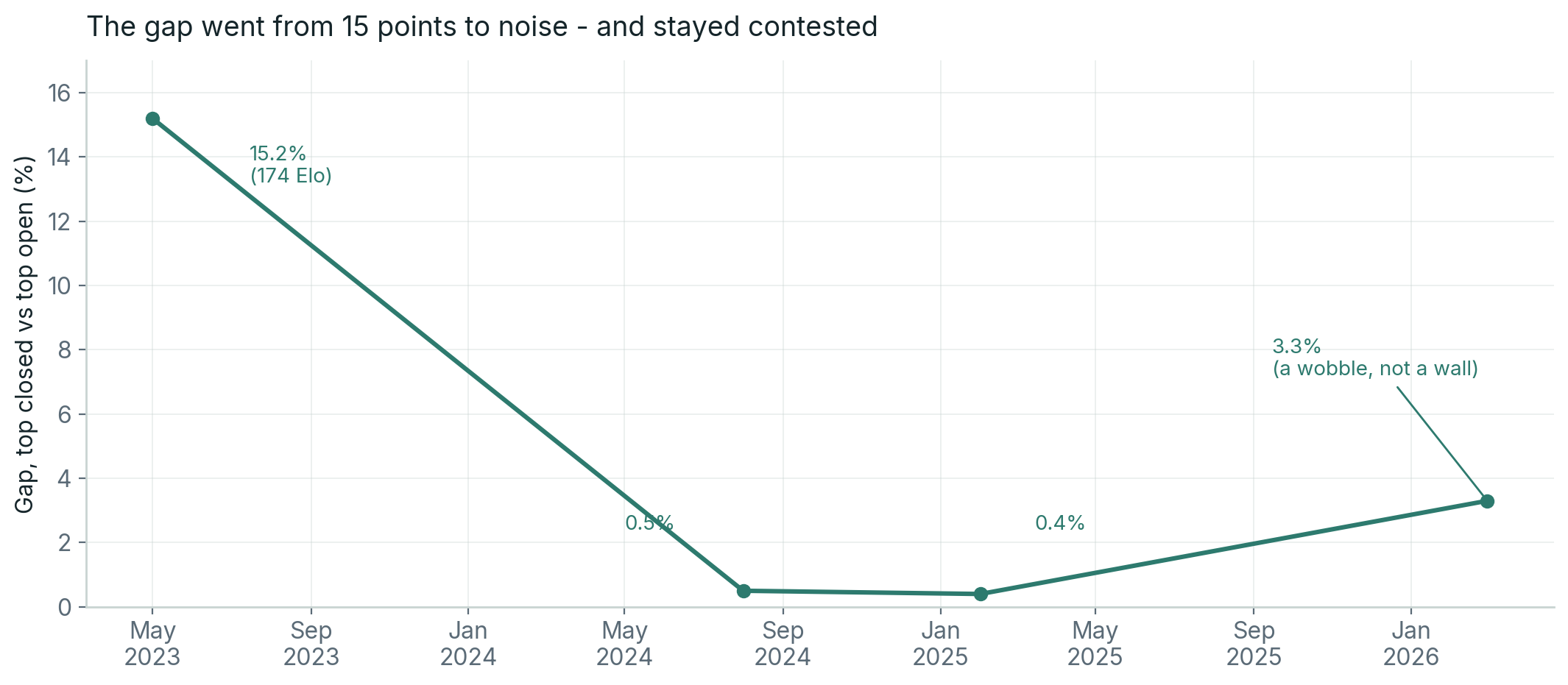
Second, the open-closed gap is not monotonically vanishing. The honest chart is this one: the gap between the best closed and best open model went from 15.2 percent of the leaderboard rating scale to 0.5 percent, and then wobbled back open to 3.3 percent in early 2026. The aggregate capabilities gap drifted from three months to four.
The honest reading is a plateau of a few months with high variance, not a smooth slide to zero.
Third, capability parity did not become wallet parity. In 2025, closed providers captured 96 percent of model-layer revenue at roughly six times the price per call, despite near-parity on many benchmarks. And the residual closed advantages are real and specific: expert professional work (a 92-point lead on a knowledge-work evaluation), very long context (89 versus 41 percent on a million-token retrieval test), and high-intensity retrieval.
Meanwhile the closed frontier's release cadence keeps resetting the gap — which is itself a form of defense: a moving target is harder to copy than a static one.
The objection to all of this is obvious, and it deserves a real answer: licenses and distribution are not knowledge — so how can intelligence commoditize them? The answer was sitting in the literature ninety years before chatbots. Coase showed that firms and markets are alternative ways of organizing the same activity, and the choice turns on transaction costs — the cost of finding the counterparty, negotiating, monitoring, enforcing. Williamson, who spent a career — and a Nobel — developing the idea, described positive transaction costs as the economic counterpart of friction.
Now make the move the strategy canon never made: every moat is a transaction cost wearing armor. IP is the rival's cost of copying. Switching costs are the customer's cost of leaving. A license is the entrant's cost of entering. A brand is the buyer's cost of evaluating alternatives. Distribution is the newcomer's cost of being found. Each one is a friction, priced. Which leaves exactly one question worth asking about any moat: is this friction made of information? Because information-work — searching, filing, integrating, migrating, monitoring, complying — is precisely the category of labor whose price just collapsed.
Knowledge moats die of imitation. Paperwork moats die of automation — the same death, one turn of the dial later. What survives is only what is made of matter, of law enforced against legal persons, or of other people. And even those you no longer own. You rent them, annually, at escalating rates.
Take licenses, the steelman's favorite exhibit, seriously. The parchment was never the moat — the state's processing speed and the compliance army were. And note what a licensing moat is not: it was never about the customer's ability to switch. Customers could always switch banks; there were thousands. It was about the entrant's cost of crossing — and that cost is applications, controls, audits, filings: information work, the exact labor agents absorb. The stablecoin that died to regulators was the old playbook's last clean win; the fintechs that took share from incumbent banks did not out-model them, they automated their way through a licensing process the incumbents assumed nobody would survive. The next shift is already arriving: when agents become the regulated intermediary, the license migrates to a new layer and yesterday's charter becomes plumbing. Regulation is not abolished by AI. It is un-moated — the moat was never the law, it was the friction of complying with the law, and friction is a cost curve, and this cost curve bends the way all the others now bend.
Now look again at the strongest apparent counterexample — default placement — because it has quietly become the thesis's best exhibit. One platform pays another more than $20 billion a year to be the default: more, by its own disclosed figures, than it spends on all other search-related expenses combined. You do not pay rent on something you own. And the remedy ruling went further — the contracts are now limited to one-year terms, so the strongest moat in business must be re-leased every twelve months at renegotiated rates.
A default, mechanically, is a switching decision that was made once and then fossilized. Agents re-make switching decisions continuously, at zero cost, so the fossil gets repriced annually. The same reframe absorbs the incumbents-get-stickier finding from the top of this section: that is not moats hardening. That is moats converting from assets into line items — continuous proprietary-software investment to keep the wall painted, twenty billion a year to keep the drawbridge leased. Not the return of the castle. The castle on a subscription.
The old theory also explains why the attackers' victories were never about out-modeling anyone. Pioneers fail at roughly 47 percent, fast followers at 8 percent, and the followers end up with about 28 percent market share to the pioneers' 10 — entering, on average, thirteen years later. Being first was never the moat. Being first with a complementary asset was. Which brings us to the man who said all of this forty years ago.
In 1986, David Teece published the paper that should replace the moat metaphor entirely. Its finding: "when imitation is easy, markets don't work well, and the profits from innovation may accrue to the owners of certain complementary assets, rather than to the developers of the intellectual property." Read that sentence again in a world where imitation costs $600. Teece told you where the money goes: not to the invention, but to the assets around it that imitation cannot reach — manufacturing, distribution, service networks, brand, regulatory position. The rows of Table 2 that still leak slowest are, almost row for row, Teece's complementary-asset list. The moat did not vanish. It moved to the parts of the business the strategy slides never bothered to diagram.
Now for the replacement model. Return to the bathtub: advantage M fills at your innovation rate i and drains at the imitation rate λM. At steady state, M* = i/λ. This is the entire strategic situation in one line of algebra. λ is now exogenous — set by open weights, distillation, and the release cadence of an industry you do not control. You cannot lower it. Patents do not lower it. Secrecy lowers it for a quarter. The only term left that you control is i.
What, concretely, is i? Not raw invention output — the industry can copy that in weeks. The durable form of i is organizational learning velocity: the speed at which you convert your own proprietary feedback into better decisions than anyone else can make with the same public models. The resource-based view already knew where to look for this. Of the four criteria that make a resource a source of sustained advantage — valuable, rare, imperfectly imitable, non-substitutable — the ones that survive an AI economy are the two that were never about information: causal ambiguity and social complexity. You can download a model. You cannot download a way of working. Routines are organizational genes; organizations, as the evolutionary economists put it, "remember by doing."
The feedback data that powers this is also not the data the old moat discourse meant. Static corpora are a commons. Outcome-linked feedback is not: your labeled actions and their verified consequences — repaid loans, avoided readmissions, retained customers, corrected shipments. Synthetic data collapses without a grounding signal, which is exactly why fresh, verified, real-world interaction data becomes more valuable as everything else gets cheaper.
Three questions, then, to replace "do you have a moat?" in every strategy review:
Schumpeter named the weather system all of this lives inside: "the perennial gale of creative destruction," in which what counts is not price competition but "the competition from the new commodity, the new technology, the new source of supply, the new type of organization... which strikes not at the margins of the profits and the outputs of the existing firms but at their foundations and their very lives." The gale did not start in 2023. It just reached the speed where the moat's water is the first thing to evaporate.
Let us finish the argument with numbers, because "the moat is dying" is a sentiment until you can say when digging one stops paying.
Model an advantage as a flow that starts at A₀ per year and decays at hazard λ, so A(t) = A₀e^(−λt). Building it costs C. The total advantage you can ever extract, undiscounted, is the integral — exactly A₀/λ. Discounted at rate r, its present value is A₀/(r+λ). Two conclusions follow immediately, and neither requires any further assumption:
The moat only pays for itself if 1/λ > C/A₀ — that is, if the total lifetime advantage exceeds the cost of digging. And the moat's NPV multiple is A₀/((r+λ)·C), which collapses as λ rises.
Now calibrate λ from the measured catch-up lags we established in Section III — each half-life is an observed imitation lag, not an invented parameter. Set the build cost at 1.5 advantage-years (a project that costs eighteen months of the full-strength edge it creates, a normal venture-scale build) and r at 10 percent:
| Era (λ set by measured catch-up lag) | Half-life | Lifetime edge (1/λ) | Payback | NPV multiple |
|---|---|---|---|---|
| 1980s industrial imitation (~30-month lag) | 2.5 y | 3.61 advantage-years | 1.9 y | 1.77× |
| 2023–24 scaling era (13-month catch-up) | 1.1 y | 1.56 advantage-years | 5.0 y | 0.90× |
| 2024–25 reasoning era (8.5-month catch-up) | 0.71 y | 1.02 advantage-years | Never | 0.62× |
| Today, aggregate (~4-month gap) | 0.33 y | 0.48 advantage-years | Never | 0.31× |
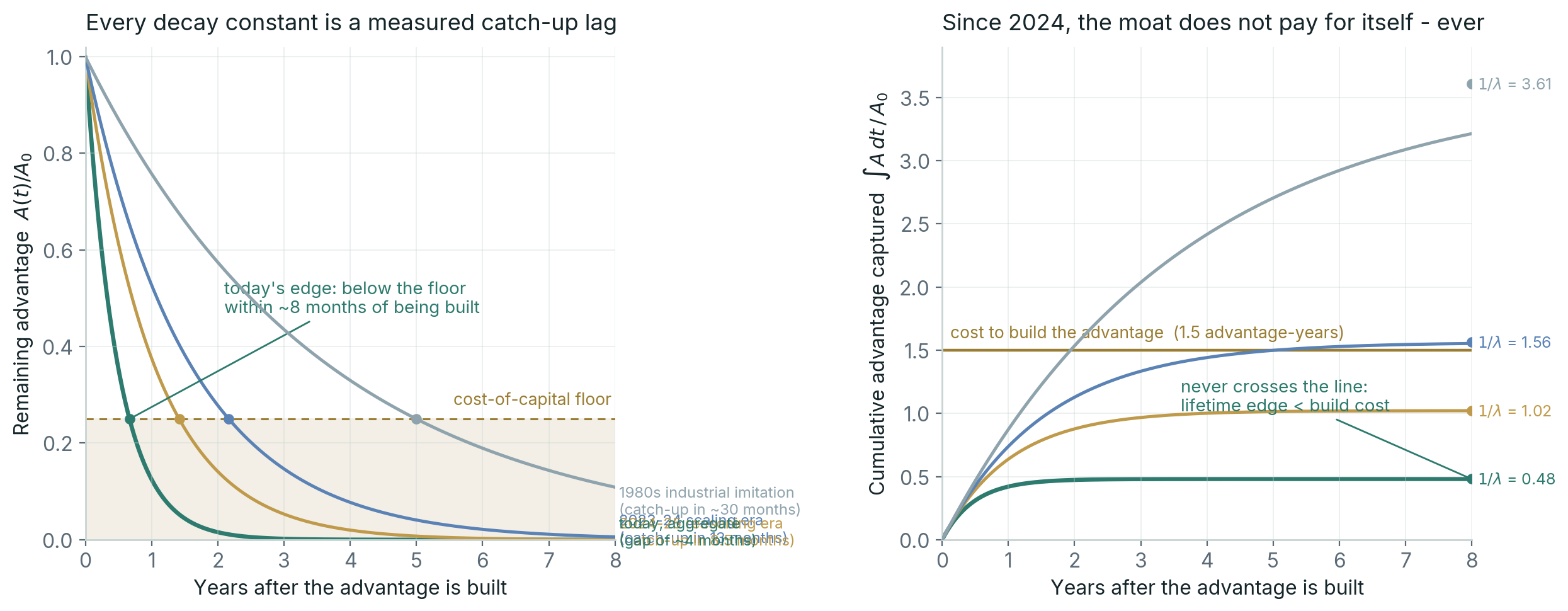
Read the last column again. In the industrial era, a moat was a good investment: it returned 1.77 times its cost. By the scaling era it was already marginal at 0.90. Since the reasoning era, the moat does not pay for itself — ever. The right-hand panel is the part that should end arguments: at today's measured hazard rates, the cumulative advantage curve approaches its asymptote below the cost of building the advantage. You cannot fix this by being patient. The hole you dig costs more than the water you will ever keep in it.
The razor that falls out of this is simple enough to put on one slide. At today's hazard rates (1/λ ≈ 0.48 advantage-years), do not build an advantage unless the build costs less than roughly six months of the full-strength edge it creates. If your build cycle is longer than your advantage's half-life, you are not investing; you are donating the surplus to your imitators. The model is stylized — the calibration is illustrative, the decay is not always exponential — but the razor depends on the ratio, not on the precise constants, and the ratio has moved by an order of magnitude.
For builders, the rule writes itself: rent the commodity, own the rare. Spend nothing defending what is diffusing; spend everything on the loop that produces the next advantage and the complementary assets the loop feeds. For investors, replace the diligence question. Do not ask "how wide is the moat?" Ask "what is the half-life of this advantage, what does the company own that does not decay, and what is i?" For incumbents, count your real assets honestly: defaults, charters, physical feedback loops, liability-backed trust. Everything else on your slide is a feature with a countdown.
One more economic term earns its place here, because it explains why even the survivors cannot relax. Contestable-markets theory holds that the barrier that confers monopoly power is sunk cost, not scale — and that when entry and exit become nearly costless, even a monopolist must price as if competitors were already in the room. AI's deepest structural effect is exactly this conversion: fixed, sunk, defensible cost becomes rented, variable, undefensible cost. Capability by the token. The implication is uncomfortable in both directions — new entrants face no wall, but incumbents' walls, where they were made of sunk investment, stop being walls too.
So, an obituary, with the instruments laid out. The moat assumed a stock you could own, an attacker you could watch, and time on your side. The stock turned out to be information, which diffuses down its gradient at a rate set by the economy's diffusivity — and that diffusivity just rose by orders of magnitude. The attacker turned out to be everyone, including your own customers' agents. And time turned out to favor whoever learns fastest, which was never the defender.
What remains is real, and worth defending with the ferocity once reserved for patents: atoms you control, accountability you can carry, consequences you have measured, people who keep showing up on your side of the market, and an organization that turns those measurements into better decisions faster than the field. None of these are information. All of them are structure — and even structure now comes on annual terms. The water in the moat was never the point; it was always the ditch's location. Most companies dug in the wrong place.
A companion essay on this blog argued that AI commoditizes the deliverable — that when cognition becomes cheap, what you produce stops being scarce. This essay adds the second half: the position stops being scarce too. The two together leave a shorter scarcity list than either alone. What remains is the rate at which you can learn, the structure through which you can act, and the judgment about which of the infinite things you could now build is worth building at all. The last of these is not a moat. It is the point of having one.
There is no moat. There is only the river — and the river is everyone's. The strategists who inherit the next decade will not be remembered for the depth of their trenches. They will be remembered for how fast they learned to swim in water they did not own.
Stop digging. Start swimming.

Thoughts and essays, published with Yokush. See more posts
 Siddharth20 min
 Siddharth12 min
 Siddharth
Comments 0