 Siddharth
Own the Harness, Rent the Model: The Quantified Case for AI's Great Rebalancing

Siddharth
August 6, 202610 min read

Open-weight models now sit within about three percentage points of the closed frontier, and roughly 80% of real AI workloads can be served by hardware you own. Quantization at 4 bits costs you about 1.5% of quality while cutting memory requirements four-fold — and routing 80% of traffic to local models saves about two-thirds of your inference bill. The API-only era is ending, not with a bang, but with a router.
Sometime in the last eighteen months, a quiet thing happened: running a serious AI model stopped being a research project. It became a purchase. You can now buy a box the size of a hardback novel, type one command, and have a model that would have been state of the art in early 2024 answering you from your desk — no account, no meter running, no data leaving the building. The community that made this possible didn't just shrink the models. It industrialized the entire stack around them: the compression math, the runtimes, the hardware, and the economics.
This post is the quantified version of that story. Not the hype version — the numbers, including the ones that cut against the thesis. Because the honest picture is more interesting than either camp admits: open weights have nearly closed the capability gap, the economics of self-hosting now win in a large and growing band of workloads, and yet the frontier API isn't dying. It's being demoted — from the whole product to one tier of a larger architecture that you own.
In late 2023, the best open-weight model trailed the best closed model by roughly 17.5 percentage points on standard benchmarks. By August 2024 the gap briefly touched half a point. It reopened slightly as the closed labs pushed again, and as of this summer it sits around three points — with the time lag between a frontier release and an open-weight equivalent down to roughly three months, from about twelve months in late 2024.
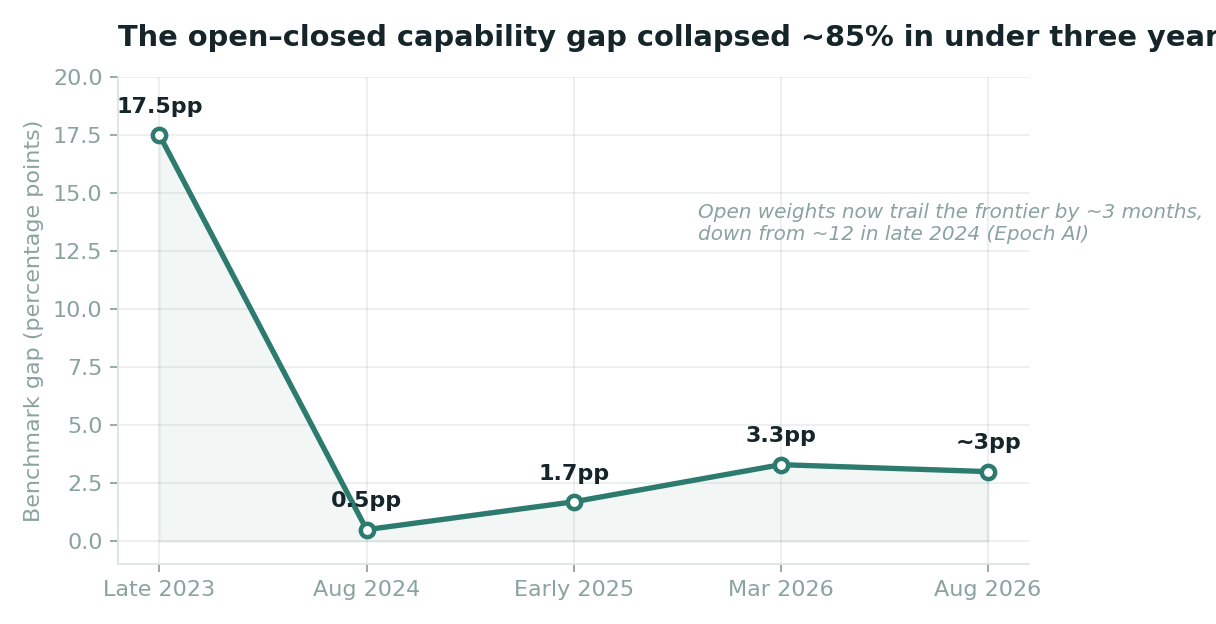
But the average hides the structure, and the structure is what matters for architecture decisions. On knowledge and graduate-level reasoning benchmarks, the gap is under two points — effectively closed. On agentic tool-use, the best open-weight model actually leads the best published closed score on at least one major web-research benchmark. On general human preference, the difference is about 1.7%. The gap that remains is concentrated in exactly two places: the hardest long-horizon software engineering tasks (roughly 15 points on the strictest coding benchmark) and frontier-level abstract reasoning (about 9 points).
Read that as an architect, not a fan. The question is no longer "is open good enough?" It's "which of my task classes need the last 9–15 points, and what do they cost?"
The single most important practical fact in local AI is a compression fact. A model's weights, natively stored at 16 bits each, can be squeezed to about 4 bits each — a four-fold reduction in memory — for a quality cost of roughly 1.5–2%. That trade is so good it has become the default: the 4-bit quantized variant is what nearly everyone actually runs.
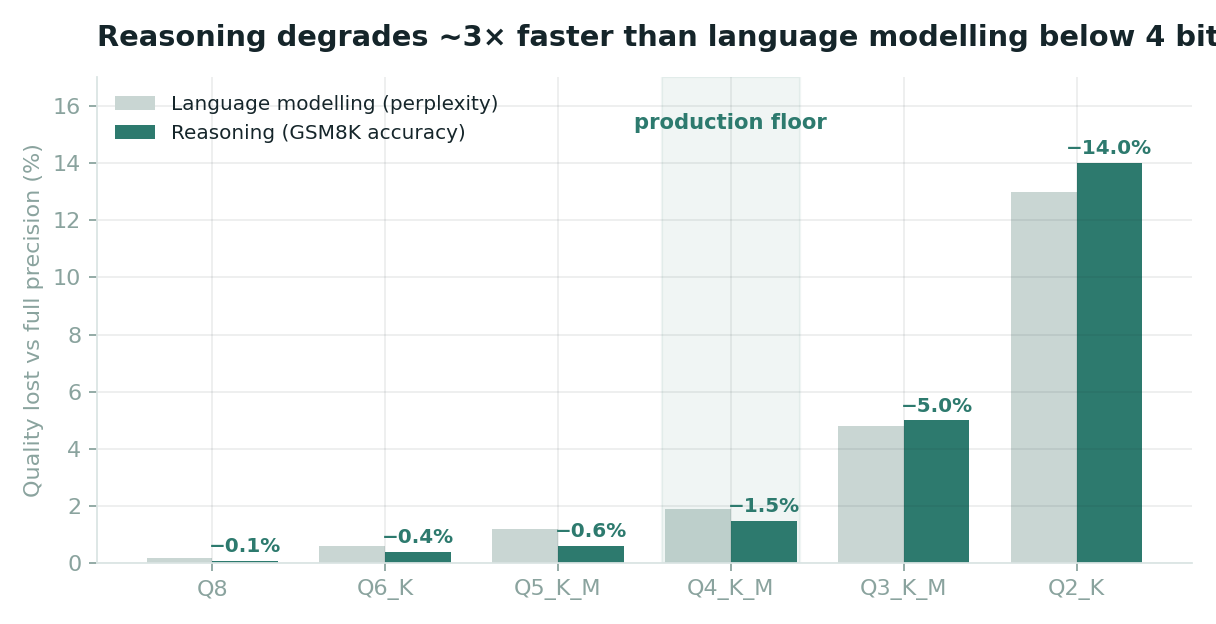
Two nuances separate people who've run these workloads from people who've read about them. First, reasoning degrades about three times faster than raw language modelling as you go below 4 bits — at 3 bits you lose ~5% on math benchmarks, at 2 bits ~14%, and naive 2-bit compression effectively destroys the model. Four bits is the production floor, and the folklore that "2-bit is fine" is only true if you never ask the model to think. Second, the credible path below 2 bits isn't compression at all — it's training models natively at 1–1.58 bits from scratch, a technique that matured from research curiosity to commercially viable releases this year, with an 8-billion-parameter model fitting in barely over a gigabyte and running on a phone.
The arithmetic that follows is the part executives should tattoo somewhere: about 0.6 GB of memory per billion parameters at 4 bits. A 70-billion-parameter model — the size class that handles the large majority of business workloads — needs about 40 GB. Two years ago that was a server rack. Today it's a single workstation GPU, a high-end desktop with unified memory, or two secondhand cards totaling about $1,700.
Productization is what happens when a technology stops requiring its own priesthood. Three signals that local AI crossed that line:
The "self-hosting is for chatbots" objection expired this year. Open-weight models are production-viable across every major modality, with parity levels that would have been unthinkable in 2024:
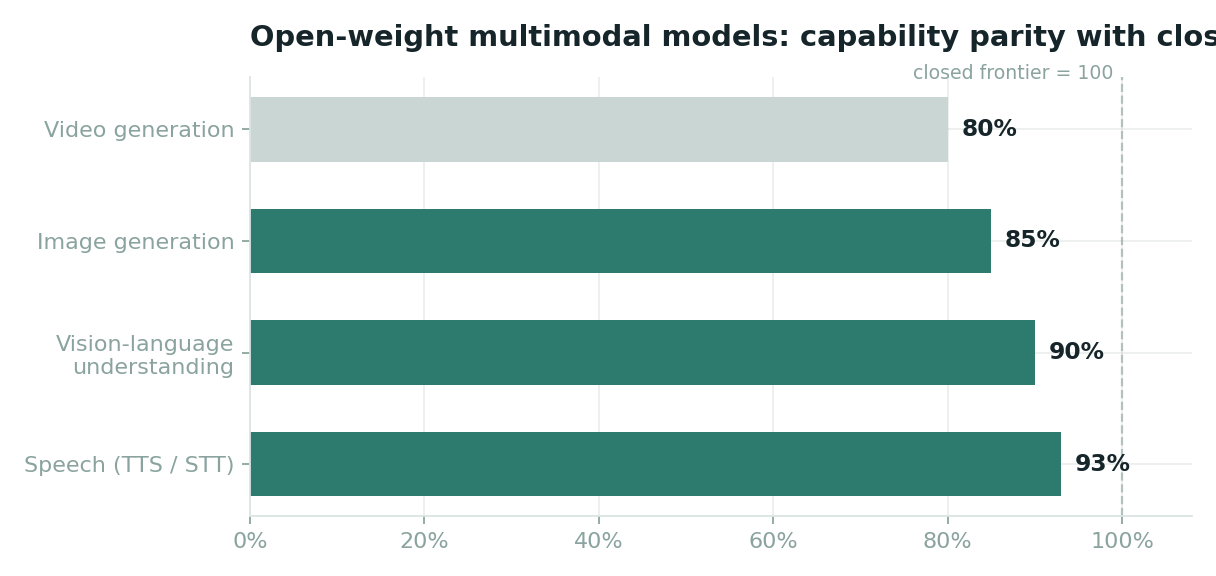
Speech is at ~93% parity — transcription accuracy now matches commercial APIs outright, and the leading open voice model sits within 81 Elo points of the best commercial one, a gap that has shrunk 64% in three years. Vision-language models are at ~90% — a 32-billion-parameter open model now outscores one of the best-known closed flagship models on the standard multimodal understanding benchmark, and runs on a $300 GPU. Image generation is at ~85%, close enough that for product photography and branded content the difference rarely survives a production workflow. Video is the laggard at ~80% — genuinely usable for controlled shots and high-volume work, still behind for cinematic physics and long-form coherence.
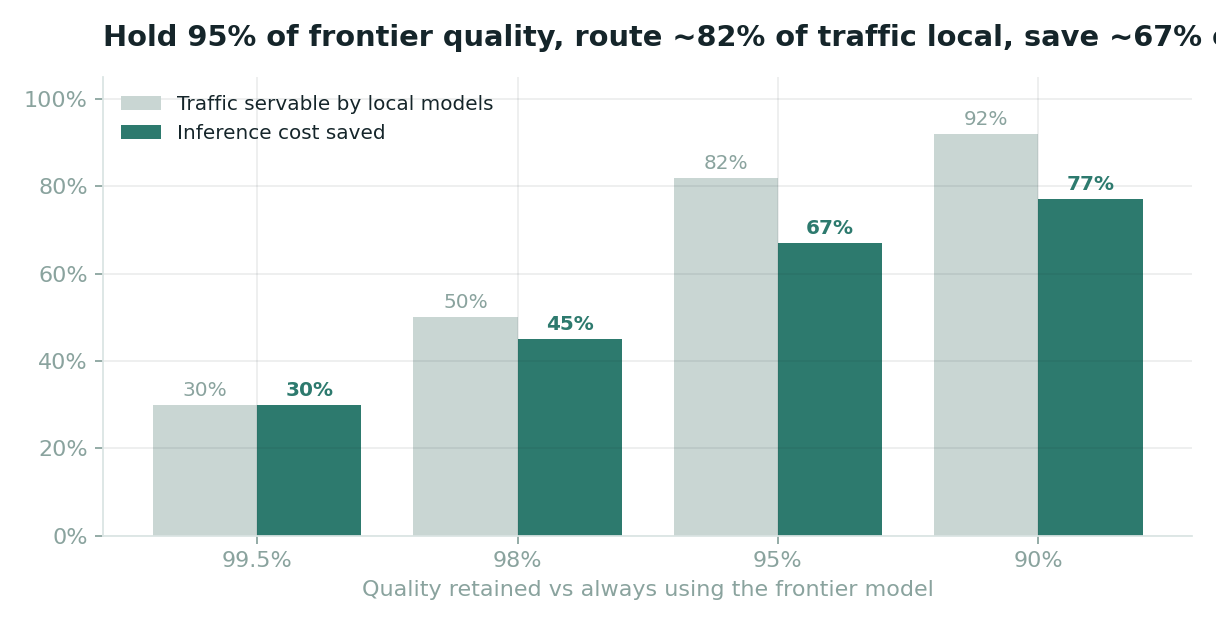
Here is where the architectural argument becomes a financial one. The naive comparison — "self-hosted model vs frontier API" — misses the point, because nobody sensible runs either extreme. The published results on intelligent routing are the real story: send each query to the cheapest model that can handle it, and you can route 80–85% of traffic to cheap local models while retaining 95% of frontier quality — cutting inference cost by 65–70%. Cascade architectures that try the cheap model first and escalate on failure report savings up to 98%.
The enterprise evidence has moved from anecdote to pattern. Two-thirds of enterprises now run at least one open-weight model in production — up from under a quarter a year ago. Four in five use three or more model families, matching models to tasks rather than pledging to one vendor. One major AI gateway reports open-weight models handling 29% of its token volume but under 4% of its spend — volume is migrating off the frontier faster than revenue is, which is precisely what "demotion" looks like in data. A global payments company cut inference costs 73% after moving to open serving infrastructure; a large customer-support software company reports saving about $250,000 a month after replacing a frontier API with a fine-tuned 14-billion-parameter open model for one pipeline.
Self-hosting's own math has turned favorable in a wide band. At saturated utilization, a 70B-class model on owned hardware lands around $1–2 per million tokens, and a small mixture-of-experts model on a single datacenter card around $0.16 — against $5–25 per million for frontier APIs. The crossover sits near 20–100 million tokens a month depending on how steady your traffic is.
First, the frontier is getting cheaper too. API prices have deflated roughly ten-fold per year for equivalent capability — the frontier price index sits 88% below its March 2023 level. Below ~20 million tokens a month, APIs still win on pure cost, and a self-hosted box running at 20% utilization costs five times its sticker figure per token. Self-hosting at low volume is a sovereignty and latency decision, not a savings decision.
Second, agents eat tokens. Agentic workloads multiply token consumption five to thirty-fold per task — which pushes the economics back toward owning your inference, because the router's 80/20 split applies to a much larger absolute bill. These two forces — deflating API prices and exploding agentic volume — are pulling in opposite directions, and where they net out for your workload is the capacity-planning question of the next two years.
Put the numbers together and they describe a specific shape — one that the market is converging on whether vendors like it or not:
Notice what's not in the diagram: a vendor relationship that matters. Both model tiers are rented commodities — one rented by the token from an API, the other rented by the watt from your power company. The durable asset is the layer in the middle that you build and own: the router that knows which tier each task deserves, the memory that carries your context across sessions, the verification that checks cheap models' work before it ships. Empirically, that layer is a larger performance variable than the model itself — the same model can jump double-digit points on hard benchmarks when only its harness changes.
The providers can read this diagram as well as you can. That's why the last year brought the once-unthinkable: frontier labs releasing their own open weights, cutting flagship prices in half, and signing on-premise distribution deals — while posting deeply negative operating margins on the API business. They are not defending the API moat. They are retreating to the top tier of the pyramid and hoping the harness layer stays friendly.
If you're an individual: the barrier is gone. A used GPU and an evening gets you a private assistant that handles most of what you ask cloud models today, and the quantization floor chart above tells you exactly which knob not to turn below 4 bits.
If you run a team or a budget: measure your task mix before you buy anything. Below ~20M tokens a month, stay on APIs and put the savings conversation on ice. In the 20–100M band, the router is the highest-ROI component you can build — it captures most of the savings with none of the capex. Above 100M steady, owned hardware pays back in 18–24 months, and in regulated industries the compliance case (data residency, audit rights, the new EU rules) often closes the argument before cost even enters the room.
And if you're deciding where to place your long-term bets, the last three years offer one clear lesson. The model layer has commoditized at breathtaking speed — seventeen points of gap to three, $60 a million tokens to pocket change. The harness layer has not commoditized at all. Intelligence, it turns out, was the easy thing to rent. The nervous system that wields it is the thing worth owning.
Own the harness. Rent the model. The market just finished proving the thesis.

Thoughts and essays, published with Yokush. See more posts
 Siddharth20 min1
 Siddharth14 min
Comments 0