 Siddharth
Bloom or Doom: The $124 Trillion Repricing of Trusted Advice

Siddharth
August 26, 202618 min read

I built a 10,000-path simulation of a representative $500M advisory firm and ran it to 2035 under three AI strategies. Same firm, same markets — and a 12.5× gap in what it's worth at the end. This is my own framework, my own model, and the argument I'd make to any board: the thing that decides your future is not the technology. It's the price of your trust.
Start with one perfectly ordinary registered investment adviser: $500 million under management, a blended fee of 80 basis points, six advisors, 350 households, a 27% operating margin. Now run its economics forward through 2035 under three different responses to artificial intelligence. Not three levels of tool-buying — three different theories of the business.
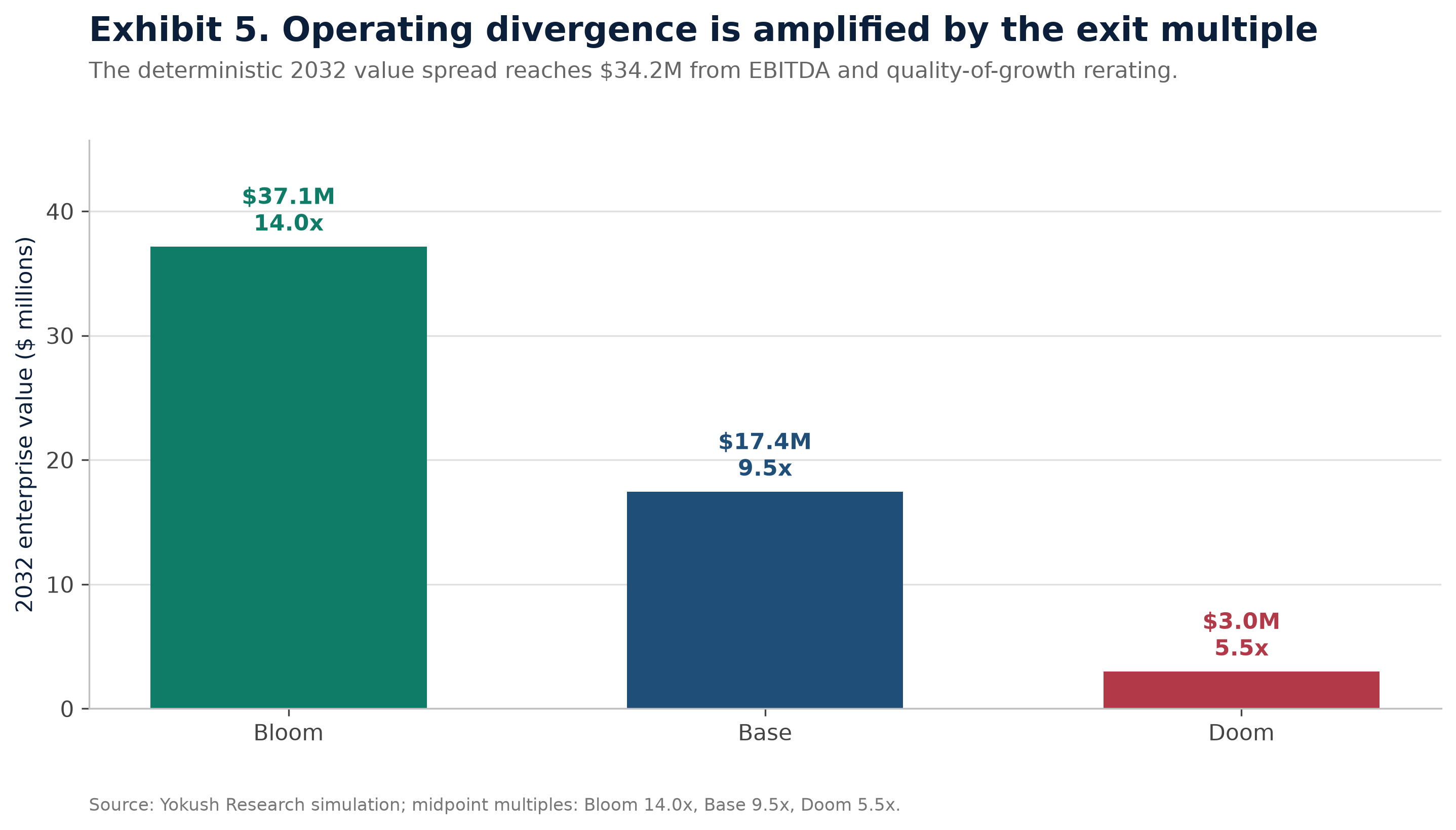
The same firm ends 2032 worth $37 million, $17 million, or $3 million.
That spread is the entire argument of this piece. AI will not kill the advice business. It will reprice it — violently, unevenly, and mostly within the next six years. And the variable that decides which side of the repricing you land on is not the one the industry conference circuit is obsessing over.
Before the economics, we have to be precise about the technology — because the strategy depends on it, and the industry keeps getting it wrong by calling it "productivity." A faster notetaker is a productivity tool. What has actually crossed the threshold is a set of cognitive capabilities, and each one changes what the advice service is, not just how fast it is delivered.
The binding constraint on human advice was never intelligence. It was context. An advisor can hold a dozen households in active working memory; the rest live in the CRM and in their head, and go stale between meetings. A machine holds the entire household graph — every account, document, policy, conversation, and open commitment — simultaneously, and reasons across it. That single shift rewrites the unit of the business.
Seven capabilities, and what each one changes:
These are not a feature list. They are the reason the bundle breaks (below) and the reason the cost curve breaks (the simulation). The reframe that matters: the machine doesn't make the advisor faster. It makes the advisor's context, memory, and execution effectively unlimited — so the advisor's job changes from doing the analysis to owning the judgment.
Most commentary treats AI, fee compression, advisor retirements, and consolidation as four separate trend lines. They are one system, and the interactions — not the trends — carry the strategic consequences.
C capacity meets a shrinking supply of trust. Advisors spend roughly 70% of their working time on things the client never sees: preparation, documentation, paperwork, follow-up, compliance file work. Early AI deployments — meeting capture, drafting, plan assembly — are already returning something like ten hours a week per advisor, and national advisor surveys put AI usage above 80% in 2026. Do the arithmetic on a six-advisor shop: 6 × 10 hours × 47 weeks ≈ 2,820 reclaimed hours a year — 1.6 full-time equivalents created before hiring a soul. Now set that against the supply side: advisor headcount is flat-to-shrinking, roughly 40% of advisors are within a decade of retirement, and consensus projections put the shortfall near 100,000 advisors by 2034. Capacity arriving exactly when trust becomes scarce is not a productivity story. It is a repricing event.
Compression attacks from the top of the book, where the assets live. Public fee benchmarking shows the median fee has been flat for a decade — about 100 bps on the first million — while the fee on large relationships erodes fast: advisors overwhelmingly expect to charge under 1% above $5 million, with average fees on $10M-plus relationships heading toward the mid-60s bps. Beneath everything sits a robo channel past $1.2 trillion charging zero to 65 bps, and direct indexing — the cheapest tax-efficient delivery of beta — on track to roughly double toward $1.1 trillion by 2028. The floor is rising toward the second story.
The largest inheritance in history arrives at the exact same moment. Industry projections put the great wealth transfer at roughly $124 trillion through 2048, the majority flowing to heirs who are digital natives, fee-literate, and owe no incumbent their business. Every firm's book of aging relationships is, in transfer terms, a leaking bucket. The question is whether you are the firm the heirs stay with — and that is a service-model question, not a portfolio question.
Capital is already underwriting the endgame. 2025 set records for advisory M&A — hundreds of transactions, hundreds of billions in acquired assets, the overwhelming majority of deals backed by private capital whose purchase math explicitly assumes AI-driven cost synergies. The buyers are building firms designed for a different cost structure than yours. That is the clock you hear ticking.
Interactions, stated plainly: capacity without shortage would mean layoffs; shortage without capacity would mean pricing power for everyone. Arriving together, with compression and the transfer, they mean pricing power for the few who can prove human value at a machine cost structure — and margin collapse for those who cannot.
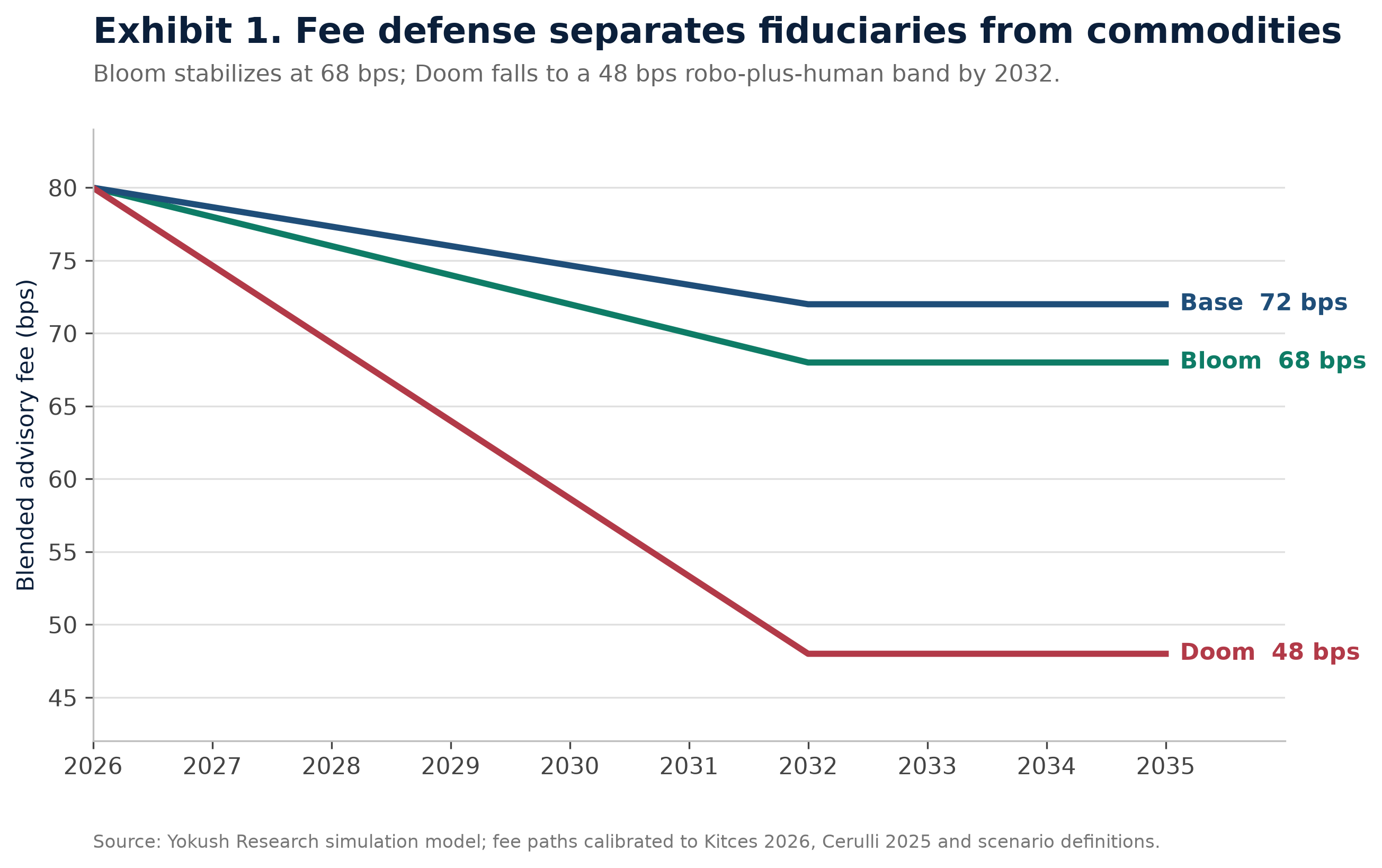
Before the scenarios, the economics. The traditional AUM fee is not a price for one thing. It is a bundle of at least four: portfolio management, financial planning, access and coordination (tax, estate, insurance, lending), and behavioral coaching. Bundles survive as long as it's hard for competitors to attack the components separately. AI breaks that protection from two directions at once.
First, it standardizes the components that were never really differentiated: portfolio construction, rebalancing, reporting, plan generation. When a machine assembles a defensible plan in minutes, the plan stops being evidence of a bespoke process and becomes evidence of a software subscription. Second, it makes pricing legible. Fee-transparency tools and AI concierges let any client decompose what they pay against what they receive. A bundle survives opacity. It does not survive arithmetic.
So which components still command a premium? The best-known research on advice value — now more than a decade of evidence — quantifies good advice at roughly 3% a year of net returns for suitable clients, and finds most of that value in behavioral coaching and asset location, not security selection. Clients, for their part, are explicit: in national surveys, roughly three-quarters want AI to support their financial decisions rather than replace the human, and fewer than two in five affluent investors say they're comfortable with AI-delivered advice. Read those two facts together and you have the whole strategy: automate everything below the conversation, and price the conversation like it's scarce — because it is.
I built an annual model of the representative firm: AUM roll-forward (market return mean 7%, volatility 15%), fee trajectory, an operating cost stack split across compensation, technology, compliance, and overhead, capacity endogenized through households-per-advisor, and enterprise value as exit multiple × EBITDA. Calibration comes from public fee benchmarking, advisor surveys, M&A deal tape, and regulatory records (2024–26); the scenario logic is my own. Three futures:
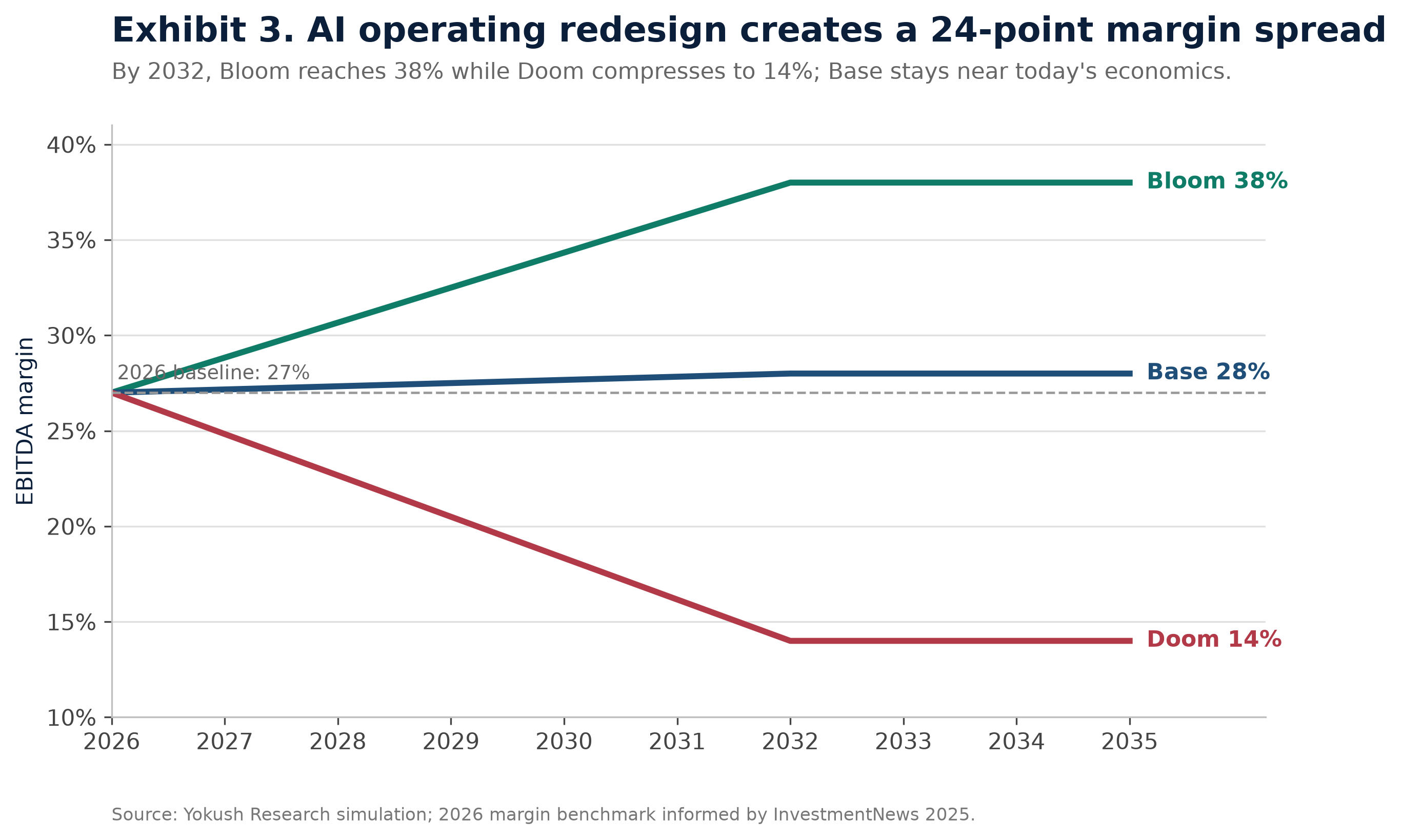
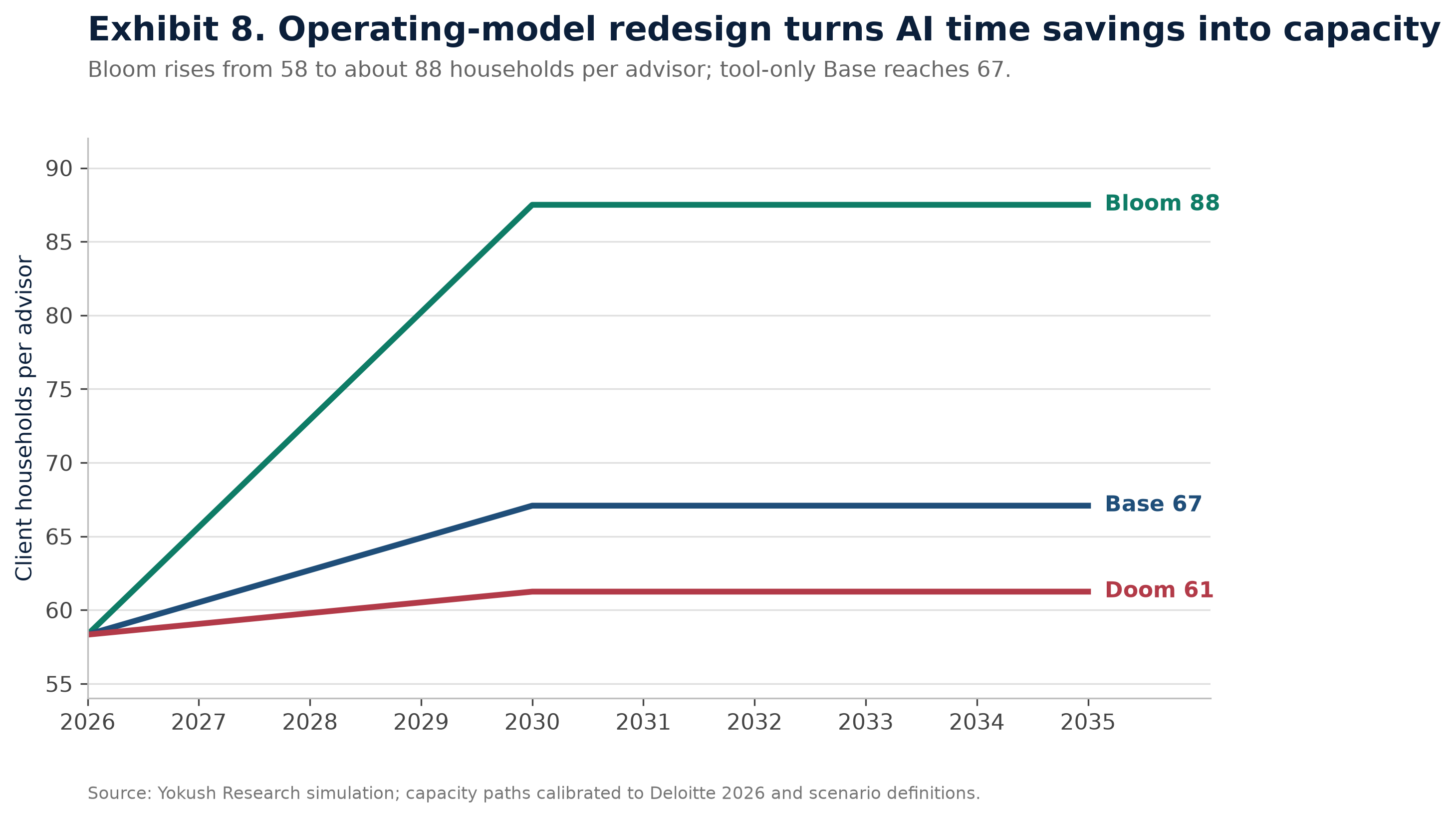
Bloom — the AI-augmented fiduciary. The firm redesigns its operating model around machine output. Capacity per advisor up ~35% by 2030; cost-to-serve per household down 30%; every reclaimed hour redeployed into growth and service depth. Organic growth rises from the industry's median ~2% to 7%; the blended fee gives ground deliberately to 68 bps and then holds, defended by unbundled pricing. Margin expands 27% → 38%. Exit at 13–15× EBITDA, because that is what the deal tape pays for durable growth.
Base — hybrid drift. Tools adopted, operating model untouched. Capacity +15%, organic growth to 4%, fee drifts to 72 bps, savings partly eaten by compensation inflation. Margin 28%. Exit at 9–10× — today's market.
Doom — commoditized advice. The firm competes on price against machines. Fee collapses to 48 bps trying to match the robo-plus-human band; growth stalls at 1% as heirs exit at the transfer margin; productivity gains are captured by clients and platforms, not the firm. Margin halves to 14%. The exit multiple de-rates to 5–6×.
| Metric | Bloom | Base | Doom |
|---|---|---|---|
| AUM | $1.03B | $0.91B | $0.80B |
| Blended fee | 68 bps | 72 bps | 48 bps |
| EBITDA | $2.65M | $1.83M | $0.54M |
| EBITDA margin | 38% | 28% | 14% |
| EBITDA CAGR 2026–32 | +16.2% | +9.2% | −10.9% |
| Enterprise value (P10–P90) | $37.1M (22–54) | $17.4M (10–26) | $3.0M (2–5) |
Source: author's simulation — 10,000 Monte Carlo paths per scenario with stochastic market returns, organic growth, fee drift, and exit multiples.
Two rows deserve a slow read. First, doom is not a client-loss story: the doom firm still grows assets 61% by 2032. It grows without economics — it ends the period managing $805 million and books less revenue than it earned in 2026 on $500 million. Second, the 12.5× bloom-doom value gap decomposes cleanly: 4.9× from operations, 2.6× from multiple re-rating. Buyers pay for what the operating model proves.
Here is where my model disagrees with the industry conversation. Stress the base case one variable at a time and the pecking order of value drivers is unambiguous — and productivity is nowhere near the top.
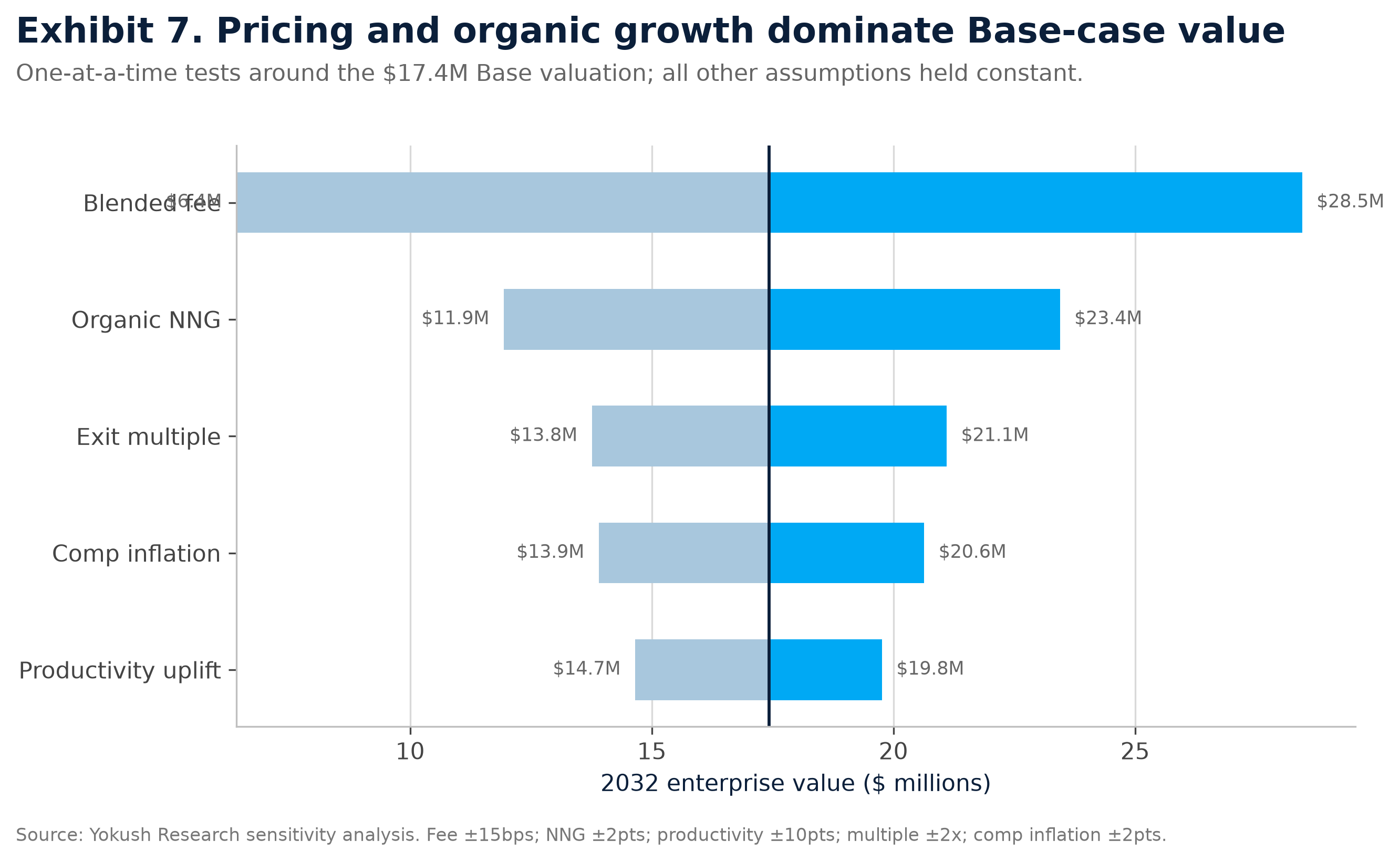
A ±15 basis-point difference in fee trajectory moves firm value by $22 million — nearly double the organic-growth lever and roughly four times the direct effect of productivity. The arithmetic is structural, not clever: a basis point prices the entire asset base, every year, at close to 100% flow-through, while growth only earns its revenue on incremental dollars. As a working rule: one basis point on $1 billion is $100K a year of revenue, capitalized at 10× — a million dollars of enterprise value per basis point per billion.
And productivity? Harvested as margin, it is a temporary blip that competition gives away. The reason is basic surplus economics: in any segment where customers can't tell providers apart, productivity gains are competed into the price — the surplus flows to clients, not firms. You only keep the surplus where differentiation survives. Which leads to the finding I'd underline for every board:
The Monte Carlo distribution sharpens it. Bloom's 10th-percentile outcome ($22.4M) sits above base's median ($16.5M); base's 10th percentile ($10.4M) sits above doom's 90th ($4.5M).
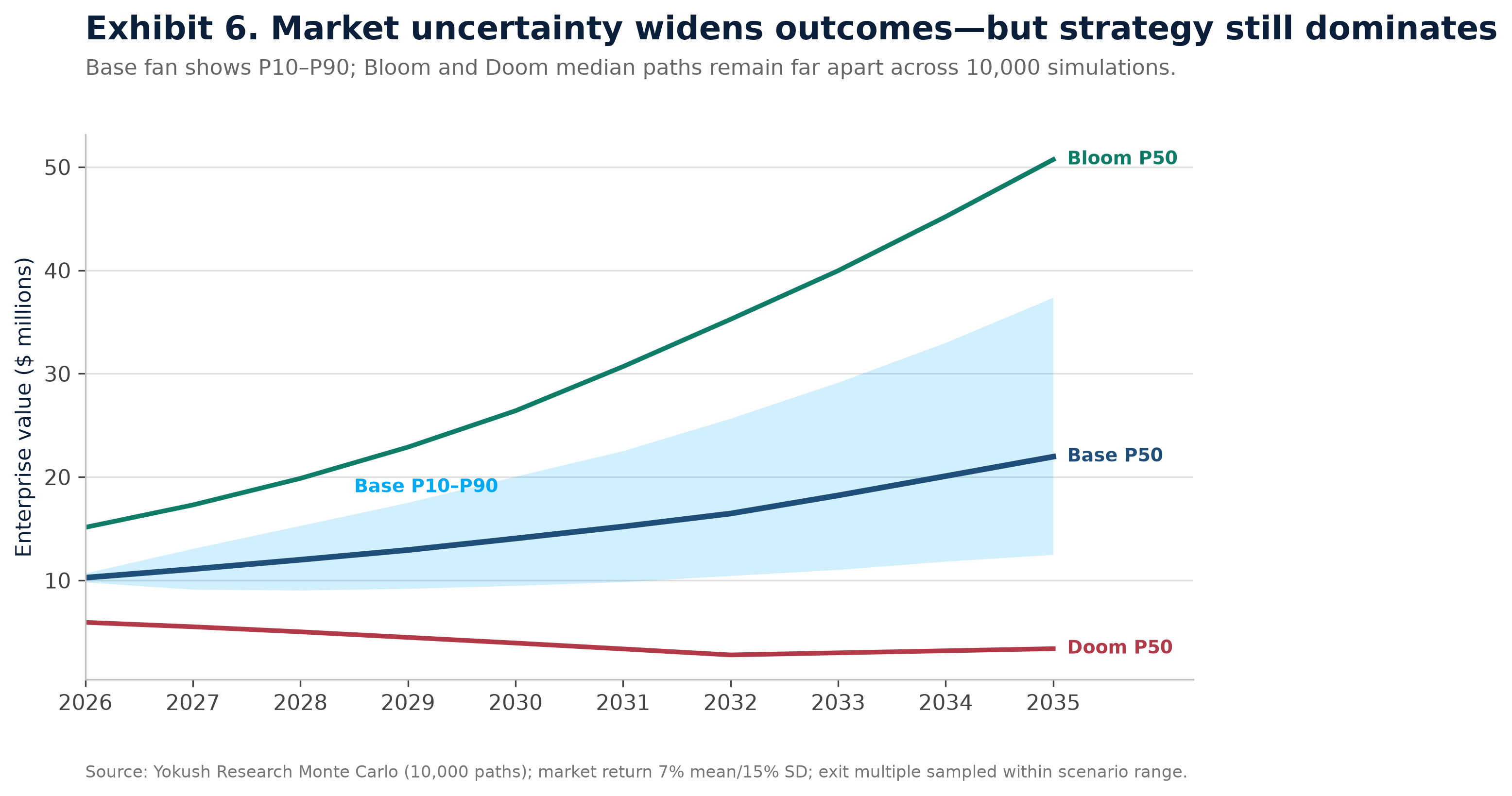
In plain terms: a firm that does the operating-model work is paid for the work, not the market cycle. A firm that waits to see what AI becomes has already picked its scenario.
Here's a mechanism most miss, and it explains why doom arrives late and suddenly. Take the representative firm's cost structure: $2.92M of operating cost against $500M of assets. That is a static cost floor of 58.4 basis points. Any blended fee below that is structurally unprofitable on today's book — and the doom endpoint of 48 bps is well below it. Yet the doom firm's margin in 2032 is +14%, not negative. Why? Because markets keep lifting AUM ~7% a year, and fee × assets keeps clearing the cost floor on volume.
That is the trap. Rising markets mask a fee structure that is underwater on a per-dollar basis — the P&L looks fine for years while the franchise is slowly repriced beneath its own cost floor. Then a flat or down market arrives, the masking stops, and the firm discovers it has been running a loss-leader at scale with a cost structure built for 80 bps. This is why doom never feels like doom from the inside. It feels like a reasonable discount strategy in a good market.
Strip the jargon and the strategy is a two-sentence operating thesis. Run the factory at machine cost: notes, plans, portfolios, paperwork, surveillance — rent the rails, don't build them. Spend every reclaimed hour on the two things clients pay a premium for and machines can't manufacture: acquiring the next relationship and deepening the ones you hold. Everything else — the tools, the vendors, the pilots — is implementation detail.
There is a distinction the industry blurs, and it is the whole ballgame: AI-augmented versus AI-native. An augmented firm has humans doing the work with AI assisting — remove the AI and the service still runs, just slower and costlier. That is where most firms are today, and it only bends the cost curve slightly. A native firm designs the operating model around machine cognition as the default engine, with humans positioned exactly where machines can't go — judgment, trust, accountability, the hard conversations. Remove the AI and the service doesn't exist, because the economics don't. The bloom scenario is native; base is augmented; doom is a firm that bought AI and never redesigned anything. The test is one question: if you removed the AI, does the service survive? Slower — augmented. Gone — native. In a native firm, the design question for every process inverts: not "can AI help with this?" but "if the machine did this by default, what does the human's role become?"
The bloom math only closes because the capacity dividend is spent, not banked. In the model, bloom advisors carry 87 households against the baseline 58 — a 50% capacity gain — at greater service depth, not less, and that is where the 7% organic growth physically comes from.
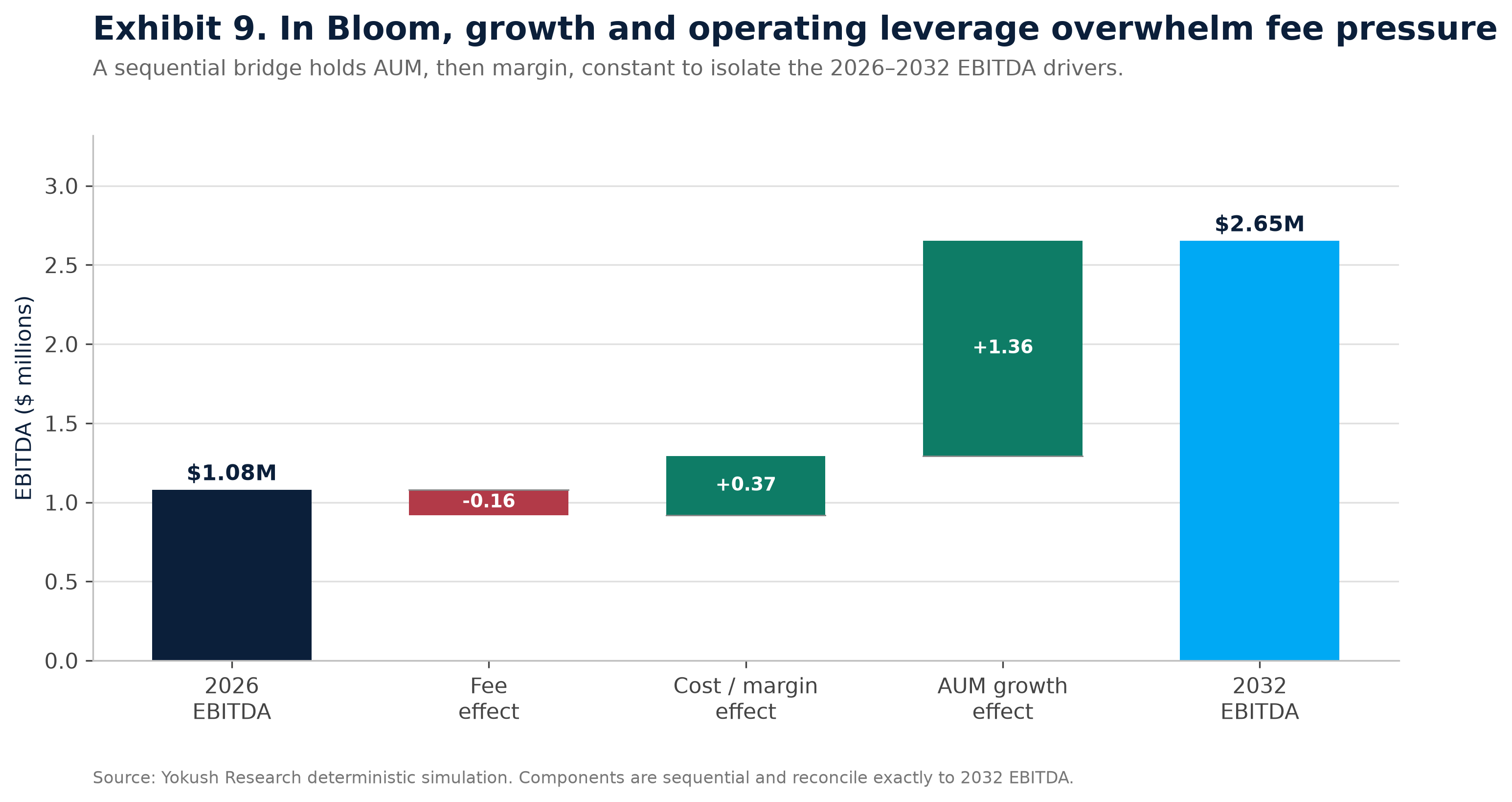
And where does the EBITDA actually come from? Decompose the bloom bridge from 2026 to 2032 and the largest single contributor is not cost-cutting — it is growth funded by redeployed capacity, with the deliberate fee give-back as the price paid to buy that growth:
Every element of doom is a decision that feels defensible in isolation. Discounting to match an app on a $12 million account. Buying AI notetakers and calling it a transformation. Letting the CRM stay messy because production matters more. Postponing succession because the practice is "just hitting its stride." Nobody chooses doom; they amortize it, one reasonable quarter at a time.
The last decade of advice technology is a controlled experiment in what happens when machine-first bets attack the bundle from outside: a zero-fee robo at one of the largest custodians paid $187 million to settle regulators' charges that its cash allocation was undisclosed; bank-built mass-affluent ventures quietly retreated; a robo mega-merger collapsed in diligence; standalone digital-advice growth stalled far below plan. The lesson was never that machines lose. It is that distribution plus trust beats product alone — and the machines that matter are being operated inside firms that already own the relationship.
| Strategic choice | Bloom firm | Doom firm |
|---|---|---|
| Capacity dividend | Reinvested — 58→87 households per advisor, growth team funded | Harvested as margin, then competed away in fees |
| Pricing | Unbundled deliberately; ~68 bps defended by visible value | Reactive discounts; drift below the 58 bps cost floor |
| Value proposition | Judgment, tax alpha, behavioral coaching, generational trust | Portfolio management — the thing machines do cheapest |
| Data estate | Clean, owned, AI-ready — the one input rivals cannot buy | Fragmented across custodians and inboxes; AI runs on noise |
| M&A role | Buyer or premium seller at 13–15× | Late seller into a thinning market at 5–6× |
The window is 2026–2029 because that is when fee trajectory, capacity design, and data readiness are still choices — before the succession wave thins the buyer market and before transparency tools make every basis point public. Seven moves, in order of leverage:
A thesis you can't falsify is a belief, not a strategy. Three things would break my model, and they're the same things I'm watching for. One: client fee-sensitivity stays asleep. If transparency tools arrive and households simply don't re-shop — if inertia proves stronger than arithmetic — the doom fee path flattens and base becomes the floor. Two: the capacity dividend fails to convert. If firms genuinely cannot sell reclaimed hours into growth — if 2,820 freed hours a year just become shorter workweeks — then bloom's 7% organic growth is fantasy and every scenario converges toward base. Three: regulators force the human out of the loop in the wrong way — either by banning AI-assisted recommendation outright (unlikely) or by letting unsupervised algorithmic advice go mainstream without liability friction (which would collapse the trust premium from below). Until evidence lands on any of those three, the model stands.
The industry's conversation treats AI as a productivity story. My simulation says it is a pricing power story wearing a productivity costume. The firms that bloom will not be the ones with the best models — they will be the ones that used the machines to buy back their advisors' time and had the discipline to spend every reclaimed hour on the only asset technology cannot manufacture: a client who trusts them with the next generation's money.
Three futures. One firm. The window is open now, and it closes in roughly 36 months. Choose before the market chooses for you.
Data & method. All figures are the author's own: a 10,000-path Monte Carlo simulation of a representative advisory firm (annual AUM roll-forward, fee trajectory, four-line cost stack, endogenous advisor capacity, exit-multiple valuation), calibrated against public fee benchmarking studies, national advisor and investor surveys, regulatory records, and M&A deal data, 2024–26. Vendors and institutions are deliberately unnamed — readers can map them from public record. The full assumption register, sensitivity tables, and validation checks appear in the companion research report.

Thoughts and essays, published with Yokush. See more posts
 Siddharth11 min
 Siddharth33 min
Comments 0