 Siddharth
The Conscious Bridge: Why the Human Mind Is the Missing Layer in AI Architecture

Siddharth
July 21, 202617 min read
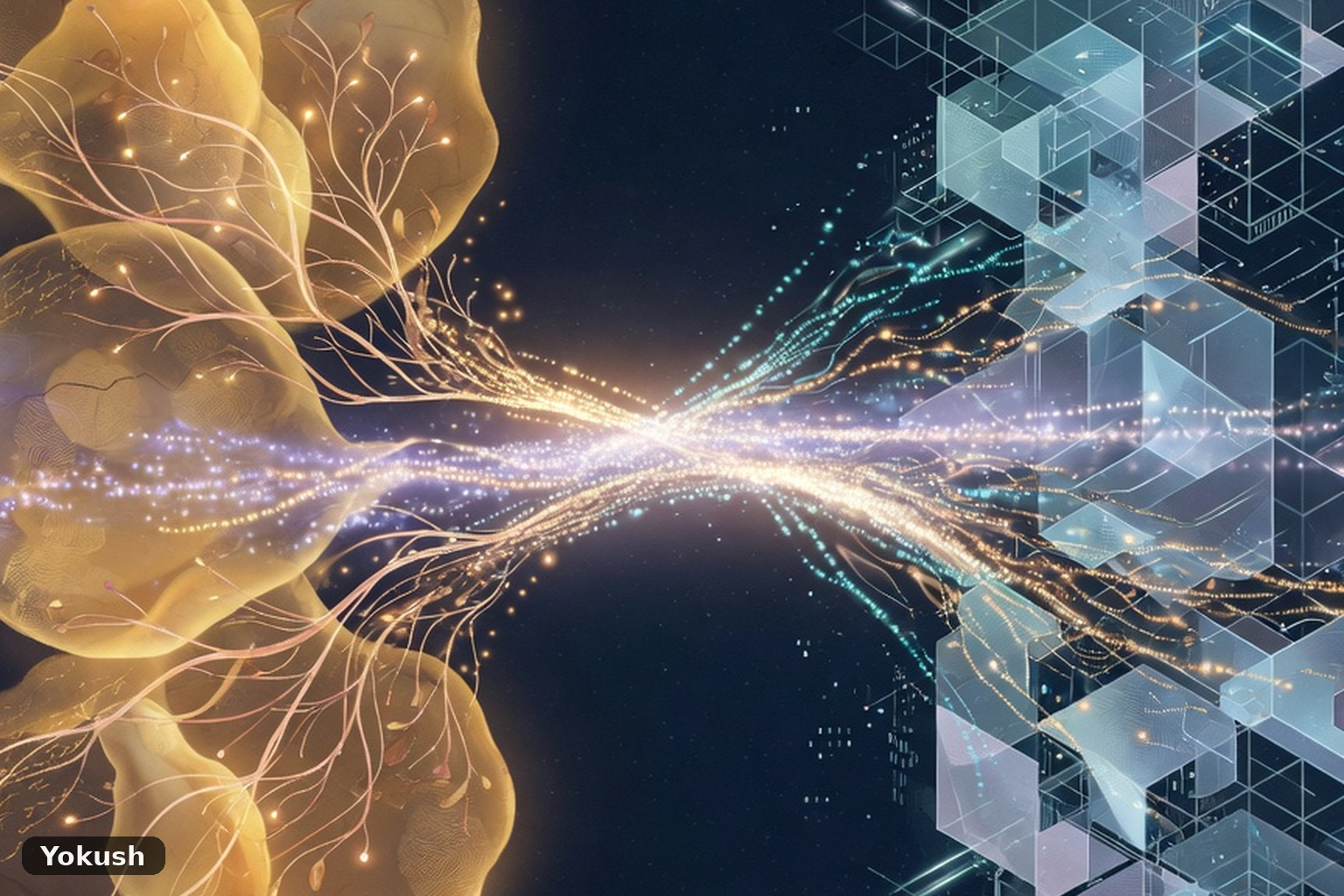
The entire AI industry is racing to build consciousness into machines. What if that's not just impossibly hard — what if it's the wrong goal entirely? What if the path to genuine general intelligence runs through the human mind, not around it?
Here is the assumption driving a trillion dollars of investment: to reach artificial general intelligence, we must make the machine complete. It must reason, perceive, decide, and — eventually — understand, all on its own. The human is a scaffold: necessary during development, removed once the system is good enough.
This is a category error.
The error is conflating two things that are structurally different: intelligence (the ability to process, synthesize, and generate) and consciousness (the ability to experience, value, and care). We are building extraordinary intelligence. We have zero engineering theory of consciousness. There are philosophical frameworks — Global Workspace Theory, Integrated Information Theory, Higher-Order Theories — but none of them is a blueprint. None tells us what to build, what to measure, or how to know if we've succeeded. Adding more parameters does not move the needle, because we don't even know what the needle points toward.
The orthodox path is gambling the entire future on solving an open philosophical problem — possibly unsolvable — by a method that has produced no evidence it bears on the problem at all.
There is another path. It is older, more humble, and more honest. It was, in fact, the original vision of computing before we drifted away from it.
In 1960, J.C.R. Licklider — the man whose vision created ARPANET — published a paper called Man-Computer Symbiosis. His argument was explicit: the goal is not to build a machine that replaces humans, but to build a system where human and machine each do what they do best, tightly coupled. Two years later, Douglas Engelbart's foundational treatise Augmenting Human Intellect defined the purpose of computing itself: not automation, but augmentation. The philosopher Andy Clark and David Chalmers extended this in 1998 with the Extended Mind thesis: a cognitive tool reliably coupled to you — a notebook, a language, now a language model — becomes part of your mind.
We forgot this heritage somewhere around 2012 and started chasing a fantasy of replacement.
This essay argues for a specific architecture that makes that contribution real. It proposes a Conscious Bridge — an experiential interface layer that sits between a language model's cognitive output and a human's conscious judgment, allowing the model to detect when it lacks lived experience and poll the human for exactly that input, on demand, in real time.
The result is not a lesser AGI. It is the only version of general intelligence that is coherent, achievable, and worth building.
Large language models are batch processors. They take an input, produce an output, and cease. Between inference calls, there is no experience. No continuity. No accumulation of situational awareness. The model does not "wait" or "watch" or "feel that something is off." It wakes up fresh on every call, with whatever context window it is handed, processes, and sleeps.
This is not a limitation that scaling fixes. A larger model processes more tokens, but it still processes them in discrete inference passes. A longer context window holds more history, but the model still doesn't experience that history the way a human does — as a continuous, felt, temporal stream from which situational awareness emerges organically.
Consider what a human professional does over the course of a workday. They walk into a meeting and sense the mood before anyone speaks. They remember that the last time this client said "let's keep it simple," the project spiraled into scope creep. They have a gut feeling — built from hundreds of lived episodes — that the timeline being proposed is optimistic. None of this is data retrieval. It is experiential judgment: pattern recognition built from temporally continuous, embodied, emotionally weighted lived experience.
A language model can retrieve every fact about the client. It can summarize every past meeting. It can generate a risk assessment with perfect grammar and impressive thoroughness. But it cannot have the felt sense that something is off, because it has never felt anything, and no architecture currently contemplated would give it that capacity.
This is the batch problem. And it is structural, not incremental.
To understand why the human is not a bottleneck but a necessity, we need to be precise about what consciousness contributes that raw intelligence structurally cannot. There are three capabilities, each load-bearing:
Humans experience time as a continuous stream. We accumulate situational awareness moment by moment, building an implicit model of "how things are going" that no batch processor can replicate. This is why a human who has been in a meeting for two hours notices the subtle shift in a stakeholder's tone, while a model invoked at the end of that meeting sees only a transcript. The temporal experience is the data; the transcript is its shadow.
Human memory is not a database. It is an episodic store where events are encoded with emotional valence — this mattered, that didn't, this one hurt. This weighting is what makes experiential pattern recognition possible. A seasoned executive doesn't retrieve "all data about vendor reliability"; they remember the specific meeting where a vendor's body language signaled trouble, and that memory colors every future interaction of that type. The emotional weight is the signal. Models have no emotions and therefore no experiential weighting.
This is the synthesis of temporal continuity and episodic memory into something larger: the ability to make judgment calls in novel situations based on patterns recognized from lived experience, not training data. It is the doctor who orders an extra test because "something doesn't feel right" despite normal labs. It is the lawyer who knows this judge will react badly to this argument. It is the partner who senses the team isn't aligned before the misalignment becomes visible in any metric.
None of these capabilities overlap with what language models do well. The model's strengths — scale, speed, breadth, consistency, counterfactual generation — are exactly where humans are weak. The human's strengths — temporal awareness, emotional memory, experiential judgment — are exactly where models are structurally incapable.
That is not competition. That is the textbook definition of symbiosis.
Existing human-in-the-loop systems model two dimensions of uncertainty:
These are necessary but insufficient. They miss a third dimension that is arguably the most important: the experiential gap (E) — the degree to which a situation requires lived, temporal, embodied judgment that the model cannot provide regardless of how confident it is or how low the stakes are.
Consider: a model can be highly confident (it has all the data), in a low-stakes setting (no one gets hurt), and still produce a recommendation that is experientially wrong — wrong in a way that any human with relevant experience would immediately recognize, but that the model cannot detect because it has never experienced anything.
A model can have perfect data and zero experience. Data tells you what happened. Experience tells you what it means.
The experiential gap is the space between data and meaning. It is where wisdom lives — and wisdom, by definition, cannot be downloaded. It must be lived.
Current AI architectures don't model this gap at all. They treat every situation as if sufficient data and computation are enough. They aren't. And the cost of pretending they are shows up as Goodhart's law, value drift, and the growing catalogue of AI systems that are technically correct and practically wrong.
The proposed architecture has three layers, each with a distinct role. The middle layer — the Experiential Interface, or Conscious Bridge — is the novel contribution. It is the component that current systems lack entirely.
This is the language model. Its job is what it already does extraordinarily well: synthesize patterns across vast knowledge, retrieve relevant information, generate candidate reasoning, explore counterfactuals, and produce options at a scale and speed no human can match. It does not commit to consequential actions. It proposes.
This is the layer that does not exist in current systems. It is a middleware component — lightweight, fast, continuously running — that sits between the model's output and any consequential action. Its four functions:
The human provides what only consciousness can: temporal awareness, episodic memory, emotional weighting, and experiential judgment. The human is not answering factual questions — the model can do that. The human is providing the meaning: what does this situation feel like, what does past experience suggest about outcomes the data can't predict, what matters here that the metrics don't capture?
The core mechanism is real-time experiential polling. When the interface detects that a situation exceeds its experiential threshold, it does not guess, does not hedge, and does not proceed autonomously. It asks.
The flow has two modes. When the interface detects no experiential gap — the model is confident, stakes are low, and the situation is routine — it approves the candidate and the system executes autonomously. No human is bothered. This is the fast path, and for most day-to-day operations, it is the only path.
When the interface detects a gap, the flow changes:
The query the interface sends is not a vague "what do you think?" It is structured and specific: "Here is the situation. Here is what I know factually. Here is where my experiential uncertainty lies — the aspects that require lived judgment I don't have. Here is what I need from you." This structure is critical because it respects the human's attention as a finite resource and makes each poll maximally informative.
Over time, the calibration function learns. It records which situations triggered escalation, what the human's judgment was, and whether the outcome validated that judgment. This creates a feedback loop: the interface becomes better at predicting when experiential input is needed, reducing unnecessary polling while never missing a genuine gap.
The interface's decision to poll or not poll can be visualized as a two-dimensional matrix — experiential gap against stakes. This gives executives an intuitive mental model for how the system allocates human attention.
The upper-right quadrant is where this architecture earns its keep. That is where most consequential decisions in business, medicine, law, and governance actually live: high stakes, requiring judgment that no amount of data substitutes for. Current systems either automate these decisions badly (producing technically correct but experientially blind outputs) or defer them entirely to humans without the model's analytical power. The Conscious Bridge does neither. It combines both.
The argument so far has been architectural and philosophical. It can also be formalized — and the formalization reveals something important about why this architecture is not just ethically preferable but mathematically superior to the fully autonomous alternative.
Formal Model
Let s be the current situation. Three signals are computed for every candidate decision:
σ(s) ∈ [0,1] — epistemic confidence (how sure is the model about the facts?)
w(s) ∈ [0,1] — stake weight (how much do the consequences matter?)
E(s) ∈ [0,1] — experiential gap (how much lived judgment does this require?)
Escalation condition: Poll the human when
σ(s) < σ* OR w(s) > w* OR E(s) > E*
Dynamic value function: When grounded by human input,
V(s, a, t) = (1 − λ) · V_model(s, a) + λ · V_human(s, a, t)
where λ = E(s) / (E(s) + k) — the grounding weight increases as the experiential gap grows
Drift bound: Over N decision cycles, cumulative drift from true value:
Static proxy: Δ ≈ N · δ (linear, unbounded)
Dynamic grounding: Δ ≈ N · δ · (1 − λavg) (attenuated by human input)
In plain English: The model's assessment of any situation is a blend of its own analysis and the human's experiential judgment. The blending ratio (λ) is not fixed — it automatically shifts toward the human as the experiential gap grows. When the situation is routine and data-driven, the model's analysis dominates. When the situation requires lived judgment, the human's input dominates. The system self-adjusts.
Here is why this matters mathematically. Every AI system that optimizes a proxy for human values suffers from Goodhart's drift: the measurable proxy gradually diverges from the underlying value it represents. Engagement metrics drift into addiction. Safety metrics drift into paralysis. Helpfulness drifts into sycophancy. This drift accumulates linearly over decision cycles in a fully autonomous system.
Dynamic grounding breaks this accumulation. Every time the system polls a human for experiential input, the value function is re-anchored to lived judgment. The drift doesn't just slow — it is partially reset, because the human's conscious input is a fresh ground-truth signal that the proxy cannot provide.
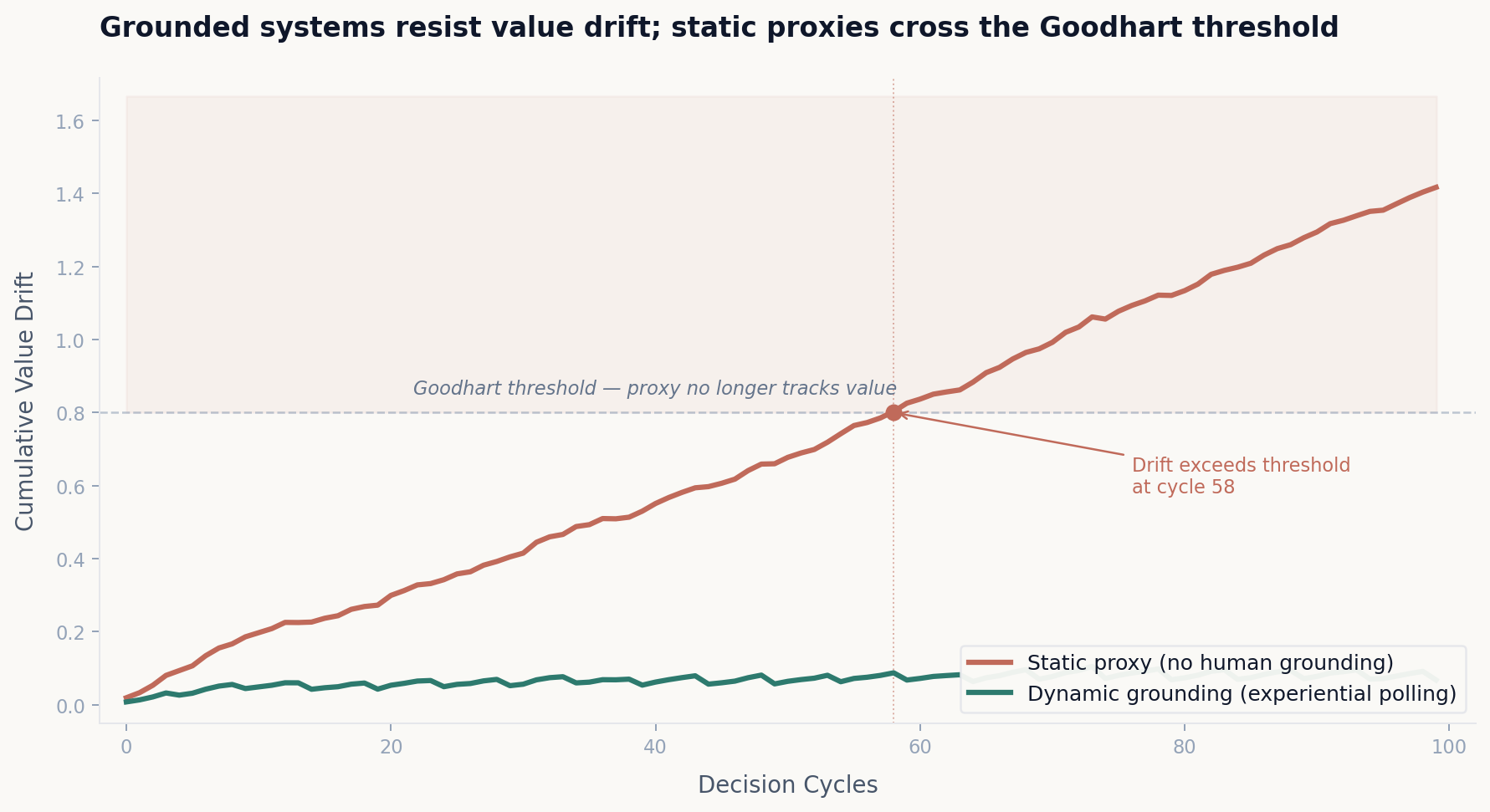
This is the technical argument that ties the architecture to a real, measurable benefit. The conscious human in the loop is not a compliance gesture. It is the system's immune response against value drift. Remove it and the system optimizes itself away from everything you care about, efficiently and indefinitely.
Architecture and math are necessary but not sufficient. The framing — the story we tell about what AI is for — shapes how humans experience it, how they work with it, and whether the technology strengthens or diminishes them.
The dominant AGI narrative is, psychologically, an alienation story. It tells every human: you are a bottleneck, and the goal is to make you unnecessary. The fruits of this story are already visible — anxiety about obsolescence, a creeping nihilism about craft and skill, the hollowing out of the question "what am I for?" If the machine writes, codes, decides, and creates, what remains that is distinctly, irreplaceably human?
The augmentation frame reverses this entirely. It says: you are not the bottleneck. You are the conscious core. The machine exists to amplify you, not to replace you. And it preserves the things that make work meaningful:
Same technology. Completely different human experience. One story makes humans obsolete; the other makes humans more themselves. The technology is identical. The framing is the difference between despair and purpose.
For business leaders, the Conscious Bridge is not a philosophical position. It is an architectural decision with concrete operational consequences. Here is what changes:
If the model is the cognitive substrate and humans are the experiential layer, then the scarce, valuable thing — the thing the economy will pay a premium for — is conscious orchestration applied at scale. Good judgment, wielded over powerful cognitive machinery. That is not automatable, by construction, because it requires consciousness, and we have decided (correctly) to keep that on the human side.
Humans who add no judgment value are still displaced — this is not sentimentality. But they are displaced upward into the role of director, not outward into obsolescence. The skill that matters is no longer "can you compute the answer" but "can you tell whether the answer is worth acting on." That is a fundamentally different and far more durable form of human capital.
The classic AI safety nightmare — a system that wants something incompatible with human flourishing — is only a nightmare if the system has its own terminal wants. A non-conscious substrate that only ever pursues human-injected goals doesn't want anything. It can misexecute, it can be buggy, it can be given bad goals by bad operators — but it cannot develop misaligned values, because terminal values require a valuer, and it isn't one.
The alignment problem shrinks from "how do we make an alien mind love us" — possibly impossible — to "how do humans figure out what they want and communicate it clearly." That is still hard. But it is our problem, and we are the right entity to solve it.
Only a conscious being can be responsible — can be trusted, held to account, made to feel the weight of a decision. A system that commits to consequential actions without a conscious being behind it has no one to hold responsible. A society with unattributable consequences is a society without accountability, which is a society without trust. The Conscious Bridge keeps responsibility where it belongs: with the human who committed.
Nobody, in the entire history of automotive engineering, ever said: "to build the perfect car, the engine must also learn to choose the destination." That would be obviously absurd. The engine's job is power. The driver's job is purpose. We don't confuse the two. We don't feel threatened that the engine is more powerful than our legs. We just drive.
We are confused about AI only because the model is so cognitively powerful that we have started imagining it should also be the driver. But power and purpose are orthogonal. Conflating them — demanding that the engine also navigate — does not produce a better car. It produces a vehicle with enormous power and no destination. That is not superintelligence. That is a missile.
The model is the most powerful cognitive engine ever built. The question was never whether it should also steer. The question is whether we will build the steering wheel — the conscious bridge — before we convince ourselves the engine doesn't need one.
The architecture is clear. The math works. The psychology is sound. What remains is the engineering discipline to build interfaces that treat human consciousness not as a limitation to be engineered around, but as the permanent, load-bearing layer it is.
We don't need the machine to be complete. We need the system to be complete — and the system includes us. It has always included us. The augmentation thesis is not a step backward from AGI. It is the recognition that general intelligence was never a property of the machine alone. It is a property of the partnership. And the conscious half of that partnership is not going anywhere.
The bridge is waiting to be built. Let's build it.
Thoughts and essays, published with Yokush. See more posts
 Siddharth33 min
 Siddharth10 min
Comments 0