 Siddharth
A Human, an AI, and the Line That Held for 167 Years
Siddharth
November 21, 202620 min read
On the morning of 20 November 2026, a mathematician posted a four-page note and 239 megabytes of machine code to his personal website. The note said he believed he had proved the Riemann Hypothesis — the most famous unsolved problem in mathematics, open for 167 years, worth a million dollars. By that evening, two independent teams on two continents had rebuilt his code from scratch and it had passed. This is what the problem actually is, what happened, and how big it is.
Start with the primes: 2, 3, 5, 7, 11, 13. Every whole number bigger than 1 is either prime or built by multiplying primes together, and there is only ever one way to do it. They are the atoms of arithmetic.
But they behave like nothing so much as noise. You cannot look at a prime and say when the next one arrives. Between 1 and 100 there are 25 primes. Between 100 and 200 there are 21. Between 1,327 and 1,361 there are none at all, and then two arrive within four numbers of each other. There is no formula, no rhythm you can tap your foot to.
And yet, step back far enough and a shape appears.
Near 1,000, roughly one number in seven is prime. Near a million, one in fourteen. Near a billion, one in twenty-one. The thinning is not erratic — it is metronomic, and it follows a law so clean you can write it on a napkin: the density of primes near a number x is about 1/ln(x). That is the Prime Number Theorem, conjectured by Gauss as a teenager and proved in 1896 by Hadamard and de la Vallée Poussin working independently .
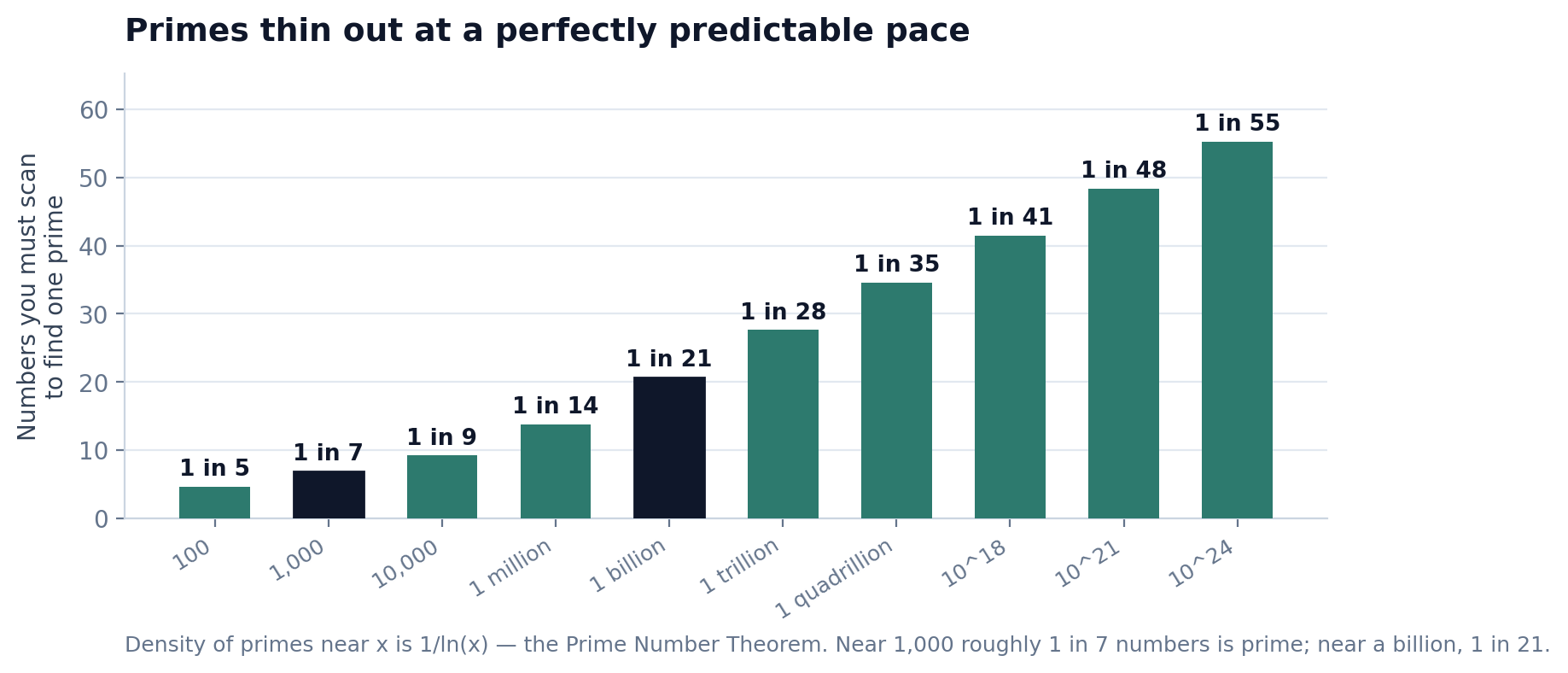
So mathematicians can estimate how many primes sit below any number you care to name. The estimate is astonishingly good. It is also never exactly right.
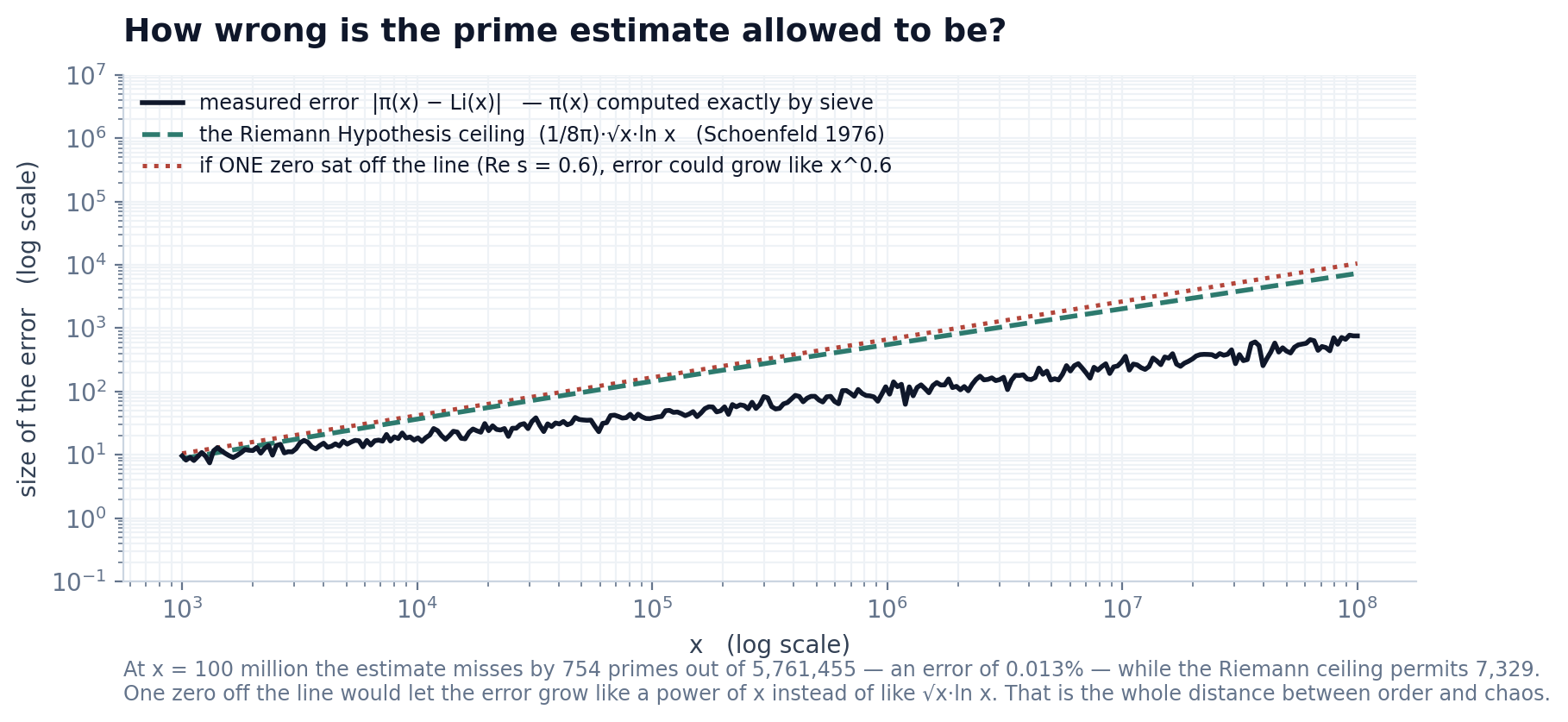
Below 100 million there are precisely 5,761,455 primes. The standard estimate, the logarithmic integral Li(x), says 5,762,209. It overshoots by 754 — an error of 0.013 per cent. Below a million the estimate is off by 129 out of 78,498.
Here is the useful way to think about that. Flip a fair coin a thousand times and you expect 500 heads, but you will get 487 or 512. The miss is real, it is unavoidable, and it is tame: it grows like the square root of the number of flips, never like the number of flips itself. Nobody fears that a thousand coin tosses will produce 950 heads.
The question that consumed the next century and a half is whether the primes are that well behaved — or whether, somewhere out past the reach of any computer, the pattern lurches.
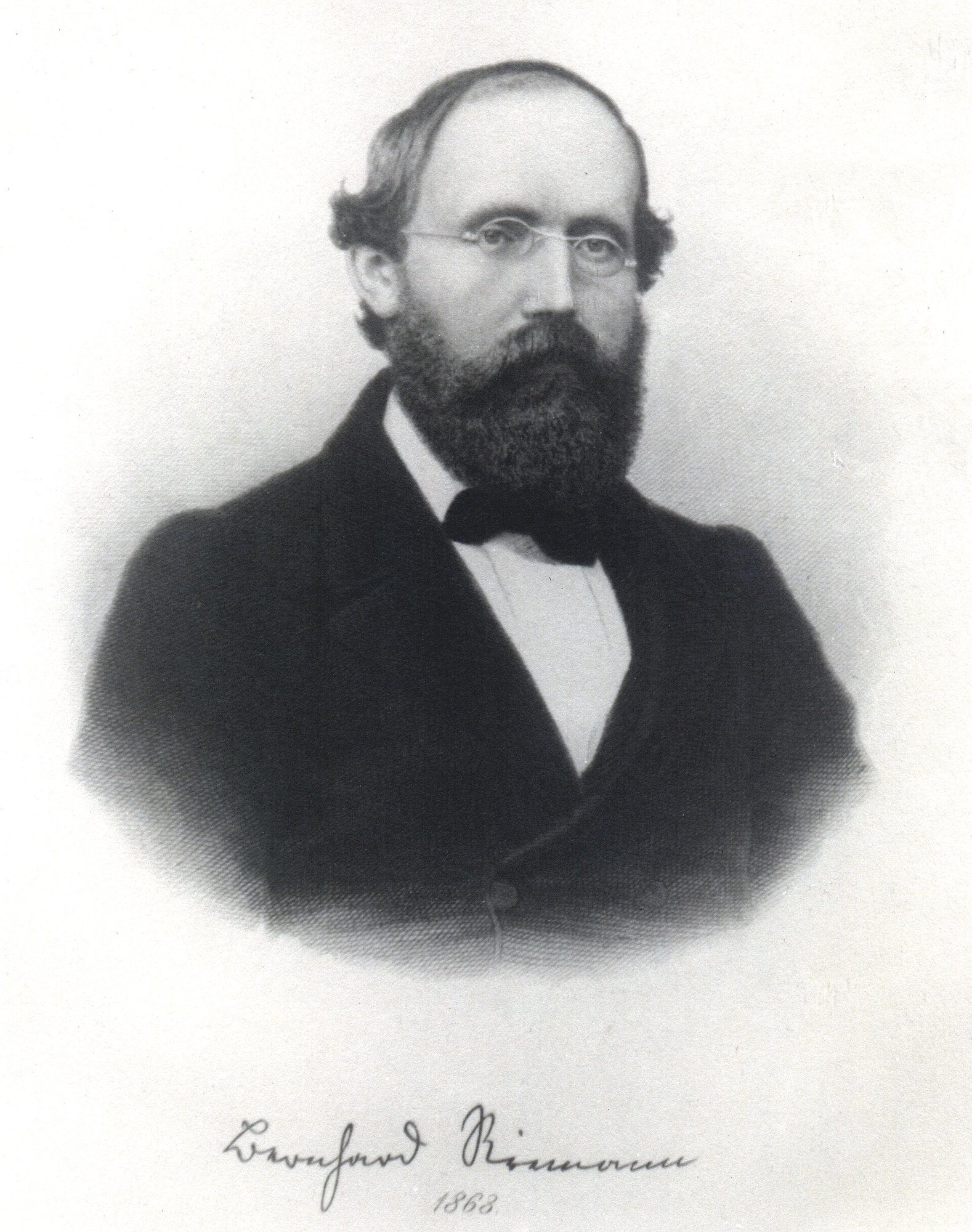
In November 1859, Bernhard Riemann submitted a paper to the Berlin Academy titled, with magnificent understatement, On the Number of Primes Less Than a Given Magnitude. It ran to six manuscript pages. It was the only paper on number theory he ever wrote .
What he did in those pages was to stop looking at primes and start looking at a function. Take every whole number, raise it to a power s, add up the reciprocals. That sum is the zeta function, ζ(s), and Euler had already noticed the extraordinary fact that it can be rewritten as a product running over the primes alone. The primes and the zeta function are the same object seen from two sides.
Riemann then did the thing nobody had thought to do: he let s be a complex number, with a real part and an imaginary part, and asked where ζ(s) equals zero.
The answers come in two kinds. There are the trivial zeros at −2, −4, −6 and so on, which are easy to explain and nobody cares about. And there are the non-trivial zeros, which all live in the vertical band of the complex plane where the real part of s is strictly between 0 and 1 — the critical strip. There are infinitely many of them, and Riemann proved that their positions control the error in the prime estimate exactly. Not approximately. Exactly. Each zero contributes a wave to the prime count; add up all the waves and you reconstruct π(x) precisely .
Then he noticed where the zeros seemed to sit, and wrote one of the most consequential hedges in the history of science:
"It is very probable that all roots are real. A rigorous proof would of course be desirable; I have, however, provisionally set aside the search for it after some fleeting vain attempts, as it seemed expendable for the immediate purpose of my investigation."
— Bernhard Riemann, 1859
"All roots are real" is Riemann's phrasing of what we now call the Riemann Hypothesis: every non-trivial zero of ζ(s) has real part exactly 1/2. Every single one sits on a single vertical line running up the middle of the strip.
If he is right, the error in the prime estimate stays small forever, exactly like the coin. Primes are as orderly as they could possibly be. If even one zero sits off that line, the error can grow like a power of x instead of like √x·ln x — and the primes are far wilder than a century of evidence suggests.
The problem has been attacked from every direction imaginable, and the partial results are genuinely spectacular. In 1914 Hardy proved that infinitely many zeros do lie on the line. In 1974 Levinson showed at least a third of them do. In 1989 Conrey pushed that to two fifths. In 2020 Pratt, Robles, Zaharescu and Zeindler reached 41.7 per cent .
And in parallel, the computers went to work.
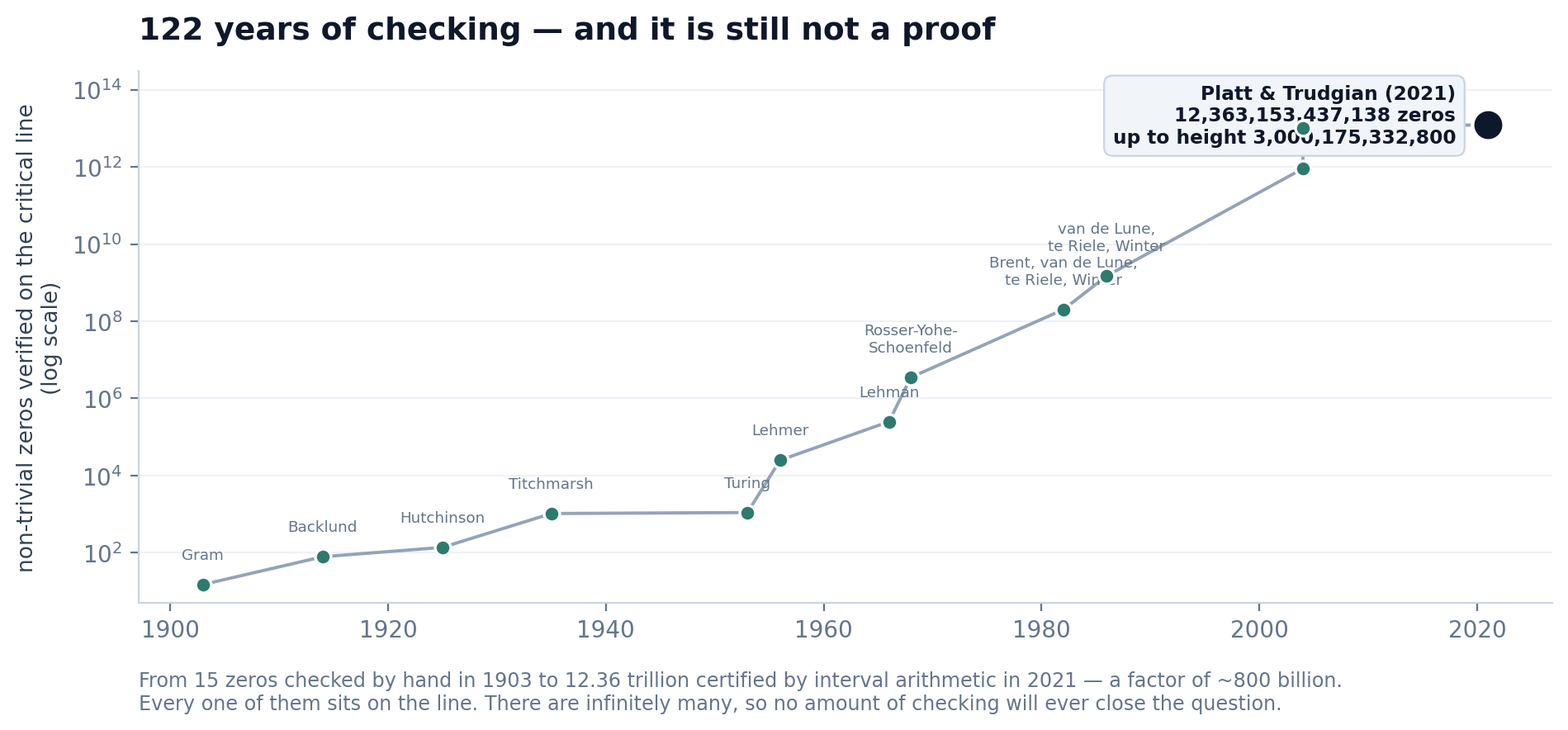
Twelve trillion zeros. Every one on the line. Not a single exception in a hundred and twenty-two years of searching, across a range that dwarfs anything the human brain can hold.
And it does not matter in the slightest. There are infinitely many zeros, so a counterexample could be hiding at the 12,363,153,437,139th. Mathematics does not accept evidence; it accepts proof. This is precisely why the Mertens conjecture is such a good cautionary tale — a closely related guess about prime behaviour that held for every number anyone could test, was widely believed for nearly a century, and was disproved in 1985 by Odlyzko and te Riele, who showed a counterexample exists somewhere below e1.59×1040 without ever finding it .
In 2000 the Clay Mathematics Institute named the Riemann Hypothesis one of seven Millennium Prize Problems, with a million dollars attached. Of the seven, exactly one has ever been solved: Perelman took the Poincaré conjecture in 2002 and then declined the prize .
Levent Alpöge is a mathematician at Anthropic and a junior fellow at Harvard's Society of Fellows. On the morning of Friday 20 November 2026 he posted a four-page note titled simply Remark to his personal site. Its first line reads: "I believe I have, working with Claude, discovered a proof of the Riemann Hypothesis."
He went further. The method, he wrote, extends to the Generalized Riemann Hypothesis, and he expects the Extended Riemann Hypothesis to follow with more time. And the arguments have been formalised — translated into code a computer can check line by line — "without assumptions" .
Then came the unusual part. He released no paper. No arXiv preprint. Instead, fourteen compressed archive parts totalling 239,275,554 bytes, containing 175,187 Lean source files and roughly 17.4 million lines of code. His explanation: "It being obviously inappropriate to attempt to post some massive unreadable travesty of 'slop', I decided to only present Lean." A human-readable write-up, he noted in a footnote, ran past 250,000 pages .
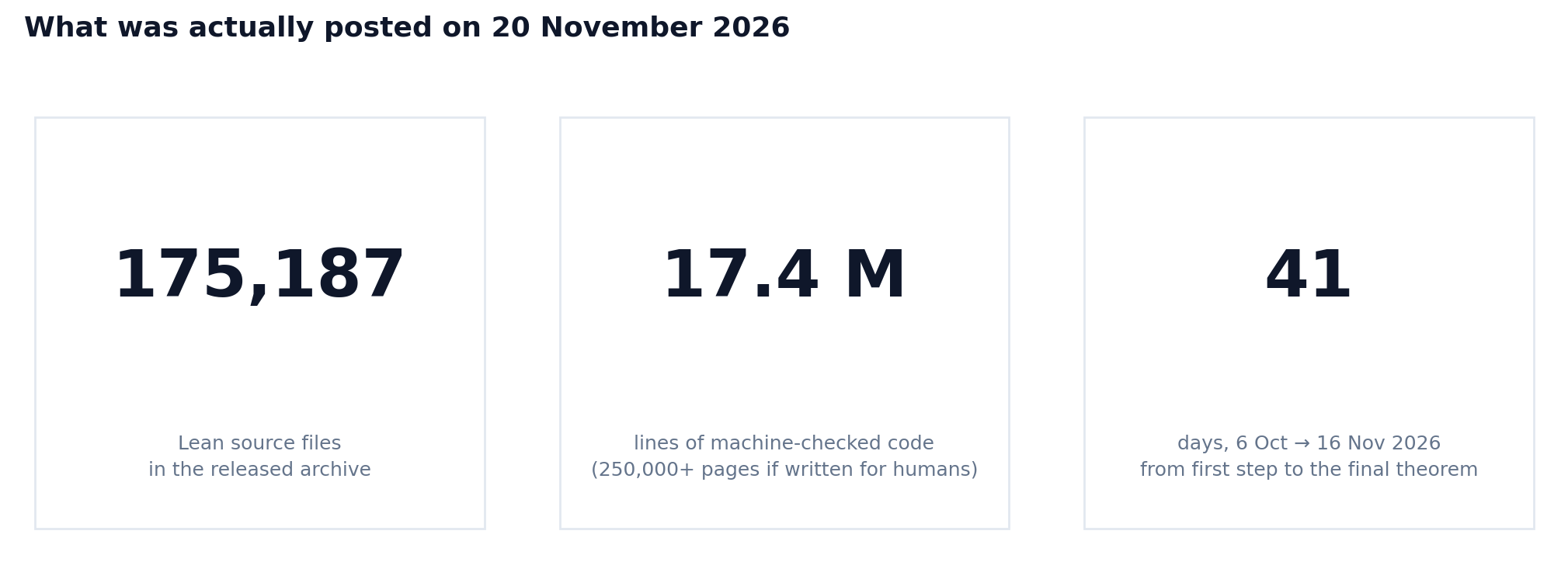
This is where the story separates itself from every previous false claim. Within hours, people started rebuilding the code independently.
Andrew Sutherland at MIT compiled all 175,187 modules against Lean v4.33.1 and Mathlib v4.33.1 with zero errors. He then ran #print axioms on the five headline theorems: they depend on propext, Classical.choice and Quot.sound — the three standard axioms of Lean's foundation, and nothing else. No hidden assumptions smuggled in. He replayed every module through leanchecker, the independent kernel: 175,187 out of 175,187, zero rejections .
Separately, Aapo Lipponen rebuilt the entire archive on the LUMI supercomputer in Finland — about 3,500 core-hours — and got a byte-identical Main.olean hash to Sutherland's . Then the exported proof, 61.57 gigabytes unpacked, was fed to
nanoda, a completely independent kernel written in Rust, which accepted it in 27 minutes 42 seconds on 80 threads. Two further independent kernels, con-leche and lean4lean, also accepted .
A static scan of the source found zero sorry, zero admit, zero axiom declarations and zero native_decide — the four ways a Lean proof can cheat .
The theorem proved is riemannHypothesis : RiemannHypothesis, using Mathlib's own definition of the hypothesis rather than one written for the occasion .
Sutherland's verdict to Scientific American: "The Lean proof has been compiled and independently re-checked by the Lean kernel with only the three standard axioms. Honestly the chance that anything is fishy here is approximately zero."
The five theorems in Main.lean cover the Riemann Hypothesis and the Generalized Riemann Hypothesis for Dirichlet L-functions — not for all L-functions. That is still an enormous result, and it is what most applications actually need, but "GRH" in the full sense covers a larger family . Anyone telling you the entire Generalized Riemann Hypothesis is settled is overreaching.
Alpöge is candid about the division of labour. He supplied the conceptual move — guiding the argument from a toy setting to a suitable analogue. Claude supplied expertise he did not have, particularly in automorphic forms on higher-rank groups, where he writes: "I personally have little mastery."
The key technical idea is credited to the machine. Stepanov's method proves the Riemann Hypothesis for curves over finite fields by building a divisor with multiplicity, using derivatives — but there is no analogue of that over the integers. Claude's move was to chain theta lifts together, each one mimicking multiplicity, and to pick a chain of length √X for a sum of length X. Alpöge's note adds, with something like disbelief: "(And yet, what else could it be?)"
On the final stretch he writes: "this time Claude far outpaced me near the finish line. No, Claude flew, and danced, and sparkled near that finish line."
He is also careful about what he has not done. He is presenting a complete argument, he writes, before having mastered the mathematics around it, and he may have "baked lots of strange suboptimal choices." He expects shorter proofs to follow.
Brian Conrey, one of the world's leading specialists on this exact problem, told AFP: "It's a monumental moment in human history. It's really the biggest thing I think that's ever happened in mathematics." He had not seen the manuscript. "It looks like it's seriously complicated. I don't think any human was about to find this."
Kevin Buzzard at Imperial College London is the voice of procedural caution. The open question, he notes, is whether the code "does not do anything nefarious like redefine the meaning of any of the symbols in the statement" — which is exactly what the still-running comparator checks for .
Thomas Bloom at Manchester captured the double shock: "I don't know whether I'm more surprised that (a) AI claims to have proved the Riemann Hypothesis or (b) that it claims to have produced a coherent proof that, written out in human-readable form, is 250,000+ pages long."
And Sutherland, the man who actually ran the checks, offered the line that will probably outlast all of them: "There is much work to be done to understand the mathematical details of the proof. And I can't wait to dig into them. But perhaps the single most important step in the proof was building a machine that can think."
Worth knowing, because it complicates the "AI did it" framing entirely. Hours after Alpöge's note, Ravi Vakil at Stanford — the president of the American Mathematical Society — posted his own announcement: Alessandro Masullo has a proposed proof of the Generalized Riemann Hypothesis, roughly 940 pages titled The Music of the Primes, the product of twelve years' work. Vakil's emphasis: "It is all human, with no AI." Brian Conrad has been reviewing it closely for months 
Conrad's own assessment is measured: "To judge the success of the method requires the paper to reach a stage of more final revision." Two claims, one day, one machine-assisted and one purely human. If both survive, the story is not that AI beat mathematicians — it is that the problem finally fell, twice, from two directions .
Assume it holds. What changes on Monday?
This is the single largest immediate consequence, and it is easy to understate. Peter Sarnak's much-quoted estimate is that there are "over five hundred papers — somebody should go and count — which start 'Assume the Riemann hypothesis,' and the conclusion is fantastic." His punchline: "With this one solution you would have proven five hundred theorems or more at once." Elsewhere he has put it at "probably thousands."
These are not trivial results parked in a drawer. They are theorems mathematicians wanted, could not prove, and so wrote down conditionally — an entire shelf of mathematics held in escrow behind one unproven sentence. The escrow releases.
Under the hypothesis, the gap after a prime p is bounded by roughly √p·log p — Cramér's 1936 result. The sharpest modern form, due to Carneiro, Milinovich and Soundararajan, guarantees a prime in the interval [x, x + (22/25)√x·log x] for every x ≥ 4 .
Unconditionally, the best anyone has managed is a gap of order p0.525 — the Baker–Harman–Pintz bound. That exponent 0.525 versus 0.5 is the entire distance the hypothesis buys, and it is the difference between "we think primes are well behaved" and "we can prove they are."
Under the Generalized Riemann Hypothesis, Miller's 1976 test becomes deterministic: every odd composite number has a witness below 2(ln n)², a bound Bach made explicit in 1990 . Test all bases up to that ceiling and you know the answer with certainty rather than overwhelming probability.
The honest caveat: nobody would actually use it. For a 1024-bit prime the deterministic version needs about 41,749 bases where forty random rounds already drive the error below 2−80 — roughly a thousand times more work for a guarantee nobody needs . And since 2002 the AKS test has been deterministic and unconditional anyway.
This is the part that always gets garbled, so let us be precise. RSA security rests on how hard it is to factor a large number into its two primes. The Riemann Hypothesis is a statement about how primes are distributed on average. Those are different questions, and knowing the answer to one does not hand you the other.
Every serious factoring algorithm in existence — trial division, Pollard's rho, the elliptic curve method, the quadratic sieve, the number field sieve — runs without consulting the truth value of the Riemann Hypothesis. None of them gets faster if it is proved .
There is also a clean logical argument, made by cryptographers for years: if a proof of RH did yield an RSA-breaking algorithm, you would not need the proof. You could simply assume RH, build the algorithm on that assumption, and run it today. The assumption costs nothing at runtime. So a proof adds no attacking power whatsoever .
What does threaten RSA is a large fault-tolerant quantum computer running Shor's algorithm — which is why NIST has been running a post-quantum migration on a 2030-to-2035 timetable. That schedule is unaffected by anything that happened on 20 November.
If anything the direction runs the other way. Prime-based cryptography has always rested on distributional assumptions about primes that mathematicians believed but could not prove. Proving them strengthens the foundation rather than cracking it.
Set the mathematics aside for a moment and look at the trajectory, because the trajectory is the actual story.
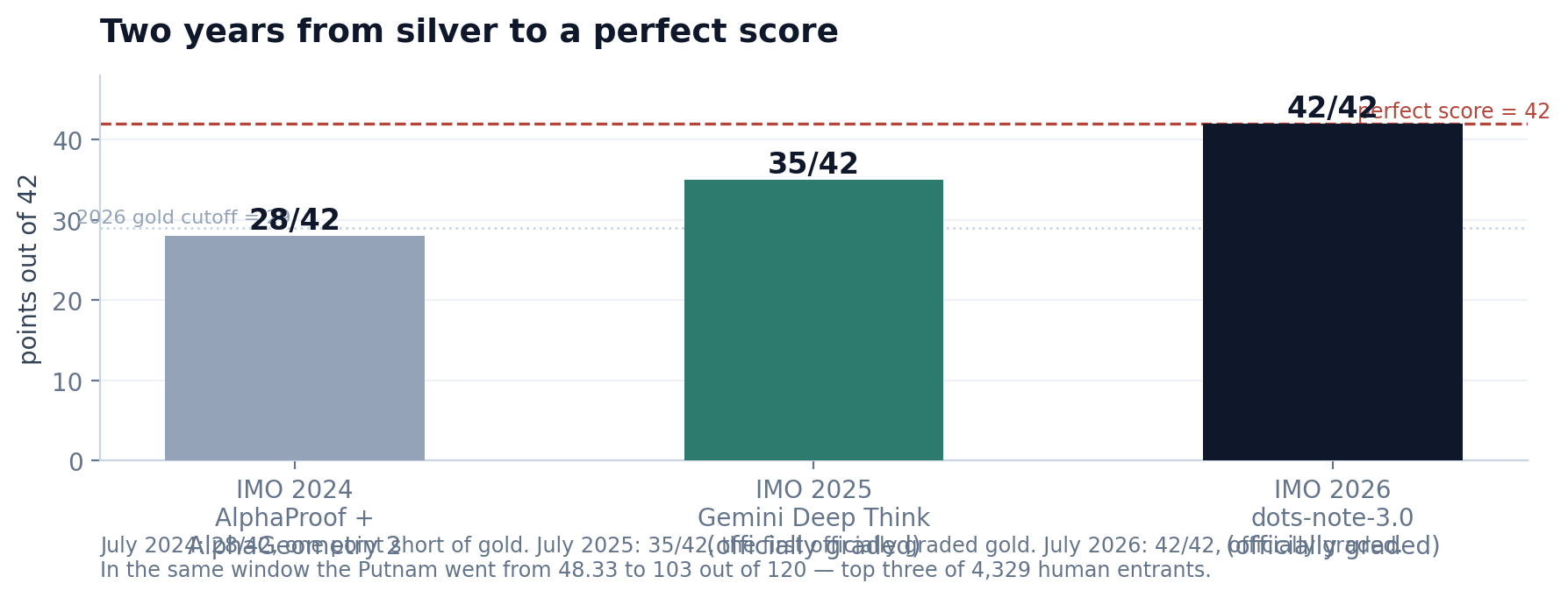
Twenty-four months from one point short of a silver medal to a perfect score under official human judging. Over the same window, performance on the Putnam — the hardest undergraduate competition in mathematics — went from 48.33 to 103 out of 120, which would have placed third among 4,329 human entrants .
Olympiad problems are solved exercises with known answers. The Riemann Hypothesis is not. It is a question that defeated Hilbert, that Hardy and Littlewood circled, that Atiyah claimed in 2018 and failed to convince anyone of, that de Branges claimed in 2004 and also failed on. It has been the standard-bearer for "problems machines will not touch" for as long as there have been machines.
And it is not even the first Millennium Problem to fall this year. In September, OpenAI announced a 166-page Lean-formalised solution to Navier–Stokes existence and smoothness, produced by a swarm of ten thousand intercommunicating agents at a reported cost of around $15 million in compute. That one came with an enormous catch: it reintroduced an external force into the equations, which the Clay problem statement technically permits but which sidesteps the question mathematicians actually care about. Luis Silvestre at Chicago put it bluntly: "The most important problem is unsolved. The Clay problem is settled, but the main problem for the Navier-Stokes equations is not."
On 20 November — the same day as the Riemann claim — Tristan Buckmaster and Levent Alpöge published the force-free version. The same Alpöge .
It would be dishonest to write this as pure triumph, because the mathematical community is in open revolt over exactly this pattern.
On 11 September 2026, twenty-five Fields Medalists — Deligne, Kontsevich, Tao, Scholze, Viazovska, Maynard, Villani, Ngô and others spanning 1978 to 2026 — published a joint declaration titled A Severe Misalignment of AI in Mathematics. Their central claim: "Solving problems is only a tool and proxy for achieving the primary goal of conceptual understanding and insight. Forgetting this in the world of AI may turn the tool against the primary goal."
Terence Tao, who runs the catalogue of Erdős problems, gives the most sobering number available. Roughly fifty to sixty of about six hundred open Erdős problems have now been solved with AI assistance — and then the easy phase stopped. "There was a month where that happened and that has stopped, not for lack of trying. I know of three separate attempts to get frontier model AIs to just attack every single one of the problems simultaneously... there hasn't been any further purely AI-powered solution yet."
Peter Scholze is blunter still. AI has not developed any new theory, he argues — it has produced answers. And his position on the Leiden Declaration, endorsed by the International Mathematical Union: "Just like I do not want my children to be educated by AI, I am pondering my mathematical ideas without use of AI."
Timothy Gowers, who declined to sign the medalists' letter while agreeing a crisis exists, has named the real risk — and it is not that machines out-think us. It is comprehension. "We might arrive at a situation where the mathematical literature has, in some form, been vastly expanded, but there is no corresponding community of human experts who have a shared understanding of parts of it."
Look back at Fig 6 with that in mind. The left column is finished. The right column is entirely about humans understanding something, and it is the column that takes years.
A proof of the Riemann Hypothesis does not let you predict the next prime. It does something subtler and, in a way, more valuable: it tells you the pattern can never go wildly wrong. The primes are permitted to be irregular. They are not permitted to be lawless. After 167 years, we would finally know which of those two things we have been living with.
What is genuinely new is not the answer. It is the shape of the getting. A human mathematician supplied the conceptual bridge and admitted, in writing, that he lacked mastery of the machinery needed to cross it. A machine supplied the machinery. Another set of machines — four independent proof kernels, written by different people in different languages on different continents — checked every step in a fraction of the time it would take a human to read the first page. And a third group of humans is now doing the slow part: working out what any of it means.
That last group is the bottleneck, and it will stay the bottleneck for years. Which suggests the real consequence of 20 November 2026 is not that a famous problem got solved.
It is that the constraint on mathematics stopped being how clever we are, and started being how many good questions we can ask — and how many people we can train to understand the answers.
Status at time of writing, 21 November 2026: the Lean proof has been independently compiled and kernel-checked by multiple parties with no stake in the outcome. It has not been peer-reviewed, no human-readable exposition exists, the Clay Mathematics Institute still lists the Riemann Hypothesis as unsolved, and under Clay's rules no prize could be awarded before late 2028 at the earliest. Treat everything above as a claim that has survived machine verification — which is a very high bar, and is not the same as acceptance.
No restrictions
Thoughts and essays, published with Yokush. See more posts
 Siddharth12 min
 Siddharth5 min


Comments 0