 Siddharth
The $8.8 Trillion Free Lunch: How Open Source Quietly Built the Modern World
Siddharth
July 25, 202612 min read

On July 24, 2026, Jensen Huang — the CEO of the most valuable company on Earth — made his first-ever post on X. It wasn't about chips. It was a plea to protect open source. Here's why that's the only thing he could have posted about, and what forty years of "free" software quietly built underneath your entire business.
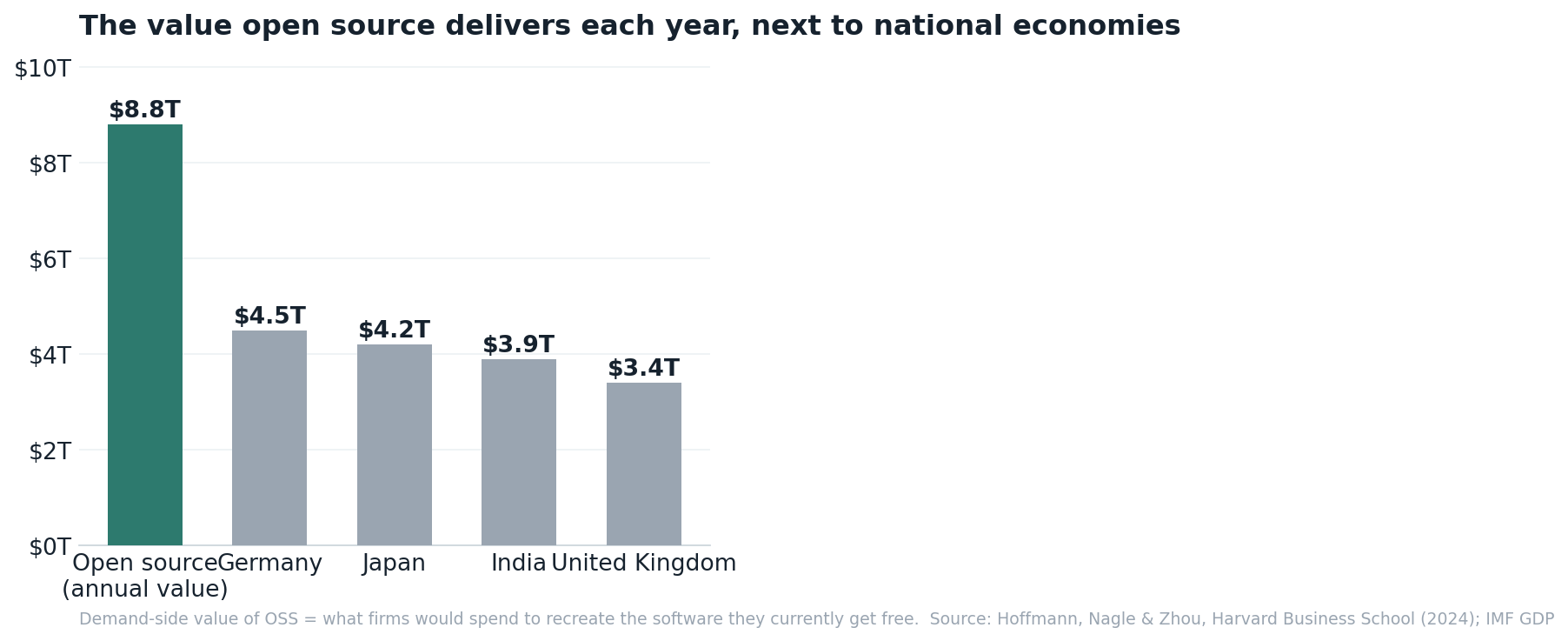
For most executives, "open source" still conjures a hobbyist in a basement, or at best a line item in a developer's expense report. That image is catastrophically wrong. Open source is not a procurement category. It is the load-bearing wall of the digital economy — and a Harvard Business School study now values what it delivers each year at roughly $8.8 trillion . That is more than the entire GDP of Germany.
This is the story of how we got here — from a Usenet post by a Finnish student to a letter signed by thirty-five companies begging Washington not to break the engine that runs the world. It is a story executives need to understand, because the same force that built the internet, the smartphone, and the data center is now reshaping artificial intelligence — and it is doing so faster than any policy can keep up with.
When Jensen Huang broke a multi-year silence on social media, the post he chose was a link to a letter titled Open Weights and American AI Leadership . The signatories were a roll call of the modern stack: NVIDIA and Microsoft, Meta and Palantir, Dell, IBM, Y Combinator, Andreessen Horowitz, Hugging Face, and yes — OpenAI. Thirty-five organizations in total. Their argument was simple and strategic: open models expand access, strengthen competition, give customers control, and — counterintuitively — improve safety through transparency rather than secrecy.
Read it as a CEO, not a developer, and the subtext is unmistakable. The company that sells the hardware beneath every model — open or closed — was signaling that the open path is now the path that matters. That is not altruism. It is a recognition that open source has, repeatedly and for forty years, been where the leverage compounds.
Before there was a movement, there was a manifesto. In September 1983, Richard Stallman posted his plan for the GNU Project — a free, Unix-like operating system — to a Usenet newsgroup . Two years later, he published the GNU Manifesto and founded the Free Software Foundation, articulating a principle that would prove quietly radical: software should be free to inspect, modify, and share
.
Stallman is a polarizing figure, and his politics are not the point here. The point is the mechanism he invented: copyleft, encoded in the GNU General Public License (GPL), which ensured that anyone could build on the work — but only if they kept their improvements equally open. By the late 1990s, roughly half of all open-source projects used a GPL-family license. Stallman gave the movement not just a philosophy but a legal architecture that made collaboration self-sustaining.
On August 25, 1991, a twenty-one-year-old computer science student in Helsinki posted a now-legendary message: "I'm doing a (free) operating system (just a hobby, won't be big and professional like gnu)…" . Linus Torvalds's first kernel was 10,239 lines of code. It was, by his own admission, a hobby.
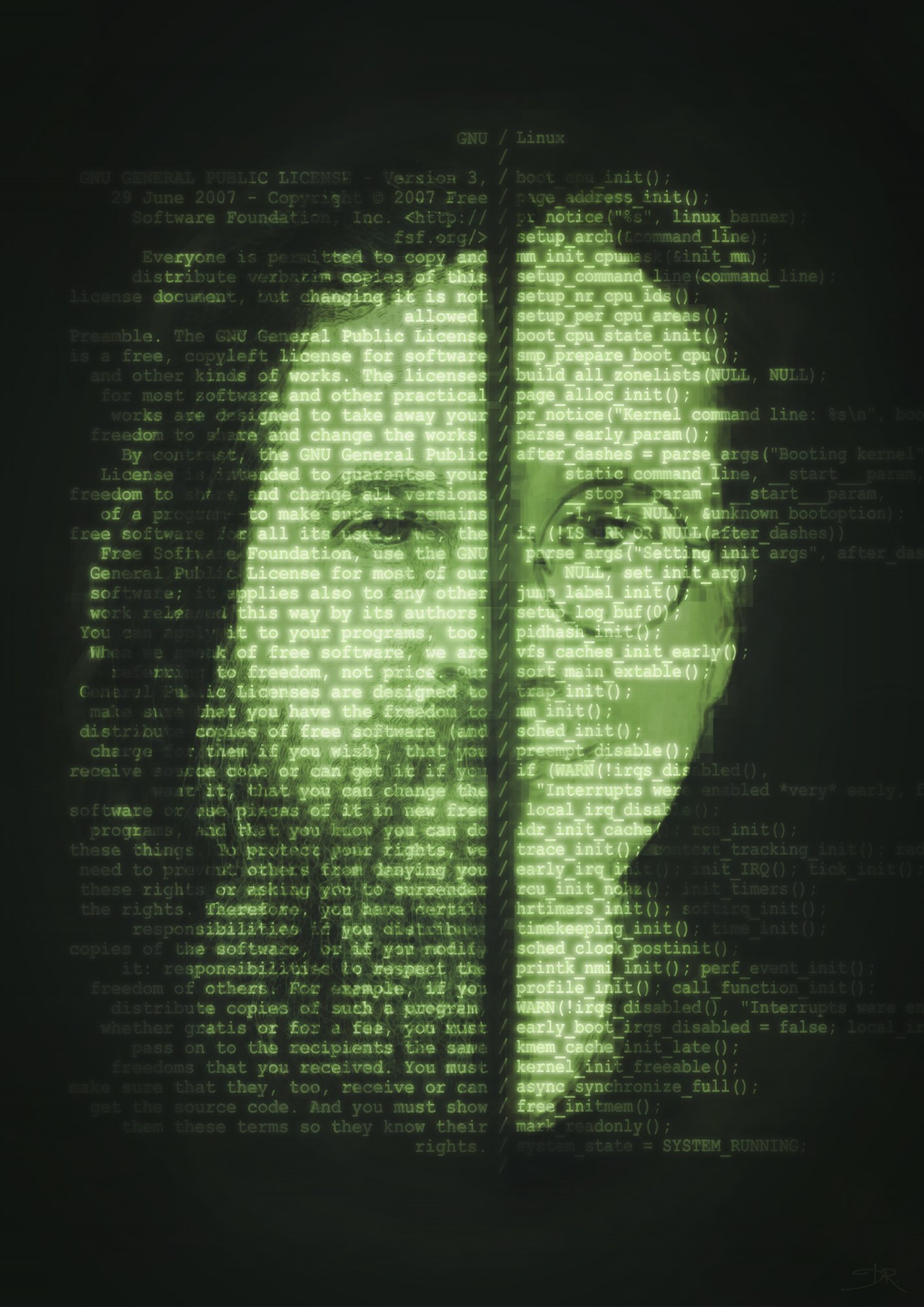
That hobby is now 40 million lines of code, maintained by over 2,100 developers per release from more than 1,700 organizations . And it runs essentially everything. Consider where the Linux kernel lives today:
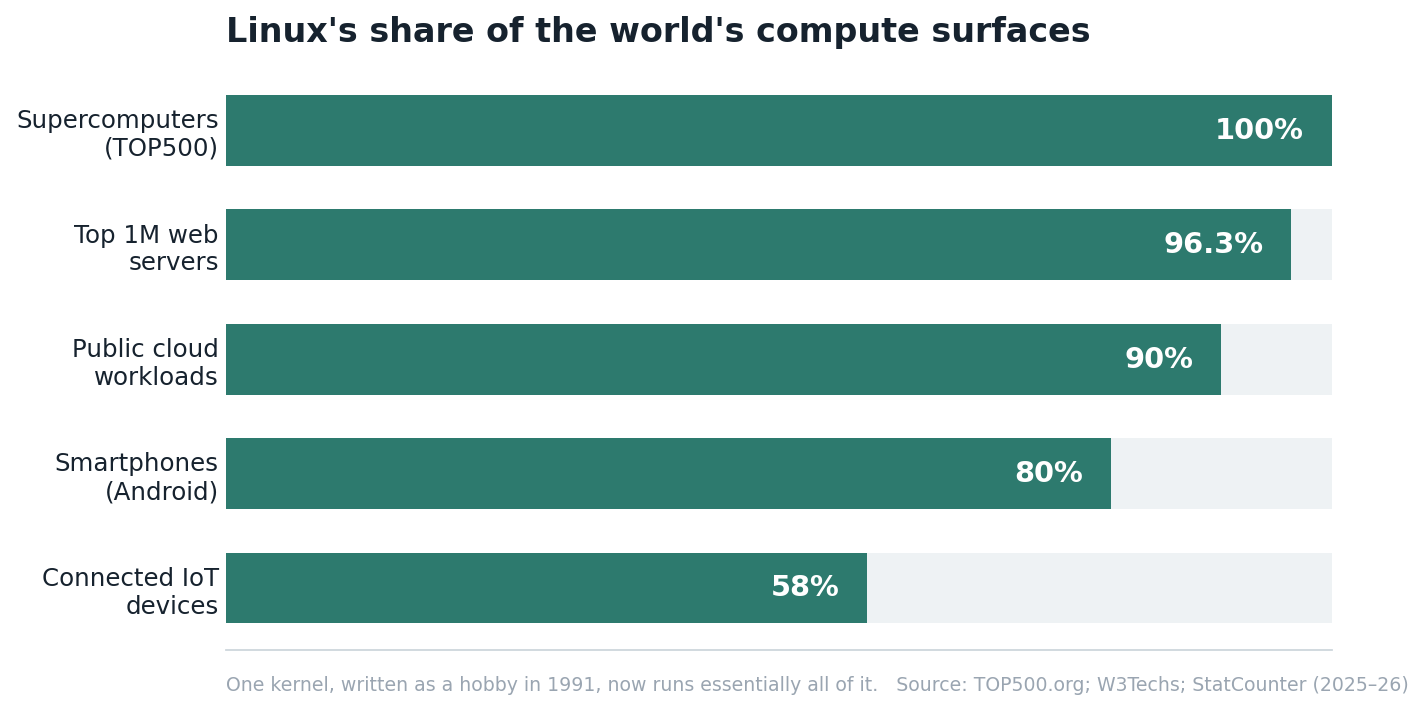
Every one of the world's 500 fastest supercomputers runs Linux — and has since November 2017 . Ninety percent of public-cloud workloads run on it. Roughly eight in ten smartphones carry it, because Android is built on the Linux kernel. If you used a website, an app, or a cloud service today, you touched Linux dozens of times without knowing it.

The early commercial web was supposed to be owned. Netscape and Microsoft sold the servers that would run the internet the way railroads sold track. Then came Apache.
Apache began in 1995 as a collection of patches to a stalled academic web server — its name a pun on "a patchy server" . It was free, and it ran on cheap commodity hardware. By 2005 it powered roughly 70% of all websites on Earth
. Netscape's server business is now a historical footnote.
Apache did not act alone. It sat atop the LAMP stack — Linux, Apache, MySQL, and PHP/Python — an acronym coined in late 1998 that gave every startup a complete, zero-cost software foundation . The consequences were enormous. Wikipedia launched on it. Google's first servers ran a modified Red Hat Linux on commodity PCs. Facebook's entire first architecture, from a Harvard dorm room in 2004, was a single LAMP box. The dot-com boom was, in large part, built on free software.
The disruption ran deepest in databases. For decades, data warehousing meant Oracle, IBM DB2, or Teradata — six- and seven-figure appliances. Then MySQL and PostgreSQL arrived. Today, open-source databases collectively hold over half the market; MySQL alone runs on 39% of web-deployed databases, against Oracle's 10% . The incumbents did not lose to a competitor with a better product. They lost to a competitor with no price.
In 2002, the Linux kernel team adopted BitKeeper, a proprietary version-control system, under a free license. When a developer reverse-engineered its protocols in 2005, BitKeeper's creator revoked the license. Linus Torvalds, unable to find a suitable open alternative, wrote his own — in roughly fourteen days . He called it Git.
Git was good. But what made it consequential was GitHub, launched in 2008, which wrapped Git in a social layer — pull requests, forks, issues, stars — that turned version control into a browser-native collaboration platform . The numbers today are staggering: 180 million developers, 630 million repositories, and a new developer joining every single second
. Ninety percent of the Fortune 100 now use GitHub Enterprise.
Here is the underappreciated part: Git did not just change open source. It changed how all software is written. Git now commands 85% of the version-control market . The pull-request workflow — born in open source — became the default way enterprises build proprietary software behind closed doors. The open-source methodology became the industry's operating system.
For a stretch in the early 2000s, Google was doing something no one else could: processing petabytes of data across thousands of cheap machines. Then it did something unusual for a company that jealously guards its secrets. It published how.
The Google File System paper appeared in 2003; MapReduce followed in 2004 . Google gave away the ideas but kept the implementation. What happened next is the textbook case for why open source matters: a developer named Doug Cutting read those papers and built a free, open-source replica, which he named Hadoop — after his son's toy elephant
. Yahoo backed it. In May 2008, Hadoop running on 910 commodity servers sorted a terabyte of data in 209 seconds, winning a benchmark that had belonged to supercomputers
. Apache Spark, born at UC Berkeley in 2009, then made it up to 100 times faster by keeping data in memory
.
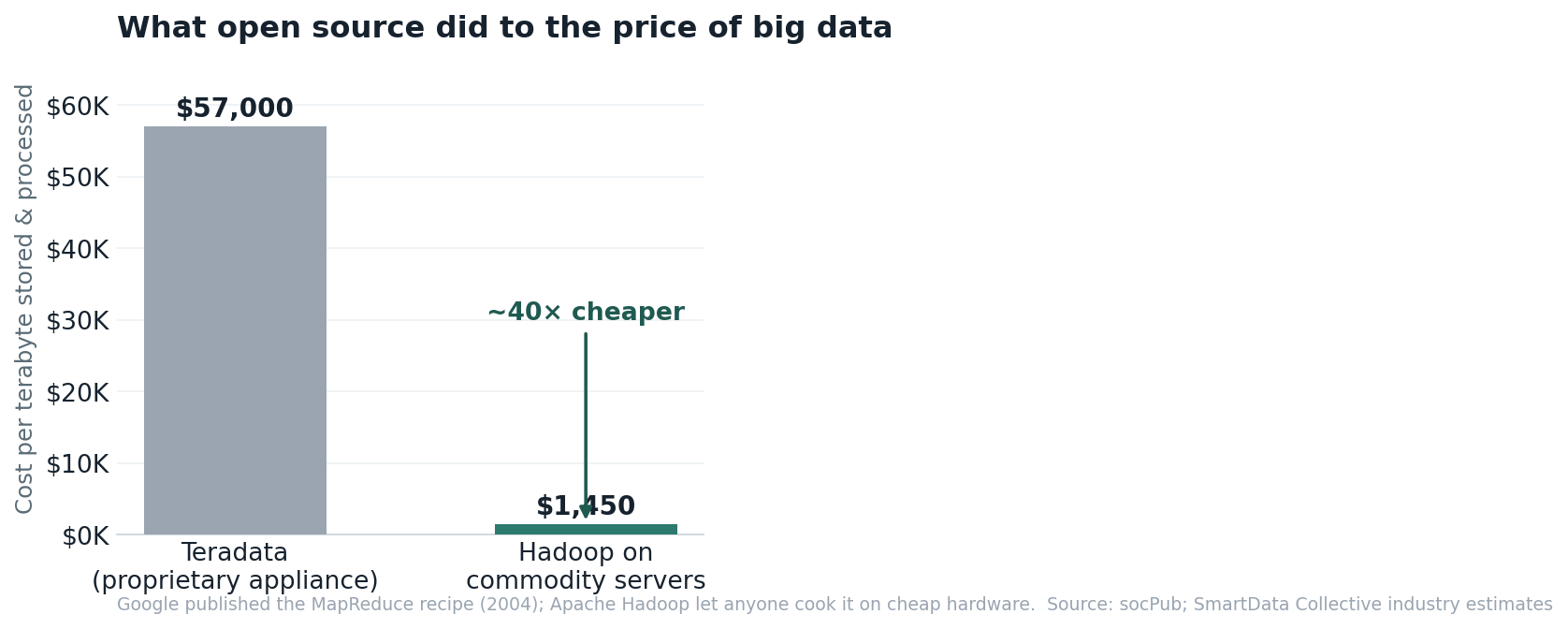
The economic effect was violent. Teradata charged around $57,000 per terabyte; Hadoop on commodity hardware came in near $1,450 — roughly forty times cheaper. Petabyte-scale analytics, once the exclusive province of Walmart and a few banks, became something a mid-sized retailer or a research lab could stand up. Google's generosity with its ideas, combined with the community's willingness to build the implementations, collapsed the cost of a whole category of capability.
Machine learning used to require a PhD, a GPU cluster, and months of low-level coding. Open source erased two of those three barriers.
OpenCV, started at Intel in 1999, packed over 2,500 computer-vision algorithms into a library now downloaded roughly 58 million times a month . scikit-learn, released in 2007, became the workhorse of classical ML, with over five billion lifetime downloads
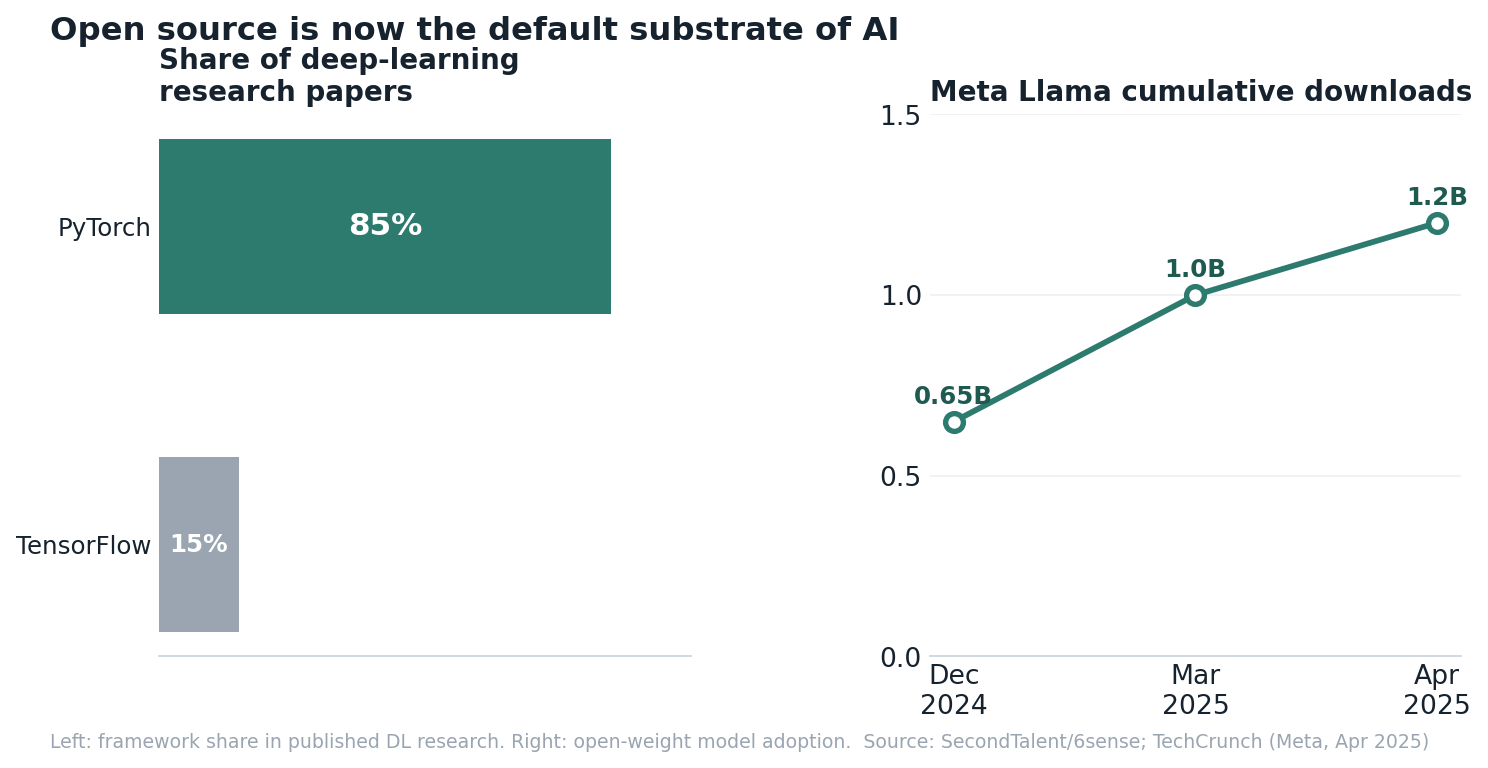
. Then came the framework war: Google open-sourced TensorFlow in 2015; Meta answered with PyTorch in 2016. The outcome split cleanly along a line every executive should note — PyTorch now appears in roughly 85% of published deep-learning research, while TensorFlow leads in enterprise deployment
. Research gravitates to the open; production follows.
The decisive moment came in 2018, when Hugging Face released the Transformers library. State-of-the-art language models — BERT, GPT-2, T5 — that had taken research labs months to reproduce could now be loaded with a single pip install transformers. Hugging Face now hosts over 350,000 models and counts more than ten million users . The platform did to AI what the LAMP stack did to the web: it turned a frontier into a foundation.
The current chapter is the most consequential yet. When Meta released the Llama family of models with open weights — downloadable, modifiable, self-hostable — it triggered a competitive cascade. Llama has been downloaded over 1.2 billion times as of April 2025 . China's DeepSeek trained its V3 model for an estimated $5.5 million — roughly one-eighteenth the cost attributed to GPT-4 — and released it under a permissive MIT license, accumulating 170,000 GitHub stars and 188 million weekly active users
. France's Mistral, fresh off a €1.7 billion funding round, put its 675-billion-parameter flagship under Apache 2.0
.
Notice the geography. The frontier of open AI is no longer a single American company. It is a three-pole race — the United States (Meta), Europe (Mistral), and China (DeepSeek) — all competing by giving models away. That is why Jensen Huang's letter mattered. Open weights are not a sideshow to the AI race; they are increasingly the race itself, and they are forcing closed-API pricing down by 60–80% wherever they land .
The pattern across forty years is remarkably consistent. A capability that was once proprietary, expensive, and rare — an operating system, a web server, a data warehouse, a deep-learning framework, a frontier language model — is recreated as open source, and within a few years it becomes the invisible, free, ubiquitous default that everyone builds on top of. The incumbents who fought openness lost. The ones who embraced it shaped what came next.
Here is the part that should keep a CIO awake. The same Harvard study that priced open source's annual value at $8.8 trillion also found that just 5% of developers create 96% of that value . The foundation of the digital economy rests on a vanishingly thin layer of people — most of them unpaid. Roughly 60% of open-source maintainers receive no compensation for their work, and 60% have either quit or considered quitting
.
We have already seen the consequences. Log4Shell, the 2021 vulnerability in a single open-source logging library, scored a maximum 10 on the severity scale and rippled through over 17,000 Java packages . The XZ Utils backdoor of 2024 was smuggled in by an actor who exploited the exhaustion of a lone, overworked maintainer. For years, the OpenSSL library securing much of the internet was maintained by, as one famous headline put it, "two guys named Steve."
The industry is finally mobilizing. In June 2026, the Linux Foundation launched Akrites — a coordinated effort backed by AWS, Anthropic, Google, JPMorgan Chase, Citi, Microsoft, NVIDIA, OpenAI, and Vodafone to remediate vulnerabilities in critical open source before attackers can exploit them . Their framing is blunt: finding a serious vulnerability in a major project used to take an expert weeks; now, with AI, it takes a machine minutes. The same open-source ecosystem that gave us the tools is now racing to defend itself with those tools.
If you lead a technology function, three things are now true whether you have noticed them or not.
First, open source is no longer a cost-saving tactic — it is a strategic asset and a strategic risk. The 2026 State of Open Source Report found that 98% of organizations are maintaining or increasing their open-source usage, and the single fastest-growing reason — cited by 55% of respondents, up 68% year over year — is fear of vendor lock-in . The question is no longer whether to use open source. It is whether you have the governance, the security processes, and the people to sustain it at scale.
Second, openness is now a competitive weapon, not a charity. The companies winning the AI layer — Meta, DeepSeek, Mistral — are winning by giving models away and commoditizing the layer below their real businesses. Organizations that contribute upstream report measurable performance gains over those who merely consume . Contribution is becoming a proxy for competitiveness.
Third, sovereignty is the new fault line. The European Union has committed €2 billion to an open-source strategy as the backbone of digital sovereignty, calculating that every euro invested returns four to five to the economy . Governments have concluded that depending on a handful of closed, foreign providers is a strategic vulnerability — and that open source is the remedy.
Which brings us back to Jensen Huang's first post. He did not break his silence to sell GPUs. He broke it to defend the commons — because the company that understands infrastructure better than any other has concluded that the open road is the only one that scales. Forty years of evidence says they are right. The open-source engine built the modern world. The only open question is whether the people who maintain it will still be there when we need them next.
CC BY 4.0CC0Thoughts and essays, published with Yokush. See more posts
 Siddharth00
 Siddharth00
 Siddharth00
Comments 0