 Siddharth
Space Has a Pixel Count: Inside the Big New Quantum Gravity Claim
Siddharth
November 26, 202614 min read
Yesterday a Stanford physicist posted a 54-page paper claiming a quantum theory of gravity with no infinities. If it is right, every region of space holds a finite number of states. Black hole entropy becomes something you can count, and Einstein's equations become a result rather than an assumption. The catch: a frontier AI model helped with the calculations, and no one has checked the work yet.
|
The short version
|
General relativity describes gravity. It treats space and time as a smooth fabric that matter bends, and it has passed every test for a century. Quantum mechanics describes atoms and light, where energy comes in steps and outcomes are probabilities. It has passed every test too.
Marry them the obvious way and the math breaks. You treat gravity as tiny ripples on a fixed spacetime and add up the ripples, including ripples of vanishingly small size. In 1985 Goroff and Sagnotti showed that "the S matrix of pure Einstein gravity diverges at the two-loop order in four dimensions." In plain words: by the second round of quantum corrections, a term appears that grows without bound. Each further round brings new infinite constants. The standard step-by-step method, called perturbation theory, cannot finish the job.
String theory avoids this by replacing point particles with tiny strings. Loop quantum gravity starts from different building blocks. As the new paper's introduction describes them, string theory reproduces Einstein at long distances but does not pin down its amplitudes beyond each step. Loop quantum gravity still has an open problem recovering Einstein's equations from its quantum states. Both are decades old. Neither has an experimental result to its name.
The new paper takes a third road. It does not assume a stage on which physics happens. That requirement is called background independence. Instead it describes a region of spacetime by what sits on its boundary, and the boundary it chooses is a null cone: the surface that light rays trace out.
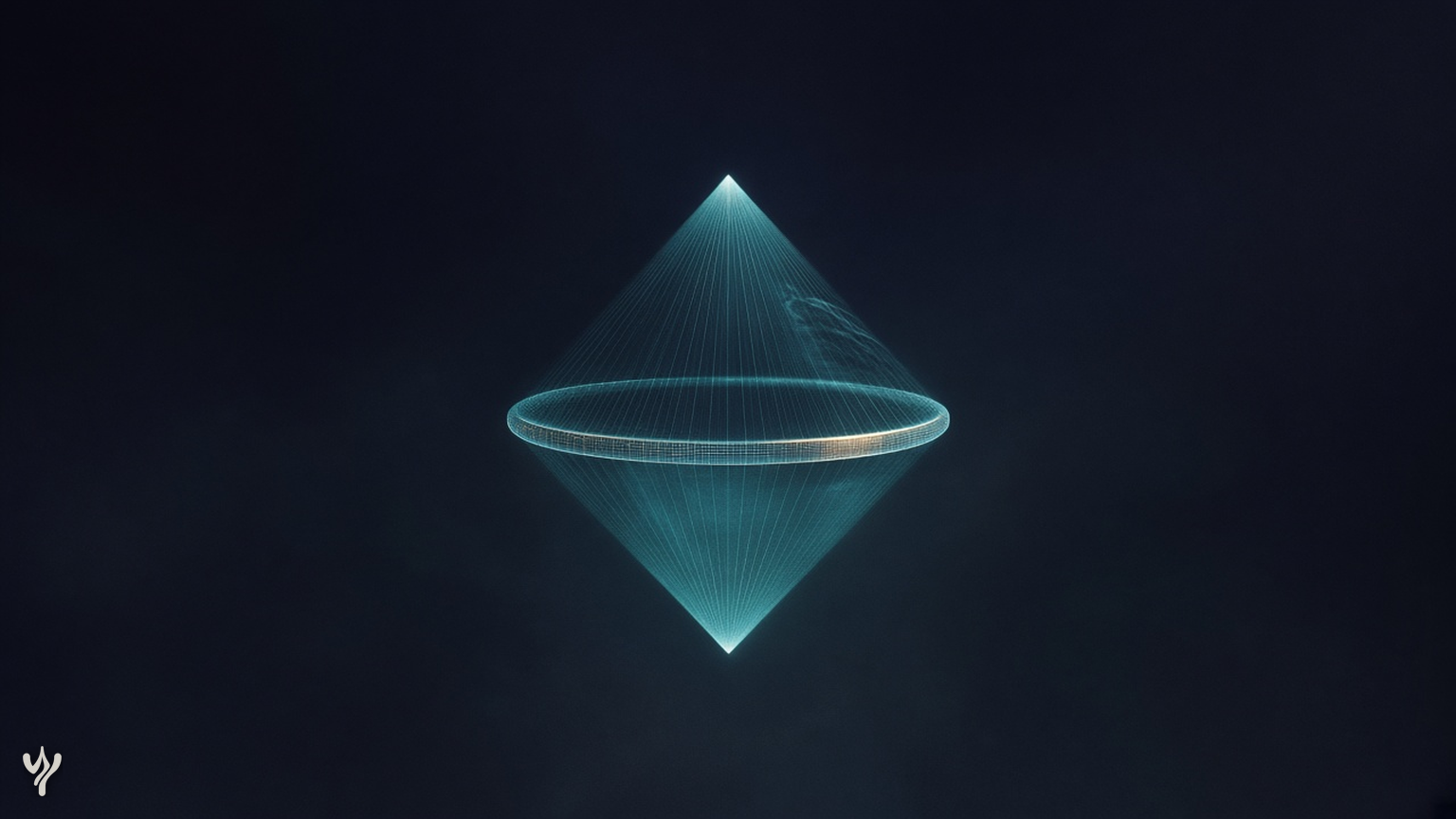
Picture a flash of light at one point. Its light spreads outward as an expanding cone. Start at a later point and light converges inward as a shrinking cone. Where the two cones meet, there is a two-dimensional sphere. The paper calls it the corner. The volume the cones enclose is a causal diamond: everything a signal from the first point can reach before it arrives at the second.
A light ray leaves the bottom tip and climbs the expanding cone until it reaches the corner. The distance it has covered there works as a clock. The upper half mirrors it: rays setting out from the corner converge on the top tip. The paper calls it a gravitational clock. A ripple of gravity riding the cone changes how far the ray has gone, so the clock reads differently. The clock is part of the geometry, not an external timer.
Analogy: the film of a soap bubble tells you what is inside without opening it. Where the analogy breaks: a soap film is a physical sheet. A null cone is only the path light would take. Nothing material sits there.
One detail keeps this from being too easy. The paper first runs the same program on a two-dimensional toy model. There the number of states stays infinite no matter how small the region. It is the traveling ripples unique to four dimensions, the gravitons, that make a real region finite.
The sharpest check is one calculation the paper completes in closed form. On a single null cone, a source creates a pair of gravitons and a second source destroys them. Summing over every wavelength of the pair gives a compact expression: a standard mathematical function (the dilogarithm, Li2) evaluated at e−2i/s, divided by 2s2. Here s is the corner area measured in units of 4GNℏ. That sum converges for every positive s.
Now run the same calculation the old way: expand in powers of GN first, then add up. At third order the sum turns into 1 + 1/2 + 1/3 + 1/4 + ..., the harmonic series, which grows like log N and never settles. The exact answer is finite. From the third order on, each slice of its step-by-step approximation is infinite. The divergence, in this example, came from the order of operations, not from the physics.
This is one process, not a general proof. But it is the kind of process where the standard method fails first.
The second result follows from a symmetry. The theory does not care how you label points in spacetime. From that invariance alone, the paper shows that a causal diamond of a given maximum size can hold only a finite number of independent quantum states. It also shows that the area of its corner sphere comes in discrete steps. The number of distinct states below an area A grows as es, where s = A/(4GNℏ).
Analogy: a photograph looks smooth but is a fixed grid of pixels. Where it breaks: pixels sit on a screen someone else built. Here the grid is the quantum system, and gravity's own constant sets the cell size.
How fine is the grid? The holographic principle dates from the 1990s. It guessed that a region holds at most one unit of entropy per four Planck areas of its boundary, roughly 1.4 × 1069 bits per square meter. That is 1.4 × 1065 bits per square centimeter. This paper does not assume that bound. It arrives at it.
A black hole makes the count dramatic. A black hole with the mass of the Sun has a horizon area of 1.10 × 10⁸ square meters (A = 4πrs2 with rs = 2GM/c2 = 2,953 m). Divide by four Planck areas (4 × 2.61 × 10−70 m2) and you get s ≈ 1.05 × 1077. That is the black hole's entropy in units of Boltzmann's constant, the figure Hawking derived in 1974–75 from quantum effects at the horizon. The paper counts the states and gets the same number. It also gets the first correction: a term equal to 106/45 (about 2.36) times the logarithm of the area. It reports that this is the coefficient Ashoke Sen found in 2013 by an entirely different, imaginary-time method.
Loop quantum gravity's count gives a different correction, a disagreement Sen himself flagged.
The acknowledgements contain the sentence everyone is quoting. The author writes that he developed several of the calculations and proofs in detailed, back-and-forth collaboration with a frontier AI reasoning model. The work took many months and roughly 400 million tokens of compute, which the lab that makes the model provided. He thanks more than a dozen gravitational physicists for comments on the draft, among them his thesis adviser Raphael Bousso.
The author is not an outsider. Venkatesa Chandrasekaran did his doctorate at Berkeley, spent years at the Institute for Advanced Study, and has co-authored well-cited papers on quantum gravity with Edward Witten and Geoffrey Penington. Public talk listings also identify him as a researcher at the same lab that built the model.
What does the AI's role change? Not the truth of the math, which stands or falls on its own. It changes the burden of checking. A proof assistant can certify a proof in a day. Physics has no such checker. The paper's own safeguards are that its results agree with things already known: Sen's coefficient, Hawking's entropy, Einstein's equations. Those agreements are real evidence. They are also checks against answers the model could have seen.
For physics. If correct, this is a background-independent, finite quantum theory of gravity in four dimensions, and it derives three results its rivals mostly assume. It also gives a setting where the interior of a black hole can be described by data outside it. Since 2019, physicists have shown in special toy universes that the entropy of a black hole's radiation rises and then falls, the curve expected if information is preserved. That result relies on assumptions about the gravitational path integral. This paper supplies a definition of that path integral with convergent sums.
For our picture of reality. "Space is smooth" becomes an approximation, the way "water is continuous" is. A region holds a finite number of bits, and gravity's waves set the resolution. The paper adds one more piece: a state on a single connected region can be rewritten as an entangled state on two disconnected regions. That is a concrete version of the 2013 conjecture that a wormhole and an entangled pair are two descriptions of the same thing.
For practice. The honest answer is that no technology follows soon. Freeman Dyson calculated in 2012 that a detector using the entire Earth, running for the Sun's lifetime, would register about four gravitons from the Sun. Gamma rays from seven billion light-years away arrive with no measurable delay, which rules out the simplest ways a granular spacetime could have slowed them.
What would change is which questions have finite answers: what happens at a black hole's center, whether information that falls in survives, and what the universe looked like at its first instant.
Within a day the paper sat second on alphaXiv, a site that tracks what physicists are reading on arXiv, and the experts were split in a familiar way. The physicist Sean Carroll called it "pretty big deal if true! He is a serious physicist," and added his own doubt: he had expected that quantum gravity at the smallest scales could not be understood without also understanding matter.
The physicist Gastón Giribet in Buenos Aires wrote one word: "Impressive."
The cautious voices are the ones worth reading. An AI researcher who promoted the paper on X also urged caution. Theoretical physics is not mathematics, he wrote: a paper cannot prove that a theory describes nature. He added that the author's recent talk at Berkeley drew "plenty of pushback." On Hacker News and Reddit, physicists asked the same question: which experiment would tell this theory from any other?
As of November 26, the paper had zero citations and no published critique.
Until then, the right stance is the one a good poker player holds with a strong hand and no showdown: interested, attentive, and not all in.
Thoughts and essays, published with Yokush. See more posts
 Siddharth33 min
 Siddharth10 min
Comments 0